
Use this calculator to find feed conversion ratio, feed efficiency, and optional feed cost per unit for gain, milk, egg mass, or eggs by dozen.
Advanced options
How to use our Feed Conversion Ratio Calculator
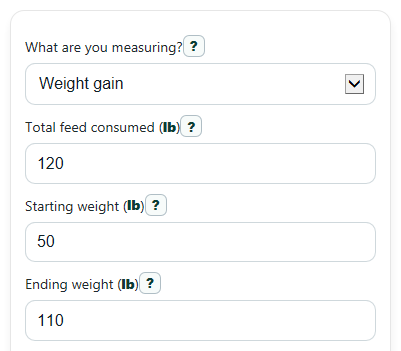
- Choose "What are you measuring?" and enter "Total feed consumed (lb)" for the same time period as your output.
- If you picked weight gain, enter "Starting weight (lb)" and "Ending weight (lb)". If you picked milk, egg mass, or eggs by dozen, enter the total in "Milk produced (lb)" using that field as the product amount for the selected basis.
- Open "Advanced options" if needed to change "Unit system", switch "Feed basis", add "Total feed cost ($)", or enter "Number of animals".
- Click "Calculate" and read "Feed conversion ratio" first. Lower FCR usually means less feed was needed per unit of output, while higher "Feed efficiency" usually means better conversion.
- Sanity-check the result by making sure "Total output used" matches your records and that the feed period, output basis, and feed basis all match before comparing groups.
Definitions
Feed conversion ratio (FCR): How much feed was needed for one unit of output. Lower is usually better when you compare the same basis.
Feed efficiency: The inverse of FCR. It shows how much output was produced per unit of feed, so higher is usually better.
Total output used: The output amount used in the math. In weight-gain mode, it is ending weight minus starting weight. In eggs-by-dozen mode, it is dozens, not pounds.
Feed basis: Whether feed is counted as as-fed or dry matter. Dry matter removes water weight, which can make comparisons fairer across feeds [1].
Unit system: Whether weights are entered and shown in US pounds or metric kilograms. The calculator uses the standard conversion 1 lb = 0.45359237 kg [1].
Feed cost per unit of output: The feed dollars spent for each unit of output, such as $ per lb of gain or $ per dozen eggs.
Common mistakes and quick fixes
Mistake: Entering "Total feed consumed (lb)" from one week but using "Milk produced (lb)" or weight data from a different time period.
Fix: Use the same date range for feed and output so "Feed conversion ratio" and "Feed efficiency" are meaningful.
Mistake: In weight-gain mode, typing a lower "Ending weight (lb)" than "Starting weight (lb)" and expecting an FCR.
Fix: For a usable gain-based result, "Ending weight (lb)" must be greater than "Starting weight (lb)" so "Total output used" is positive.
Mistake: Using the "Milk produced (lb)" field as pounds when "What are you measuring?" is set to eggs by dozen.
Fix: In eggs-by-dozen mode, enter the total number of dozens in the product field so "Total output used" and "Feed conversion ratio" use dozens correctly.
Mistake: Comparing one result on "As-fed" and another on "Dry matter" as if they were the same.
Fix: Match the "Feed basis" before comparing "Feed conversion ratio" or "Feed efficiency" across groups or time periods.
Mistake: Entering a negative value in "Total feed cost ($)" or expecting a cost result without that field filled in.
Fix: Enter 0 or a positive amount in "Total feed cost ($)" if you want "Feed cost per unit of output" to appear.
Mistake: Typing a fraction or zero in "Number of animals".
Fix: Enter a whole number greater than 0 so "Average feed per animal" and "Average output per animal" can be calculated correctly.
Limitations & Key Assumptions / Boundary Conditions
- Results are only comparable when the time period, output basis, and feed basis match.
- In weight-gain mode, the calculator requires positive gain. If ending weight is less than or equal to starting weight, FCR is not computed.
- In eggs-by-dozen mode, the product field must represent dozens of eggs, not egg weight.
- Feed cost per unit of output is shown only when "Total feed cost ($)" is entered and output is greater than 0.
- Average per-animal values are shown only when "Number of animals" is a whole number greater than 0.
- Switching between US and metric changes weight units, but ratio-based outputs such as FCR and feed efficiency stay numerically the same when the same mass unit is used on both sides.
- This tool measures feed-to-output ratios from your records. Real farm performance can also be affected by feed quality, animal health, age, environment, and how carefully intake and output were measured.
Methodology
How the calculator works
The calculator first finds the output amount for the selected basis, then divides feed by output to get feed conversion ratio. It also shows the inverse value, feed efficiency, because some records and guides report that metric instead [1].
FCR = feed consumed / output amount
feed efficiency = output amount / feed consumed = 1 / FCR
Output amount by basis
For weight gain, output is the change in live weight.
weight gain = ending weight - starting weight
For milk or egg mass, output is the entered product amount for the same period as feed.
output amount = product amount
For eggs by dozen, the calculator uses dozens as the output unit, following the contract for this page.
FCR_dozen = feed consumed / dozens of eggs
Optional cost and per-animal values
If feed cost is entered, the calculator shows the feed dollars spent for each unit of output. If animal count is entered, it shows group averages.
cost per output = total feed cost / output amount
per-animal feed = feed consumed / animal count
per-animal output = output amount / animal count
Unit handling
US mode uses pounds, and metric mode uses kilograms. The calculator converts using the standard relation 1 lb = 0.45359237 kg [4]. Ratio outputs keep matching units on both sides, so an FCR based on lb per lb has the same numeric value as kg per kg for the same records.
Worked example
If "What are you measuring?" is weight gain, "Total feed consumed (lb)" is 120, "Starting weight (lb)" is 50, and "Ending weight (lb)" is 110, then weight gain is 60 lb. FCR is 120 / 60 = 2, and feed efficiency is 60 / 120 = 0.5. If "Total feed cost ($)" is 36, then cost per unit of output is 36 / 60 = $0.60 per lb. If "Number of animals" is 10, then average feed per animal is 12 lb and average output per animal is 6 lb.
Assumptions used
The calculator assumes feed consumed and output were measured over the same period, feed consumed is greater than 0, and output amount is greater than 0. Hidden inputs are ignored when they do not apply to the selected basis. Dry matter and as-fed results should be compared only with results on the same basis.