
Estimate how many cattle your pasture can support or how many acres your herd needs using forage, grazing use, animal size, and grazing days.
Advanced options
How to use our Cattle per Acre Calculator
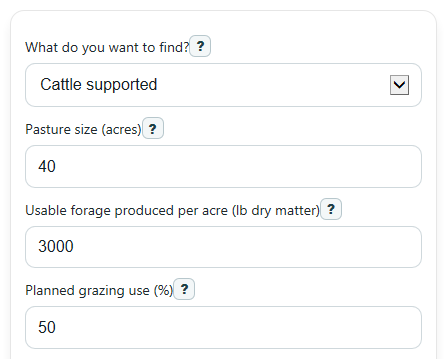
- Pick What do you want to find?, then enter Pasture size (acres), Usable forage produced per acre (lb dry matter), Planned grazing use (%), and Grazing time (days).
- Choose a Cattle type. If you pick Custom weight, also enter Average animal weight (lb) and, in Advanced options, Daily intake (% of body weight).
- If you are finding acres needed, enter Number of cattle (head). If you know extra feed will be lost, add Forage lost to trampling and waste (%) in Advanced options.
- Click Calculate. Read the main answer first, then compare Total forage available to cattle with Total herd forage needed and check Forage balance to see surplus or shortage.
- Sanity-check the result before planning: if the calculator shows a very high Stocking rate or a large negative Forage balance, recheck your forage per acre estimate, grazing days, and percent settings.
Definitions
Dry matter: Forage weight with the water removed. This makes pasture and feed amounts easier to compare.
Usable forage produced per acre (lb dry matter): The forage amount per acre you expect to count in this plan, measured in pounds of dry matter.
Planned grazing use (%): The share of forage you expect cattle to eat. The rest stays behind because of plant needs, grazing limits, and normal field conditions.
Forage lost to trampling and waste (%): Extra forage that is produced but not eaten because it gets stepped on, fouled, or otherwise wasted.
Forage needed per animal for this period: One animal's total dry matter need over the full grazing time.
Total forage available to cattle: The pasture's forage budget after acres, forage per acre, grazing use, and optional waste are applied.
Forage balance: Available forage minus herd forage need. Positive means surplus. Negative means shortage.
Stocking rate: The average number of head per acre in this scenario. Higher values mean more grazing pressure on the pasture.
Common mistakes and quick fixes
Mistake: Entering total standing forage in Usable forage produced per acre (lb dry matter) and then also using a low Planned grazing use (%) plus a high Forage lost to trampling and waste (%) .
Fix: Make sure your forage per acre number and your percent settings match the same planning method so you do not count losses twice.
Mistake: Leaving Planned grazing use (%) blank or typing 0 or more than 100.
Fix: Enter a real percent between 0 and 100, such as 50, because the calculator needs a usable grazing share.
Mistake: Using Number of cattle (head) when finding cattle supported and assuming it changes the answer.
Fix: Use Number of cattle (head) only when What do you want to find? is set to acres needed.
Mistake: Choosing Custom weight but not updating Average animal weight (lb) or Daily intake (% of body weight) .
Fix: If Cattle type is Custom weight, enter both custom values or switch back to a preset cattle class.
Mistake: Reading Estimated cattle supported as an exact herd size when the math gives part of an animal.
Fix: Plan with the whole-head result and treat any fraction as extra forage margin, not another full animal.
Mistake: Ignoring a negative Forage balance .
Fix: A negative Forage balance means the plan is short on forage, so reduce head count, shorten Grazing time (days) , or add more acres.
Limitations & Key Assumptions / Boundary Conditions
- This is a planning estimate, not a field measurement. Real pasture output can change with rainfall, soil, forage type, fertility, and grazing management [1].
- The result is only as good as your Usable forage produced per acre (lb dry matter) estimate. If that input is off, the final head count or acres needed will also be off.
- Planned grazing use (%) and Forage lost to trampling and waste (%) should match how you measured forage. If your forage number already reflects usable forage, leave waste at 0 to avoid double counting.
- Preset cattle classes use fixed daily dry matter values. Actual intake can differ with age, stage of production, forage quality, weather, and animal condition.
- Custom weight assumes intake stays at the same Daily intake (% of body weight) for the whole grazing period, which may not hold in real conditions.
- Stocking rate is an average ratio for this one scenario, not a universal rule for every pasture. Managers often adjust stocking as forage conditions change [2].
- The calculator does not account for regrowth during the grazing period, rotation timing, supplements, hay feeding, or separate pasture areas with different production levels.
Methodology
How the calculator works
The calculator builds a forage budget, then compares that budget with what one animal or the whole herd is expected to eat during the selected grazing period.
Step 1: Find total forage available
available_forage_total = pasture_acres x forage_dm_per_acre x (grazing_use_pct / 100) x (1 - forage_loss_pct / 100)
This converts acres and forage per acre into a total dry matter amount cattle can actually use. If your forage-per-acre value already reflects usable forage after losses, keep waste at 0.
Step 2: Find forage need per animal
For preset cattle classes, the calculator uses built-in daily dry matter values from the contract.
forage_need_per_head = daily_dm_lb x grazing_days
For Custom weight, the calculator uses body weight and intake percent.
forage_need_per_head = animal_weight x (intake_pct_bw / 100) x grazing_days
Step 3: Solve for the answer you picked
If you want cattle supported, divide total available forage by forage need per animal.
head_supported = available_forage_total / forage_need_per_head
The main planning result is shown as a whole number of head because partial animals are not practical for most pasture plans.
If you want acres needed, first find total herd need, then divide by forage available per acre after use and waste.
herd_forage_need = head_count x forage_need_per_head
acres_needed = herd_forage_need / (forage_dm_per_acre x (grazing_use_pct / 100) x (1 - forage_loss_pct / 100))
Supporting outputs
forage_balance = available_forage_total - herd_forage_need
stocking_rate = head_count_used / pasture_acres
A positive forage balance means estimated surplus remains. A negative forage balance means the plan is short on forage. Stocking rate is simply the average head per acre for this scenario.
Mini example
Suppose you have 40 acres, 3,000 lb dry matter per acre, 50% planned grazing use, 30 grazing days, and a 1,000 lb cow with calf preset.
available_forage_total = 40 x 3000 x 0.50 x 1.00 = 60,000 lb dry matter
forage_need_per_head = 25.8 x 30 = 774 lb dry matter
head_supported = 60,000 / 774 = 77.52
For planning, that rounds down to 77 head. The stocking rate is 77 divided by 40, or 1.925 head per acre.
Assumptions used here
The method assumes a single average forage value across the pasture and a steady intake level over the chosen period. In real grazing systems, carrying capacity and stocking rate can shift with pasture conditions and management [1][2].