
Estimate outdoor temperature from cricket chirps using the cricket type, your count time, and clear notes about how reliable the rule is.
Advanced options
How to use our Crickets Chirping Thermometer Calculator
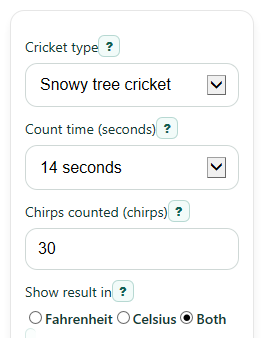
- Choose Cricket type, then pick your Count time (seconds) so the calculator knows which chirp rule to use.
- Enter Chirps counted (chirps) from one cricket if possible, then choose Show result in for Fahrenheit, Celsius, or both.
- If you want, open Advanced options and set Rounding style, Number style for big or tiny values, and Show formula note.
- Click Calculate to see Estimated temperature, Chirps per minute, Rule used, and the reliability notes.
- Sanity-check the result: if Confidence note says rough estimate or Assumptions and limits mentions multiple crickets, treat the temperature as approximate and try counting again.
Definitions
Cricket type: The kind of cricket rule the calculator uses. Snowy tree cricket is the classic thermometer rule, while field cricket uses a rougher classroom rule.
Count time (seconds): How long you listened before writing down your chirp count, such as 13, 14, 15, or 60 seconds.
Chirps counted (chirps): The number of chirps you heard during the selected count time.
Chirps per minute: Your chirp count converted to a 60-second rate so different count times can be compared fairly.
Estimated temperature: The air temperature calculated from the selected cricket rule, shown in Fahrenheit, Celsius, or both.
Confidence note: A short message telling you whether the result is a strong match to a known rule or only a rough guide.
Rule used: The chirp-to-temperature relationship applied in the calculation.
Rounding style: Whether the temperature is shown as a whole degree or to one decimal place.
Common mistakes and quick fixes
Mistake: Leaving Chirps counted blank or typing a negative number.
Fix: Enter 0 or a positive count only. The calculator blocks blank and negative chirp counts.
Mistake: Counting for 15 seconds but leaving Count time set to 14 seconds.
Fix: Match Count time to the actual number of seconds you used so Chirps per minute and Estimated temperature convert correctly.
Mistake: Picking Field cricket when you really are not sure which cricket you heard.
Fix: Choose Cricket type as Not sure so the Confidence note clearly marks the result as a rough estimate.
Mistake: Expecting the same number in Fahrenheit and Celsius after changing Show result in .
Fix: Remember that Estimated temperature changes units, not just the label. Use Both if you want to compare them.
Mistake: Hearing several insects at once and entering the total as one Chirps counted value.
Fix: Try to follow one cricket if possible. If not, read Assumptions and limits because the estimate can come out too high.
Mistake: Thinking a zero count means the air really matches the displayed Estimated temperature exactly.
Fix: Treat 0 chirps as a weak estimate and read the Confidence note and Assumptions and limits before using the number.
Limitations & Key Assumptions / Boundary Conditions
- The classic snowy tree cricket rule is the strongest match for this kind of calculator; other cricket types are less exact.
- If you choose Not sure for Cricket type, the result is only a rough estimate based on the snowy tree cricket baseline.
- The calculator assumes you counted one cricket clearly. Several crickets chirping at once can push the estimate too high.
- Very low or very high Chirps per minute may mean missed chirps, multiple insects, or a different insect entirely.
- A count of 0 chirps still produces a math result, but silence or hard-to-hear chirps make that estimate weak.
- Weather, insect age, species differences, and counting errors can make real outdoor temperatures differ from the calculated value.
- Negative Celsius results are allowed because temperature conversion math can go below 0 C.
Methodology
How the calculator works
The calculator first converts your chirp count to a common rate called chirps per minute. That makes 13-second, 14-second, 15-second, and 60-second counts comparable.
CPM = Nw * (60 / w)
Here, Nw is the chirps counted in your chosen window, and w is the count time in seconds.
Temperature rules used
For Snowy tree cricket, the calculator uses the classic 14-second Dolbear-style baseline [1][2].
T_F = (CPM * (14/60)) + 40
For Field cricket, it uses a common classroom rule based on chirps per minute.
T_F = 40 + (CPM / 4)
If you choose Not sure, the calculator still uses the snowy tree cricket baseline, but labels it as a rough estimate because species matters.
When you ask for Celsius, the calculator converts from Fahrenheit using the standard temperature formula.
T_C = (T_F - 32) * 5 / 9
Mini example
Suppose you choose Snowy tree cricket, count 30 chirps in 14 seconds, and show both units.
CPM = 30 * (60 / 14) = 128.57
T_F = (128.57 * 14/60) + 40 = 70 F
T_C = (70 - 32) * 5 / 9 = 21.1 C
So the main result is about 70 F, or 21.1 C if you choose one decimal place.
How to read the notes
Confidence note is strongest for snowy tree cricket, lighter for field cricket, and lowest when the cricket type is unknown. Rule used tells you exactly which formula the calculator applied.
Assumptions behind the math
This tool assumes the chirps came from a cricket that fits the selected rule, that the count window was timed correctly, and that you mostly tracked one insect. Real field conditions can differ, so treat the result as an estimate rather than an exact thermometer reading.
Sources
- University of Nebraska-Lincoln: crickets and temperature - UNL
- Crickets are natural thermometers | Climate and Agriculture in the Southeast - UGA
- Utah State University Extension (PDF): Crickets fact sheet (mentions Dolbear's Law) - USU
- Sonorous Science: Have a Cricket Tell You the Temperature! | Scientific American - Scientificamerican