
Calculate a weight-to-length index for your cat, with optional guidance from a separately assessed body condition score (BCS). The length index has no validated healthy-weight cutoffs.
Advanced options
Body condition score (BCS)
Number display
How to use our Cat BMI Calculator
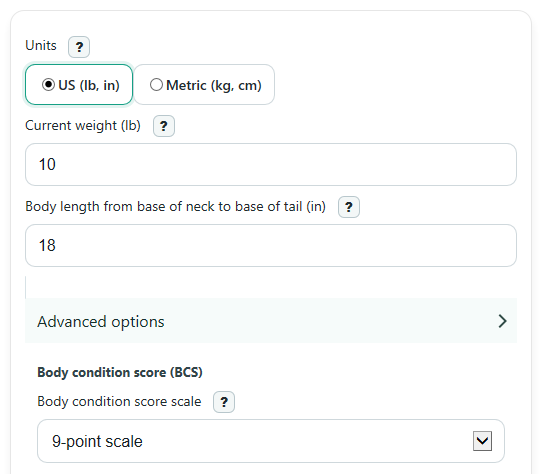
- Pick Units, then enter Current weight (lb) and Body length from base of neck to base of tail (in) or the metric versions if you measured in kg and cm.
- Measure body length along the body from the base of the neck to the base of the tail, without including the tail or stretching your cat.
- If you have an assessed BCS, open Advanced options and select "Body condition score scale" and "Body condition score". Weight estimates are available only for the supported ideal or above-ideal scores.
- Click "Calculate" to see "Cat BMI-style score (kg/m^2)". It is a mathematical ratio only; "Body condition score meaning" comes from the BCS you entered, not from that ratio.
- Sanity-check the result: if the score seems extreme, remeasure Body length from base of neck to base of tail carefully and make sure you used the active unit system for every entry.
Definitions
Cat BMI-style score: A rough index based on body weight and body length. Higher values usually mean more weight for the cat's length.
Body condition score (BCS): A hands-on body fat check used in pet care. It is more standard than a simple BMI-style ratio for screening body condition [1].
Body condition score scale: The scoring system used for BCS, usually 9-point or 5-point. You must match the scale to the score you enter.
Estimated ideal weight from BCS: An approximate reference weight for supported BCS values, in the selected unit. It is not a prescribed target.
Weight change to reach estimated ideal: The difference between current weight and the supported BCS reference estimate; no underweight target or feeding instruction is calculated.
Index interpretation: No underweight, healthy or overweight category is assigned from weight divided by length squared.
Common mistakes and quick fixes
Mistake: Entering pounds in Current weight (kg) or kilograms in Current weight (lb) .
Fix: Match the number to the selected Units option and fill in only the weight field for that active unit system.
Mistake: Measuring the full cat including the tail for Body length from base of neck to base of tail .
Fix: Measure only from the base of the neck to the base of the tail along the body, then enter that number in the active length field.
Mistake: Using the length index to decide whether a cat is underweight or overweight. Fix: Use a properly assessed BCS and veterinary evaluation; this calculator does not derive body condition from the index.
Mistake: Picking the wrong Body condition score scale before choosing Body condition score .
Fix: Use the same scale your chart or vet uses, because a 5-point score and a 9-point score are not interchangeable.
Mistake: Treating "Weight change to reach estimated ideal" as prescribed weight loss. Fix: It is an approximate comparison based on the entered BCS; confirm any weight-management plan with your veterinarian.
Mistake: Using an estimated weight as a feeding target for a kitten, pregnant cat, or cat with muscle loss or fluid buildup. Fix: Ask your veterinarian to assess weight and nutrition; the arithmetic does not account for these conditions.
Limitations & Key Assumptions / Boundary Conditions
- This weight-to-length-squared ratio is not a validated screening test for feline body fat. It has no health-category thresholds in this calculator.
- Veterinary screening more commonly uses body condition score, body weight, muscle condition, and exam findings together rather than a single ratio [1].
- Small measurement errors in Body length from base of neck to base of tail can change the score a lot because length is squared in the formula.
- Breed, frame size, body shape, amputations, and unusual muscle mass can make the index less representative.
- Kittens, pregnant cats, and cats with fluid buildup or major muscle loss may not fit the ideal-weight estimate well.
- For above-ideal scores, the optional weight estimate uses the approximate excess-weight mapping in AAHA guidance. It is not a personalized feeding or treatment target; no target is extrapolated for underweight scores.
- If your cat's score, weight trend, appetite, or activity seems concerning, real-world care decisions should be confirmed with a veterinarian.
Methodology
How the calculator works
The index is calculated from the active weight and length measurements. Optional BCS interpretation uses a separately assessed score; BCS cannot be calculated from this length index.
cat_bmi = weight_kg / (length_m^2)
length_m = length_cm / 100
weight_kg = weight_lb x 0.45359237
length_cm = length_in x 2.54
The index is reported in kg/m^2 without health labels. The previously used 15 and 25 cutoffs were not established by the cited veterinary guidance and are not used.
BCS-based ideal weight
AAHA associates each whole score above 5/9 with approximately 10% excess weight. Its table maps 4/5 to 7/9 and 5/5 to 9/9. We use those mappings for a rough weight estimate; scores 4–5/9 or 3/5 retain current weight as a reference. Lower scores show BCS guidance without a calculated target.
For BCS 6–9/9: estimated_weight = current_weight / (1 + 0.10 x (bcs9 - 5))
ideal_weight_5_point = current_weight / factor
For BCS 3, 4 or 5 on the 5-point scale: factor = 1.00, 1.20 or 1.40. No underweight target is calculated.
weight_change_needed = current_weight - ideal_weight
The displayed difference is current weight minus the BCS-based reference estimate. It does not prescribe weight loss or a feeding amount; your veterinarian should set an appropriate target.
Mini example
For a cat weighing 10 lb with a measured length of 18 in, the index is (10 x 0.45359237) / (18 x 0.0254)^2 = 21.70 kg/m^2 when rounded to two decimals. This number has no health category. If an independent BCS assessment is 5/9, the reference weight stays 10 lb and the calculated difference is 0 lb.
Assumptions used
Only measurements in the selected unit system are used. BCS must be assessed independently, and the approximate weight calculation cannot account for illness, muscle loss or individual nutritional needs.