
Use this quick dog size quiz to estimate adult weight range and size class from a few simple answers.
Advanced options
How to use our Dog Size Calculator Quiz
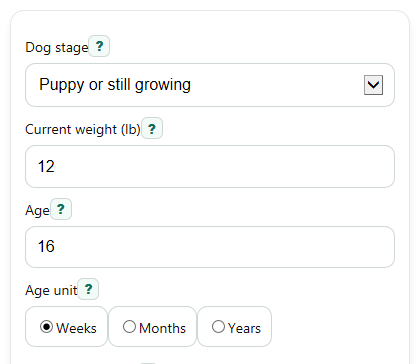
- Pick Dog stage, then enter Current weight (lb), Age, and the correct Age unit.
- Choose the best match for Breed information. If you know extra clues, open Advanced options and add Known breed size group or both parent weights.
- Choose Result type, then click Calculate to see the estimated size class, adult weight range, and best estimate adult weight.
- Sanity-check the result: make sure the predicted adult weight range fits the dog's build and history, and read Confidence note and Important note before treating the estimate as reliable.
Definitions
Dog stage: Whether the dog is still growing or already full-grown. This decides whether the tool predicts future size or classifies current size.
Current weight (lb): The dog's body weight right now, entered in pounds.
Age unit: The time label for the age number you entered: weeks, months, or years.
Breed information: How much background you know about the dog, such as unknown mix, one main breed, or parent sizes.
Known breed size group: An optional clue about the usual adult size of the main breed, such as Toy, Small, Medium, Large, or Giant.
Estimated size class: The likely adult weight group used on this page: Toy under 12 lb, Small 12 to under 25 lb, Medium 25 to under 50 lb, Large 50 to under 100 lb, and Giant 100 lb or more.
Estimated adult weight range (lb): A likely adult weight interval, shown instead of pretending one exact number is certain.
Best estimate adult weight (lb): The middle estimate used to assign the size class.
Confidence note: A plain-English note about how strong or weak the estimate is based on the clues you entered.
Common mistakes and quick fixes
Mistake: Entering Age as 16 but leaving Age unit on Years instead of Weeks.
Fix: Match Age unit to the number you typed before you calculate.
Mistake: Using Dog stage = Adult or mostly full-grown for a puppy.
Fix: Pick Dog stage = Puppy or still growing so the calculator uses growth logic instead of current adult classification.
Mistake: Choosing Breed information = Parent sizes known but filling only Parent 1 adult weight (lb) .
Fix: Enter both Parent 1 adult weight (lb) and Parent 2 adult weight (lb) , or switch Breed information to another option.
Mistake: Typing 0 or a negative number in Current weight (lb) .
Fix: Enter a recent positive body weight in pounds before clicking Calculate.
Mistake: Treating Best estimate adult weight (lb) like an exact final answer.
Fix: Read Estimated adult weight range (lb) and Confidence note too, because real dogs can finish above or below the middle estimate.
Mistake: Ignoring Important note when the puppy is very young or information is limited.
Fix: Use the result as a rough planning estimate and recheck later with a new Current weight (lb) and age.
Limitations & Key Assumptions / Boundary Conditions
- This tool gives an estimate, not a breed guarantee or a veterinary assessment.
- For Dog stage = Puppy or still growing, results depend heavily on age because puppies reach adult weight at different speeds.
- If Breed information is unknown or mixed breed, the calculator uses a neutral growth track, so the range is wider.
- If Breed information is parent sizes known, both parent weights are needed for the parent-based estimate. Otherwise the tool falls back to age and weight.
- Very young puppies, especially under about 8 weeks, can change quickly, so predictions may swing a lot.
- For Dog stage = Adult or mostly full-grown, the tool classifies size from current weight rather than predicting future growth.
- Body condition is not measured here. A dog that is unusually lean or overweight can look larger or smaller by weight than its natural frame.
- The size bands on this page are a practical consumer-friendly method, not a universal official standard used by every breeder or clinic.
Methodology
How the estimate is made
If Dog stage is adult, the calculator uses the current weight as the adult weight estimate and then assigns a size class from that weight.
If Dog stage is puppy and both parent weights are provided while Breed information is set to parent sizes known, the calculator uses the average of the two parent weights as the main adult estimate.
If the dog is a puppy and parent weights are not available, the calculator estimates adult weight from current weight divided by an age-based completion fraction. That fraction represents the share of adult weight a puppy is expected to have reached by that age.
If a main breed size clue is provided in Known breed size group, the calculator uses that to pick a better growth track. If not, it uses a neutral default track and lowers confidence.
Formula lines
age_months = age_value / 4.34524 when age_unit = weeks
age_months = age_value when age_unit = months
age_months = age_value * 12 when age_unit = years
adult_weight_est = (parent1_weight_lb + parent2_weight_lb) / 2
adult_weight_est = current_weight_lb / completion_fraction(age_months, size_track)
range_low = adult_weight_est * (1 - spread)
range_high = adult_weight_est * (1 + spread)
Size class bands used on this page
Toy: under 12 lb
Small: 12 to under 25 lb
Medium: 25 to under 50 lb
Large: 50 to under 100 lb
Giant: 100 lb or more
Worked mini-example
A puppy weighs 10 lb at 16 weeks. First convert weeks to months: 16 / 4.34524 is about 3.68 months. Using the neutral puppy growth track, the completion fraction at this age is set near 0.40, so the best estimate adult weight is about 10 / 0.40 = 25 lb. That lands in the Medium size class because this page starts Medium at 25 lb. If the spread is 20%, the estimated adult weight range is about 20 to 30 lb.
Confidence and notes
The calculator gives higher confidence when both parent weights are known, medium confidence when a breed size clue is known, and lower confidence when the estimate uses only puppy age and current weight. It also adds an important note for very young puppies, missing parent details in parent mode, or cases where body condition may skew a weight-based estimate.
Assumptions used here
The puppy method assumes growth completion changes with age and size track rather than using one flat multiplier for all puppies. The weight range is created with a wider spread for uncertain cases and a narrower spread when information is stronger. Real dogs can still finish outside the range because growth, mix, and body condition vary.