
Convert a rough adult water reference from body weight into cups, US fluid ounces and milliliters, and record measured drinking without treating it as a diagnosis.
Advanced options
How to use our Dog Water Intake Calculator
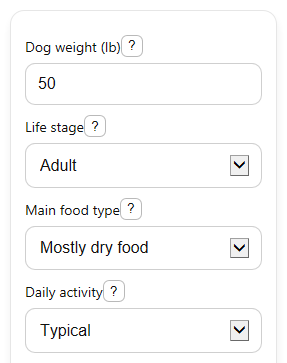
- Enter your Dog weight (lb), then choose Life stage, Main food type, Daily activity, and Weather today.
- Open Advanced options if you want to compare the estimate with real drinking. Set Compare with measured drinking? to Yes, then enter Measured water drunk per day and the matching Measured amount unit.
- Choose Rounding style if you want simpler or more exact display values, then click Calculate.
- Read the weight-based adult reference in oz, cups and mL. Life stage, food, activity and weather provide context; this tool does not assign numerical multipliers to them.
- Wet food contributes water and can reduce bowl drinking. Do not infer dehydration from a bowl measurement below this rough reference. Ask a veterinarian about persistent or sudden changes.
Definitions
Dog weight (lb): Your dog's body weight in pounds. The calculator starts with 1 fluid ounce of water per pound per day as the baseline [2].
Life stage: A simple age or condition group such as adult, puppy, nursing dog, or senior. Puppies and nursing dogs may need more water than a typical adult dog.
Main food type: Whether your dog mainly eats dry food, mixed food, or wet food. Dogs eating wetter food may drink less from the bowl because food already contains more water.
Daily activity: How active your dog is on a usual day. More play, walks, running, or work can raise water needs.
Weather today: A simple heat setting for the day. Hot weather can raise water needs, while cool indoor days may lower them.
Measured water drunk per day: The amount your dog actually drank in 24 hours from a bowl, bottle, or other measured source.
Estimated daily water: A rough adult 1 US fluid ounce per pound reference, not a prescribed intake or a limit.
Baseline by body weight only: The same adult reference before conversion to cups or mL. No life-stage, food, weather or activity multipliers are applied.
Difference from estimate: Measured intake minus estimated intake. Negative means below the estimate, and positive means above it.
Measured intake check: A numerical comparison of recorded bowl drinking with a rough adult reference. It cannot establish normal hydration or diagnose a problem.
Common mistakes and quick fixes
Mistake: Entering kilograms into Dog weight (lb).
Fix: Use pounds only in Dog weight (lb). If you know kg, convert to pounds before entering it.
Mistake: Leaving Measured water drunk per day blank after turning Compare with measured drinking? to Yes.
Fix: Enter a positive daily amount or switch Compare with measured drinking? back to No.
Mistake: Measuring in mL or ounces but leaving Measured amount unit on cups.
Fix: Set Measured amount unit to the same unit you actually used so the comparison is correct.
Do not use this reference as a feeding or water restriction target. Puppies, nursing dogs, illness, heat, exercise and food moisture can change needs; obtain individual advice when needed.
Mistake: Thinking a negative Difference from estimate means the calculator broke.
Fix: A negative Difference from estimate means measured intake was below the estimate. A positive value means above the estimate.
Mistake: Measuring only one refill or part of a day and entering it as Measured water drunk per day.
Fix: Measure the full 24-hour total before using Measured intake check for comparison.
Limitations & Key Assumptions / Boundary Conditions
- This calculator estimates typical daily water need. It does not account for illness, vomiting, diarrhea, fever, medications, kidney problems, diabetes, or other medical causes of thirst changes.
- The baseline uses the common rule of about 1 US fluid ounce per pound per day for adult dogs [2]. Real healthy dogs can still vary around that amount.
- Life stage, food type, activity, and weather are handled with modest multipliers for practical comparison, not a full veterinary fluid prescription.
- If your dog eats mostly wet food, total water from all sources may be fine even when bowl drinking looks lower than the estimate.
- The measured comparison is only as good as the 24-hour measurement. Shared bowls, spills, topping off without measuring, and water from other places can distort the result.
- Very small or very large dogs may vary more from the estimate because breed, body condition, and daily routine can matter more.
- Never restrict water to force intake to match the estimate. Sudden big changes, extreme thirst, or trouble drinking should be discussed with a veterinarian.
Methodology
How the estimate is built
The calculator starts with a simple body-weight rule, then adjusts it for life stage, food moisture, activity, and weather.
baseline_oz = weight_lb * 1
This baseline matches the common rule of thumb that adult dogs need about 1 fluid ounce of water per pound of body weight per day [2].
reference_oz = weight_lb * 1; no profile multipliers are applied
Life stage, food, activity and weather selections inform care notes only. No validated numerical adjustment is inferred from those selections.
Unit conversions
The same rough reference is converted to cups and milliliters for comparison of measurement units.
cups = oz / 8
mL = oz * 29.5735
These use US household and metric conversions: 8 US fluid ounces per cup and 29.5735 mL per US fluid ounce.
Measured intake comparison
If comparison is on, the measured amount is converted to US fluid ounces and subtracted from the adult reference. This is arithmetic, not a clinical cutoff.
actual_oz = cups * 8, or oz, or mL / 29.5735
difference_oz = actual_oz - adjusted_oz
A negative difference means your dog drank less than the estimate. A positive difference means more.
No percentage threshold is used to classify intake as healthy, insufficient or excessive. Food water and individual needs make that inference inappropriate from these entries alone.
Mini example
Suppose your dog weighs 40 lb, is an adult, eats mixed dry and wet food, has typical activity, and the weather is mild.
baseline_oz = 40 * 1 = 40 oz
reference_oz = 40 * 1 = 40 oz
cups = 36.8 / 8 = 4.6 cups
If you measured 4 cups in a day, that is 32 oz.
difference_oz = 32 - 40 = -8 oz
The measured 4 cups equals 32 US fluid ounces, which is 8 ounces below the reference. That difference does not establish a water deficit.
Assumptions and limits
The 1 US fluid ounce per pound rule is a broad adult reference, not an individual prediction. No exact adjustment is inferred from the selected profile. Food moisture, health, medications, environment and measurement error all affect interpretation.