
Estimate your puppy's likely adult weight range, size group, and possible shoulder height using age, current weight, and optional parent size details.
Advanced options
How to use our Dog Size Calculator
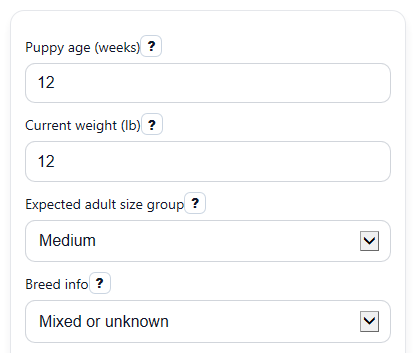
- Enter Puppy age (weeks), Current weight (lb), Expected adult size group, and Breed info.
- If you know it, add Current shoulder height (in) to get an adult height estimate too.
- Open Advanced options if you want to add Sex, Mom adult weight (lb), Dad adult weight (lb), or parent shoulder heights.
- Click Calculate, then read Estimated adult weight range first, use Middle estimate for adult weight only as a planning shortcut, and check Confidence level plus Estimate notes to see how strong the guess is.
- Sanity-check the result: if the range seems far too small or large for your puppy's build, recheck age in weeks, weight in lb, and whether you picked the right Expected adult size group.
Definitions
Puppy age (weeks): Your dog's current age measured in weeks.
Current weight (lb): Your puppy's body weight right now in pounds.
Expected adult size group: A simple adult category: toy, small, medium, large, or giant.
Breed info: Whether your dog is mixed or unknown, mostly one known breed, or a mix of two known breeds.
Current shoulder height (in): Height from the ground to the top of the shoulders, not the top of the head.
Estimated adult weight range: The likely span of adult weights based on the inputs, shown as a range instead of one exact number.
Middle estimate for adult weight: The midpoint of the weight range, useful when you need one planning number.
Confidence level: A plain-language summary of how strong the estimate is based on the information you entered.
Estimated adult shoulder height range: A likely adult shoulder-height span, shown only when enough height information is available.
Common mistakes and quick fixes
Mistake: Entering adoption age instead of the puppy's real age in Puppy age (weeks) .
Fix: Use the puppy's current age in weeks today, because age drives the growth estimate.
Mistake: Typing kilograms into Current weight (lb) .
Fix: Enter pounds only in Current weight (lb) so the adult weight estimate is not too low or too high.
Mistake: Guessing the wrong Expected adult size group for a breed that is clearly toy, giant, or somewhere else.
Fix: Pick the closest likely adult group, not the puppy's current size, because the formula uses adult growth patterns.
Mistake: Measuring head height or back height instead of Current shoulder height (in) .
Fix: Measure from the ground to the top of the shoulders while the puppy is standing naturally.
Mistake: Treating Middle estimate for adult weight like an exact promise.
Fix: Use Estimated adult weight range as the main answer and read Confidence level before making gear or crate decisions.
Mistake: Entering only one parent value and assuming the result is just as strong as using both Mom adult weight (lb) and Dad adult weight (lb) .
Fix: One parent can help, but check Estimate notes because one-parent anchoring is weaker than having both parents.
Limitations & Key Assumptions / Boundary Conditions
- This tool gives an estimate, not a guaranteed final adult size.
- Very young puppies, especially under 6 weeks, can have much wider uncertainty.
- Mixed or unknown breeds usually get wider ranges because growth patterns vary more.
- Height estimates are less reliable than weight estimates and are omitted unless Current shoulder height (in) is entered.
- Entering one parent size can help, but two parents usually anchor the estimate better than one.
- If your dog is already near adult age, the result should be close to current size and the tool becomes less useful for prediction.
- Health, nutrition, body condition, and breed-specific growth patterns can shift real adult size away from the estimate.
- The size group is based on the midpoint of the estimated adult weight, so dogs near a cutoff may finish in a neighboring group.
Methodology
How the estimate is built
The calculator starts with age, current weight, and the selected adult size group. It estimates what fraction of adult weight a puppy of that size class has usually reached by the entered age, then divides current weight by that fraction to get a middle adult-weight estimate.
adult_weight_mid = current_weight / weight_completion(age_weeks, size_class)
Next, it turns that middle estimate into a range. The uncertainty band is wider for very young puppies and for mixed or unknown breeds, and narrower when the inputs give a stronger anchor.
adult_weight_low = adult_weight_mid * (1 - u)
adult_weight_high = adult_weight_mid * (1 + u)
How parent size changes the estimate
If one or both parent weights are entered, the calculator blends the age-based estimate with the known parent size. One known parent helps a little. Two known parents help more. The result still stays a range so it does not pretend to be exact.
parent_weight_mid = average(known_parent_weights)
blended_weight_mid = w_age * adult_weight_mid + w_parent * parent_weight_mid
How height is estimated
Adult shoulder height is only estimated when Current shoulder height (in) is entered. The calculator uses an age-based height completion fraction for the chosen size group, then optionally blends that estimate with parent shoulder heights when those are also known.
adult_height_mid = current_height / height_completion(age_weeks, size_class)
How the size group is assigned
The likely adult size group is based on the middle adult-weight estimate. The cutoffs are: toy up to 12 lb, small up to 22 lb, medium up to 57 lb, large up to 99 lb, and giant above that. If the range crosses a cutoff, the calculator still classifies by midpoint and adds a note that the dog may finish near a border.
size_group = classify(adult_weight_mid)
Worked mini-example
Suppose a 12-week-old puppy weighs 12 lb, the selected Expected adult size group is medium, and the medium-size weight completion at 12 weeks is about 0.35. The middle adult-weight estimate is 12 / 0.35 = 34.29 lb. If the uncertainty fraction is 0.22, the range becomes about 26.75 lb to 41.83 lb. That midpoint falls in the medium group.
34.29 = 12 / 0.35
26.75 = 34.29 * (1 - 0.22)
41.83 = 34.29 * (1 + 0.22)
Confidence and practical interpretation
Confidence level increases when the age is more informative and when helpful anchors such as parent weight or current shoulder height are included. Higher confidence means a tighter, better-supported guess, not certainty. In measurement work, uncertainty is commonly expressed as a range around a central estimate [1].
Assumptions used here
This method assumes the selected size group is a reasonable match for the puppy's adult build, that the entered weight is current and accurate, and that parent sizes are adult values when used. Real dogs can still finish outside the estimate because growth timing differs across breeds, mixes, health history, and body condition.