
Choose your resistor's color bands or enter its printed SMD code to find its resistance and, when available, its tolerance range.
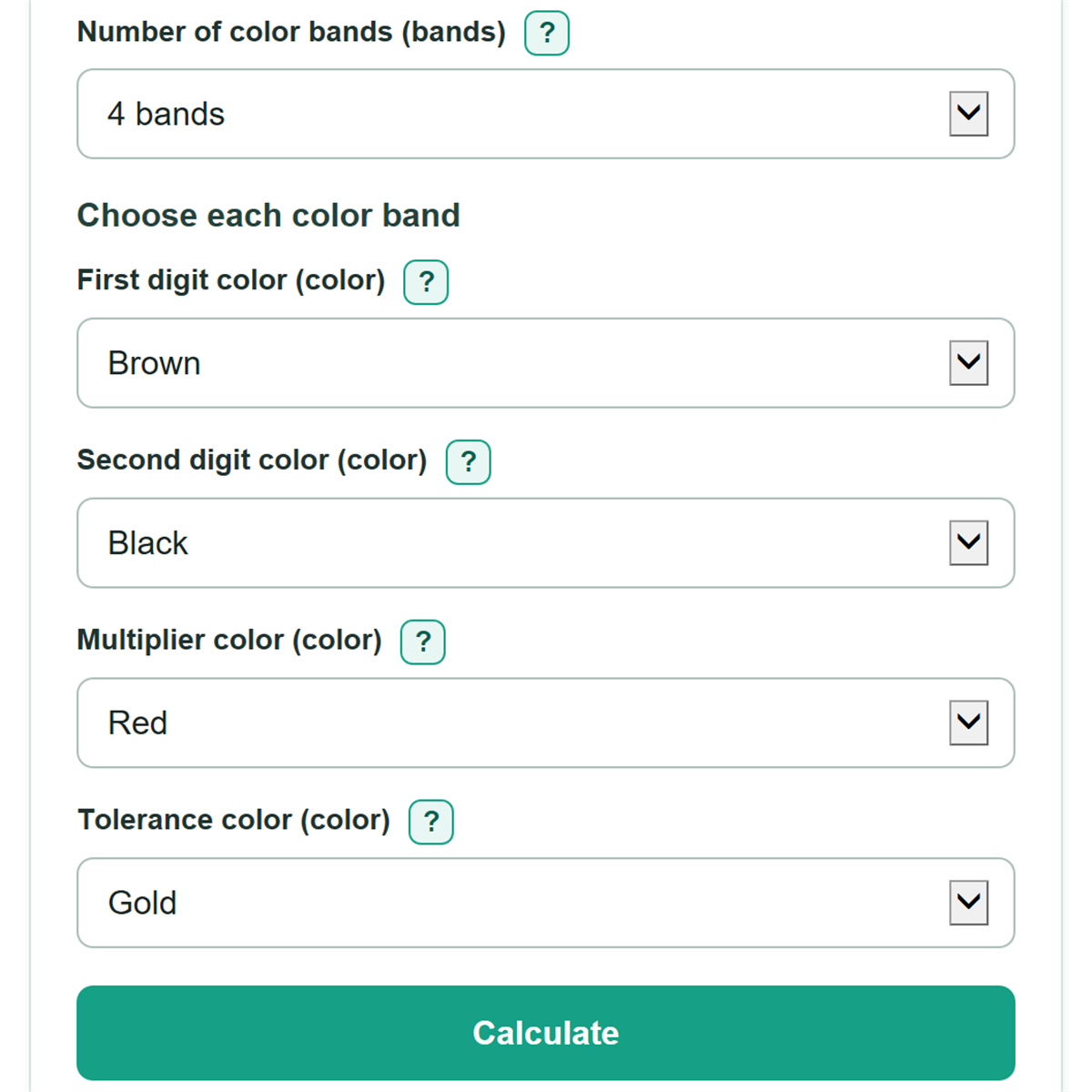
Choose each color band
Table of contents
How to use our Resistor Calculator
- Choose "Color bands" for a resistor with colored rings, or "Printed SMD code" for a chip resistor with letters or numbers printed on it.
- For color bands, count every ring, then read from the end opposite the separated tolerance band. Choose each digit color, the multiplier color, and the tolerance color when shown.
- For a chip resistor, copy its marking exactly into "Printed SMD resistor code." Enter 103 or 4992 for a numbered code, or use R as the decimal point, such as 4R7.
- Click Calculate. Confirm that the displayed resistance fits the marking you entered; for color bands, compare a meter reading with the displayed lowest and highest allowed resistance.
Definitions
Resistance: How much a component opposes electric current. It is measured in ohms and may be shown as ohms, kOhms, or MOhms.
Nominal resistance: The labeled target value decoded from the marking. The actual resistance may vary within its tolerance.
Multiplier color: The band that scales the digit value. For example, red means multiply by 100, while gold means multiply by 0.1.
Tolerance: The allowed percentage above or below nominal resistance. A gold tolerance band means plus or minus 5 percent.
SMD code: The printed marking on a surface-mount resistor. In 103, 10 is multiplied by 1,000; in 4R7, R marks the decimal point.
ppm/C: Parts per million per degree Celsius. On a 6-band resistor, it states the rated amount resistance may change as temperature changes.
Common mistakes and quick fixes
Mistake: Reading the rings from the tolerance-band end.
Fix: Check What marking is on your resistor? and then recalculate. Start at the end opposite the separated final band. The separated band is usually the tolerance band.
Mistake: Choosing 4 bands when the resistor has five rings.
Fix: Check What marking is on your resistor? and then recalculate. Count every visible ring again. A 5-band resistor has three digit colors before its multiplier.
Mistake: Entering a chip-resistor marking in the color-band controls.
Fix: Choose "Printed SMD code" and copy the characters into "Printed SMD resistor code."
Mistake: Expecting a meter to read exactly the decoded resistance.
Fix: Check What marking is on your resistor? and then recalculate. For color-banded resistors, compare the reading with the displayed lowest and highest allowed resistance.
Mistake: Typing a decimal point, spaces, or extra letters in an SMD code.
Fix: Check What marking is on your resistor? and then recalculate. Use a 3-digit code, 4-digit code, or one R decimal marker, such as 103, 4992, or 4R7.
Limitations & Key Assumptions / Boundary Conditions
- The calculator decodes axial 3-band through 6-band markings and printed 3-digit, 4-digit, and single-R SMD markings only.
- It cannot determine faded, burned, hidden, or misread colors. Check an unclear part with a meter and circuit documentation.
- Printed SMD codes return nominal resistance only because this calculator does not decode tolerance from the entered marking.
- A meter reading can differ because of meter accuracy, temperature, contact resistance, or parallel paths when the resistor remains connected in a circuit.
- A decoded resistance does not identify power rating, voltage rating, resistor material, or suitability for a particular circuit.
Methodology
Color-band decoding
The calculator maps digit colors as follows: black 0, brown 1, red 2, orange 3, yellow 4, green 5, blue 6, violet 7, gray 8, and white 9. For 3-band and 4-band resistors, the first two colors form the significant digits. For 5-band and 6-band resistors, the first three colors form the significant digits.
two-digit value = 10 x first digit + second digit
three-digit value = 100 x first digit + 10 x second digit + third digit
The multiplier band scales that value. The calculator uses 20 percent tolerance for a 3-band resistor; otherwise, it uses the selected tolerance color.
decoded resistance = significant-digit value x multiplier
lowest allowed resistance = decoded resistance x (1 - tolerance / 100)
highest allowed resistance = decoded resistance x (1 + tolerance / 100)
Printed SMD decoding
For a 3-digit SMD marking, the first two digits are the value and the last digit is the number of zeros. For a 4-digit marking, the first three digits are the value. In R notation, R is the decimal point.
3-digit resistance = first two digits x 10^final digit
4-digit resistance = first three digits x 10^final digit
R-notation resistance = code with R replaced by a decimal point
Worked example
Brown, black, red, and gold gives 10 x 100 = 1,000 ohms, or 1 kOhm. Gold means plus or minus 5 percent, so the allowed range is 950 to 1,050 ohms. A 4R7 SMD marking decodes to 4.7 ohms.