
Use this calculator to estimate your recommended pregnancy weight gain range and see how your gain so far compares with your current week.
Advanced options
How to use our Pregnancy Weight Gain Calculator
- Choose Pregnancy type and Input unit system, then enter your pre-pregnancy weight and height using the matching fields.
- Enter Current pregnancy week (weeks) using completed weeks, then add Current weight (lb) or Current weight (kg) if you want a comparison against the current-week range.
- Click Calculate to see your Pre-pregnancy BMI, BMI category before pregnancy, and your full-pregnancy recommended gain range.
- For one baby, check the Recommended gain by current week minimum and Recommended gain by current week maximum; for twins, focus on the total range and read the twin guidance note.
- Sanity-check the result by making sure your height and starting weight are correct and that Your actual weight gain so far equals current weight minus pre-pregnancy weight in the same unit system.
Definitions
Pre-pregnancy BMI: A number from your starting weight and height that places you in the recommendation group used by the calculator.
BMI category before pregnancy: The group based on BMI: underweight, normal, overweight, or obese.
Current pregnancy week (weeks): Your completed gestational week, which is how far along the pregnancy is counted.
Trimester: One of the three stages of pregnancy. The first trimester is the early part, and the second and third trimesters are the later parts when weekly gain guidance is commonly used.
Recommended total weight gain minimum and maximum: The full-pregnancy target range for total gain, not just for today.
Recommended gain by current week minimum and maximum: An estimate of how much total weight gain is recommended by your current week for a singleton pregnancy.
Your actual weight gain so far: Your current weight minus your pre-pregnancy weight in the same unit system.
Comparison with recommended gain by current week: A simple tracker result that shows whether your actual gain is below, within, or above the current-week range.
Common mistakes and quick fixes
Mistake: Entering metric numbers while Input unit system is set to US, or US numbers while it is set to Metric.
Fix: Match the unit setting to the fields you fill in, and use only Pre-pregnancy weight (lb) , Height (feet) , and Height (inches) for US or only Pre-pregnancy weight (kg) and Height (cm) for Metric.
Mistake: Typing total height inches into Height (inches) instead of using both Height (feet) and Height (inches) .
Fix: Put whole feet in Height (feet) and only the extra 0 to 11 inches in Height (inches) .
Mistake: Using a current weight in a different unit than the starting weight, which makes Your actual weight gain so far wrong.
Fix: If you entered Pre-pregnancy weight (lb) , also enter Current weight (lb) . If you entered Pre-pregnancy weight (kg) , use Current weight (kg) .
Mistake: Entering an estimated due-date month instead of a completed number in Current pregnancy week (weeks) .
Fix: Use the current completed gestational week, usually counted from the first day of the last menstrual period.
Mistake: Treating Recommended total weight gain minimum and Recommended total weight gain maximum as the amount you should have gained today.
Fix: Use the total range for the whole pregnancy, and for one baby use Recommended gain by current week minimum and Recommended gain by current week maximum to track progress now.
Mistake: Assuming a negative Your actual weight gain so far is an error.
Fix: A negative value simply means your Current weight (lb) or Current weight (kg) is below your pre-pregnancy weight.
Limitations & Key Assumptions / Boundary Conditions
- The calculator is built for Pregnancy type values of one baby or twins only. It does not estimate triplets or higher-order multiples.
- Week-by-week estimates are shown only for singleton pregnancies. For twins, the calculator focuses on the full-pregnancy range and a note instead of creating a week-by-week estimate from singleton rates.
- Pre-pregnancy BMI is classified using the exact calculated value, even if the displayed BMI is rounded to 1 decimal place.
- The singleton current-week estimate uses a first-trimester gain range of 1.1 to 4.4 lb through week 13, then adds BMI-based weekly gain after week 13 [2].
- If Current weight (lb) or Current weight (kg) is left blank, the calculator can still show BMI and recommended ranges, but it cannot show Your actual weight gain so far or the comparison outputs.
- A negative Your actual weight gain so far is allowed and kept as a signed result because some users weigh less than their pre-pregnancy weight early on.
- For twins with very high BMI, published twin guidance is commonly presented through BMI 39.9, so users with BMI 40 or higher should treat the twin result as limited guidance and confirm goals with their clinician [1].
- Real care plans can differ because of medical history, edema, fetal growth, starting body composition, or clinician guidance, so this tool should be used as a tracking estimate rather than a personalized treatment plan.
Methodology
How the calculator works
The calculator first finds your Pre-pregnancy BMI from your starting weight and height. It then places you into a BMI category, matches that category to the recommended pregnancy gain range, and, for one baby, estimates what the recommended range looks like by your current week.
BMI step
BMI = 703 x weight_lb / (height_in_total^2)
height_in_total = height_ft x 12 + height_in
BMI = weight_kg / (height_m^2)
height_m = height_cm / 100
The calculator shows BMI rounded to 1 decimal place, but it uses the unrounded BMI to decide the category cutoffs: under 18.5, 18.5 to 24.9, 25.0 to 29.9, and 30.0 or higher [1].
Total pregnancy gain ranges used
For one baby, the calculator uses these total ranges in pounds: underweight 28 to 40, normal 25 to 35, overweight 15 to 25, and obese 11 to 20 [1]. For twins, it uses underweight 50 to 62, normal 37 to 54, overweight 31 to 50, and obese 25 to 42, with extra caution at very high BMI [1][3].
Current-week estimate for one baby
For singleton pregnancies, the calculator combines a small first-trimester gain range with BMI-based weekly gain after week 13.
If gestational week <= 13, expected gain now = 1.1 to 4.4 lb
If gestational week > 13, expected minimum now = 1.1 + weekly_min x (week - 13)
If gestational week > 13, expected maximum now = 4.4 + weekly_max x (week - 13)
The weekly singleton rates in pounds per week are: underweight 1.0 to 1.3, normal 0.8 to 1.0, overweight 0.5 to 0.7, and obese 0.4 to 0.6. This follows the common first-trimester plus later-week framework used in pregnancy guidance [2].
Actual gain and comparison step
actual gain = current weight - pre-pregnancy weight
difference from minimum = actual gain - expected gain minimum now
difference from maximum = actual gain - expected gain maximum now
If your actual gain is below the estimated range, the status is below. If it falls inside the range, the status is within. If it is above the range, the status is above. Negative actual gain is kept as a valid signed result.
Mini example
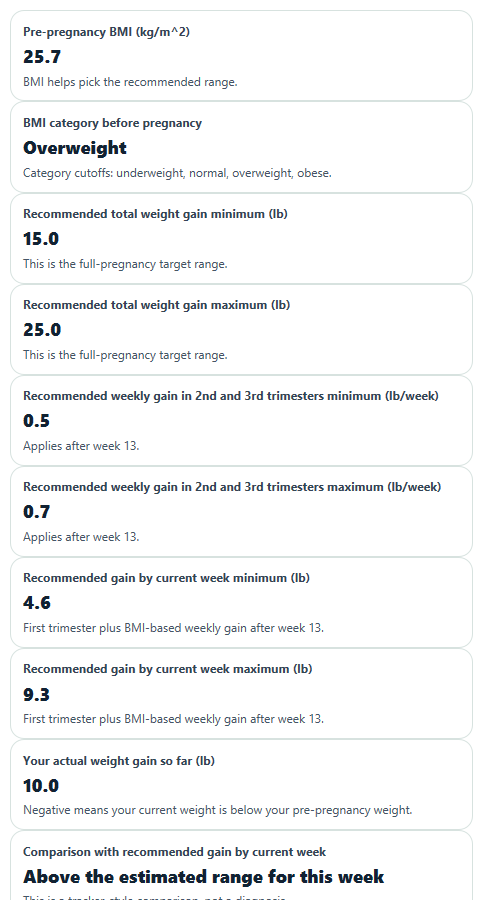
A user with one baby, pre-pregnancy weight 150 lb, height 5 feet 4 inches, and current week 20 has a BMI of about 25.7, which falls in the overweight category. The singleton total target range is 15 to 25 lb.
expected minimum now = 1.1 + 0.5 x (20 - 13) = 4.6 lb
expected maximum now = 4.4 + 0.7 x (20 - 13) = 9.3 lb
If the current weight is 160 lb, then actual gain is 10 lb, which is slightly above the current-week range.
Assumptions used
The calculator assumes your starting weight is your pre-pregnancy or very early pregnancy weight, your gestational week is entered correctly, and your current weight uses the same unit system as your starting weight. For twins, it does not create a week-by-week estimate from singleton weekly rates because that would add false precision.