
Estimate ideal weight with several common formulas, compare them side by side, and use the median result as a practical quick summary.
Advanced options
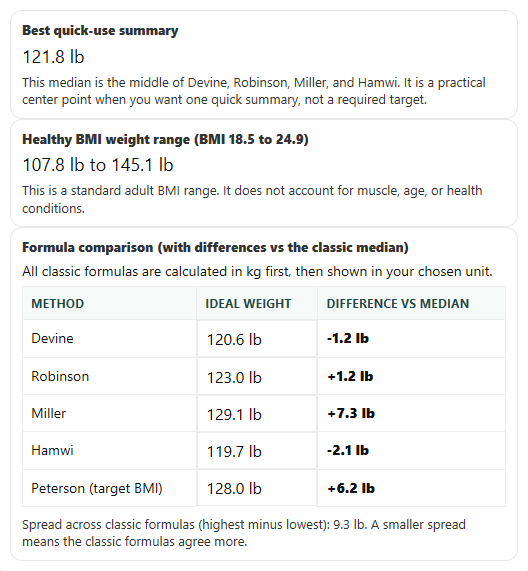
| Method | Ideal weight | Difference vs median |
|---|---|---|
| Devine | ||
| Robinson | ||
| Miller | ||
| Hamwi | ||
| Peterson (target BMI) |
How to use our Ideal Weight Calculator
- Choose "Sex used by the formula" and your "Unit system", then enter height as either "Height (feet)" plus "Height (inches)" or "Height (cm)".
- Open "Advanced options" if you want to change "Target BMI for Peterson method" or switch "Result display unit" between pounds and kilograms.
- Click "Calculate" to see Devine, Robinson, Miller, Hamwi, Peterson, the healthy BMI range, the "Median of classic formula estimates", and the "Spread across classic formulas".
- Sanity-check the output by comparing each formula with the median and the healthy BMI range: if the classic spread is small, the formulas agree closely; if it is larger, treat any single number more cautiously.
Definitions
Sex used by the formula: The male or female setting that changes the constants in the classic equations.
Unit system: Whether you enter height in US units or metric units.
Target BMI for Peterson method: The BMI value used to calculate the Peterson estimate. Higher target BMI gives a higher Peterson result.
Result display unit: Whether results are shown in pounds or kilograms.
Healthy BMI range: The weight range at BMI 18.5 to 24.9 for your entered height, using the standard BMI idea for adults over age 20 [2].
Median of classic formula estimates: The middle result from Devine, Robinson, Miller, and Hamwi after sorting them. With four values, it is the average of the two middle values.
Spread across classic formulas: The highest classic result minus the lowest classic result. Bigger spread means less agreement.
Common mistakes and quick fixes
Mistake: Entering both "Height (feet)" and "Height (cm)" and expecting both to be used.
Fix: Only the active height field for your chosen "Unit system" is used, so fill in the US height rows or the metric height row, not both.
Mistake: Typing 64 into "Height (inches)" in US mode.
Fix: Put the whole-feet part in "Height (feet)" and only the extra 0 to 11 inches in "Height (inches)".
Mistake: Leaving "Target BMI for Peterson method" blank or entering 0.
Fix: Enter a positive value in "Target BMI for Peterson method" because the Peterson result changes directly from that input.
Mistake: Treating "Devine ideal weight" as the one correct answer.
Fix: Compare "Devine ideal weight" with "Robinson ideal weight", "Miller ideal weight", "Hamwi ideal weight", and the "Median of classic formula estimates" before picking a quick reference number.
Mistake: Ignoring the "Healthy BMI range lower weight" and "Healthy BMI range upper weight".
Fix: Use those two outputs to see whether a single formula estimate sits near the lower end, middle, or upper end of the standard adult BMI range.
Mistake: Reading a tiny "Spread across classic formulas" as if it proves a personal target.
Fix: A small spread only means the classic formulas are close to each other for your height, not that the result is a diagnosis or a personalized goal.
Limitations & Key Assumptions / Boundary Conditions
- These formulas are screening-style estimates for adults. They are not direct measures of body fat, muscle, frame size, or health status.
- The healthy BMI range output is based on standard adult BMI cutoffs and is most appropriate for adults, not children or teens.
- Classic formulas use only height and the selected sex constant. They do not adjust for age, athletic build, pregnancy, edema, or body composition.
- Peterson depends directly on your chosen "Target BMI for Peterson method". Changing that input can move the result a lot.
- For heights far outside common adult ranges, formula results may be less useful because these equations are simple linear rules built around adult height references.
- Heights below 5 ft are not clamped in the classic formulas, so results can fall noticeably lower than many users expect.
- Different real-world settings may use different reference methods, rounding, or professional judgment, so your result may not match every chart or clinic tool exactly.
Methodology
What the calculator does
It converts your height to the units needed by each formula, calculates each estimate in kilograms first, then converts to pounds only if you choose pounds for display.
Height conversions
height_in_total = 12 x height_ft + height_in
height_m = height_cm / 100
height_in_total = height_cm / 2.54
The US path uses feet plus extra inches. The metric path uses centimeters, then converts to meters for BMI-based outputs and to inches for the classic inch-based formulas.
Classic ideal weight formulas
Devine, female = 45.5 + 2.3 x (height_in_total - 60)
Devine, male = 50 + 2.3 x (height_in_total - 60)
Robinson, female = 49 + 1.7 x (height_in_total - 60)
Robinson, male = 52 + 1.9 x (height_in_total - 60)
Miller, female = 53.1 + 1.36 x (height_in_total - 60)
Miller, male = 56.2 + 1.41 x (height_in_total - 60)
Hamwi, female = 45.5 + 2.2 x (height_in_total - 60)
Hamwi, male = 48 + 2.7 x (height_in_total - 60)
These formulas return kilograms. The math stays signed below 60 inches, so the calculator does not clamp shorter heights to 5 ft.
Peterson and healthy BMI range
peterson_kg = target_bmi x (2.2 + 3.5 x (height_m - 1.5))
bmi_min_kg = 18.5 x height_m^2
bmi_max_kg = 24.9 x height_m^2
The BMI range uses standard adult BMI thresholds, and BMI is based on weight divided by height squared [2].
Median summary and spread
classic_median = median(devine_kg, robinson_kg, miller_kg, hamwi_kg)
formula_spread = max(classic_formulas) - min(classic_formulas)
The median gives one center point from the four classic formulas. The spread shows how far apart those classic estimates are. A smaller spread means closer agreement.
Unit conversion
lb = kg x 2.2046226218
All comparison logic uses the kilogram source values first, then the calculator converts every output consistently into pounds if pounds are selected.
Worked mini-example
Example:
female, 5 ft 4 in, target BMI 22, results in pounds. Total height is 64 inches, so Devine is 45.5 + 2.3 x (64 - 60) = 54.7 kg, which is about 120.15 lb. Robinson is 55.5 kg or about 122.36 lb. Hamwi is 54.5 kg or about 119.71 lb. Sorting the four classic results gives a median near 121.25 lb, and the difference between the highest and lowest classic result is about 10.14 lb.
Assumptions used
The calculator assumes adult use, standard BMI cutoffs for the healthy BMI range, exact conversion factors, and the published constants listed in the formulas above. Results are best read as comparison estimates, not as a single required personal target.