
Compare two washer models by their installed price, yearly costs, lifetime cost, and the time needed to recover a higher upfront price.
Energy and water details
Household use and utility prices
Advanced options
Delivery and setup
Yearly upkeep allowances
Table of contents
How to use our Top Load vs Front Load Washer Lifetime Cost Calculator
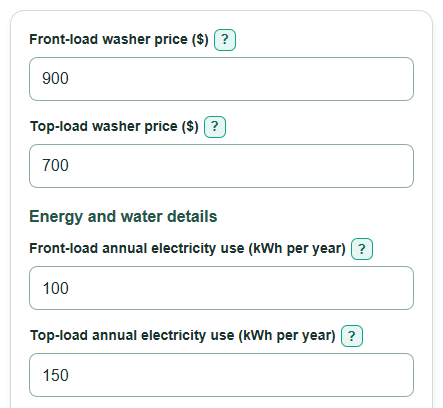
- Enter the price of each model in Front-load washer price and Top-load washer price.
- Copy each model's annual kWh figure into Front-load annual electricity use and Top-load annual electricity use, then enter water use for comparable wash cycles.
- Enter your Laundry loads per year, Years you expect to keep the washer, and the variable rates from your utility bill.
- Open Advanced options if delivery, hookup, removal, repairs, or upkeep costs differ between models.
- Click Calculate. Check whether Front-load cost minus top-load cost is negative or positive, then compare Operating-cost break-even time with your planned ownership years.
Definitions
Installed cost: Washer price plus one-time delivery and setup cost.
Annual electricity use: Electricity used in one year, measured in kWh. The calculator scales each entered 300-load figure to your Laundry loads per year.
kWh: Kilowatt-hour, the unit electric utilities use to bill for electricity.
Water usage rate: The variable water-supply charge in dollars per 1,000 gallons.
Sewer usage rate: The variable wastewater charge in dollars per 1,000 gallons, if billed separately.
Yearly operating cost: Estimated electricity, water, sewer, and entered yearly repair and upkeep costs for one year.
Operating-cost break-even time: The number of years for lower yearly costs to recover a higher installed cost.
Common mistakes and quick fixes
Mistake: Entering the monthly electric bill total as Electricity price.
Fix: Enter the variable price per kWh from the bill or rate schedule, such as 0.1730 for 17.30 cents per kWh.
Mistake: Using annual kWh for one washer and per-cycle kWh for the other in Front-load annual electricity use or Top-load annual electricity use.
Fix: Use each model's annual figure based on 300 loads, or convert both figures to that same basis before entering them.
Mistake: Including a fixed monthly account fee in Water usage rate or Sewer usage rate.
Fix: Enter only the part of each utility charge that changes with gallons used.
Mistake: Counting sewer twice because Water usage rate already includes it.
Fix: Set Sewer usage rate to 0 when the water rate you entered already includes wastewater charges.
Mistake: Comparing different cycle types in Front-load water use and Top-load water use.
Fix: Use water figures for similar normal-cycle settings so the comparison is fair.
Mistake: Reading a negative Front-load cost minus top-load cost as an error.
Fix: A negative amount means the front-load washer is estimated to cost less over the selected years.
Limitations & Key Assumptions / Boundary Conditions
- The comparison assumes both washers handle the same Laundry loads per year and that electricity and water use change directly with load count.
- Use utility prices that apply to additional use. Fixed account charges are excluded because they usually do not change with the washer choice.
- Water-use figures can vary by cycle, temperature, load size, soil level, and selected options. Compare similar cycles whenever possible.
- Electricity, water, and sewer rates can change during ownership. The calculation keeps the entered rates constant.
- Front-load yearly repair and upkeep allowance and Top-load yearly repair and upkeep allowance are personal budget estimates, not reliability predictions.
- The calculation does not include detergent, laundry-room changes, financing, resale value, downtime, or a replacement washer after the selected ownership period.
Methodology
Calculation method
Each washer is calculated separately before the calculator compares the two lifetime totals. Washer price and setup are one-time costs. Electricity, water, sewer, and optional upkeep are yearly costs.
installed_cost = washer_price + setup_cost
The annual electricity value is adjusted from the 300-load comparison basis to your household's entered laundry volume.
scaled_annual_kwh = label_annual_kwh * loads_per_year / 300
annual_electricity_cost = scaled_annual_kwh * electricity_rate
annual_water_sewer_cost = gallons_per_load * loads_per_year * (water_rate + sewer_rate) / 1000
annual_operating_cost = annual_electricity_cost + annual_water_sewer_cost + yearly_upkeep
lifetime_cost = installed_cost + annual_operating_cost * ownership_years
front_minus_top_lifetime_cost = front_lifetime_cost - top_lifetime_cost
A negative signed difference means the front-load washer costs less. A positive signed difference means the top-load washer costs less.
Break-even calculation
break_even_years = -(front_installed_cost - top_installed_cost) / (front_annual_operating_cost - top_annual_operating_cost)
A future break-even is shown only when the washer with the higher installed cost has the lower yearly operating cost. If yearly costs are equal, or one washer is cheaper both upfront and yearly, there is no operating-cost crossover.
Mini-example
If the front-load washer has a $1,000 installed cost and $67.70 yearly operating cost, its 10-year cost is $1,677. If the top-load washer has an $800 installed cost and $97.95 yearly operating cost, its 10-year cost is $1,779.50. The signed difference is -$102.50, so the front-load washer costs less over 10 years. Its extra $200 upfront cost is recovered in about 6.61 years.