
Compare your pool and bucket water drops, then estimate the added water, sewer, and reheating cost of excess loss.
Advanced options
Table of contents
How to use our Pool Leak Water and Heating Cost Calculator
- Run a bucket test and measure Pool water drop during the test and Bucket water drop during the test over the same period.
- Enter the pool waterline dimensions in Pool length and Pool width.
- Copy only variable charges from your utility bills into Water usage price, Sewer usage price, and the price for your selected heater.
- Choose Pool heater type, then enter the target and replacement-water temperatures. Enter heat pump COP or gas efficiency when that heater is selected.
- Check the Bucket-test reading before using the cost estimate. A positive excess-loss reading means the pool dropped farther than the bucket; a zero cost after a negative reading is expected.
Definitions
Bucket test: A comparison between the pool waterline drop and the drop inside a partly submerged bucket during the same test period. The bucket acts as an evaporation control.
Pool drop above the bucket control: Pool water drop minus bucket water drop, in inches per test. A positive number means the pool dropped farther.
Excess water loss: The estimated gallons per day from a positive pool-minus-bucket drop. The calculator uses zero gallons when the signed comparison is negative.
Water usage price: The variable water-service charge per 1,000 gallons. It does not include a fixed account charge.
Sewer usage price: The variable wastewater charge per 1,000 gallons. Some utilities do not apply it to pool refill water.
Heat pump COP: Heat delivered to the water divided by electricity used. For example, a COP of 4 means one unit of electricity supplies about four units of heat under the stated conditions.
Therm: A natural gas energy unit equal to 100,000 Btu. [1]
Common mistakes and quick fixes
Mistake: Entering the full Pool water drop during the test as a leak without measuring the bucket.
Fix: Run the bucket test and enter Bucket water drop during the test from the same time period.
Mistake: Measuring the pool and bucket for different lengths of time.
Fix: Use one shared Test duration and take both ending readings at the same time.
Mistake: Adding a fixed monthly service fee to Water usage price or Sewer usage price.
Fix: Enter only the variable price that rises with the next 1,000 gallons. Enter 0 for sewer if a pool refill is not charged for sewer service.
Mistake: Using an average household bill divided by all household kWh as Electricity price.
Fix: Use the variable energy rate for the next kWh from your bill, excluding fixed customer charges.
Mistake: Treating Heat pump COP as the heat pump's electric power rating.
Fix: Enter the COP from a performance table for similar pool-water and outdoor conditions.
Mistake: Entering the pool temperature as Replacement water temperature.
Fix: Measure water from the fill hose after it has run long enough to reach a steady temperature.
Limitations & Key Assumptions / Boundary Conditions
- The pool is treated as a rectangle with surface area equal to Pool length times Pool width. This can be inaccurate for oval, round, kidney, and freeform pools.
- The bucket test estimates excess loss above the measured evaporation control. A positive Bucket-test reading does not identify a leak location or prove its cause.
- Pool and bucket measurements must cover the same weather, pump condition, and positive Test duration. Short tests can make small ruler-reading errors matter more.
- Water, sewer, electricity, and gas estimates use only entered variable usage prices. Fixed account charges, taxes, tier changes, and utility-specific pool-refill rules can change an actual bill.
- Reheating cost covers only replacement water warmed from Replacement water temperature to Target pool temperature. It excludes normal evaporation, wind, solar gain, pool cover effects, plumbing losses, and heater standby use.
- Heat pump performance changes with air temperature, humidity, and water temperature. Enter a COP that fits your equipment and conditions. Gas efficiency can also differ from its rated value during use.
- The monthly result uses 30 days, and the seasonal result assumes the measured daily excess loss, temperatures, and prices stay unchanged for the entered Swim season.
Methodology
Calculation method
The calculator first compares the two measured waterline drops. It keeps that signed comparison visible, then uses only a positive difference to estimate usable excess water loss.
surface area (square feet) = Pool length (feet) x Pool width (feet)
signed excess drop (inches) = Pool water drop during the test - Bucket water drop during the test
excess gallons per day = max(0, signed excess drop) x surface area / 12 x 7.48052 x 24 / Test duration
The 12 converts inches to feet, and 7.48052 converts cubic feet to US gallons. A negative signed drop remains visible as a measurement result, but it produces zero estimated excess gallons and zero added cost.
Water and sewer cost use separate variable usage prices.
daily water and sewer cost = excess gallons per day / 1,000 x (Water usage price + Sewer usage price)
For reheating, the calculator finds how much colder the replacement water is than the target. It uses 8.34 pounds per gallon and the Btu energy conversions described by EIA. [1]
daily heat needed (Btu) = excess gallons per day x 8.34 x max(0, Target pool temperature - Replacement water temperature)
electricity (kWh per day) = daily heat needed / 3412.142 for electric resistance
heat pump electricity (kWh per day) = daily heat needed / (3412.142 x Heat pump COP)
natural gas (therms per day) = daily heat needed / (100000 x Gas heater efficiency / 100)
Estimated monthly water and reheating cost = (daily water and sewer cost + daily heating cost) x 30
Estimated swim-season water and reheating cost = (daily water and sewer cost + daily heating cost) x Swim season
Worked example
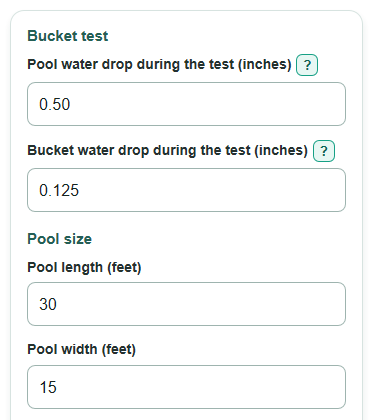
If the pool drops 0.50 inches, the bucket drops 0.125 inches, and the pool is 30 feet by 15 feet over 24 hours, the positive difference is 0.375 inches. That produces about 105.2 excess gallons per day. With water and sewer prices totaling $14 per 1,000 gallons, the water and sewer part is about $1.47 per day before any reheating cost.
What the estimate leaves out
This is a rectangular-surface, steady-rate estimate. It does not diagnose a leak, model ordinary pool heat loss, or predict tiered utility billing. If replacement water is at or warmer than the target, the reheating part is set to zero while water and sewer costs can still apply.