
Calculate the corrected molar titrant concentration, correction factor, and blank-corrected volume from your standardization measurements.
Advanced options
Table of contents
How to use our Titrant Standardization Factor Calculator
- Choose Standardization method based on your record: a weighed primary standard or a known standard solution.
- Enter the Nominal titrant concentration (mol/L) from the titrant label or preparation record and the delivered Titrant volume at endpoint (mL).
- Enter the fields for the chosen method, then copy both reaction coefficients from the same balanced reaction.
- Open Advanced options only if your method uses a blank or a purity correction. Enter Blank titrant volume (mL) from a separate blank run.
- Click Calculate, then check that Titrant volume after blank correction is positive and that the correction factor direction matches your expectation: above 1 means stronger than nominal.
Definitions
Nominal titrant concentration: The intended concentration written on a titrant label or preparation record, in mol/L.
Corrected titrant concentration: The actual molar concentration calculated from the standardization measurements, in mol/L.
Titrant correction factor: A unitless ratio of corrected titrant concentration divided by nominal titrant concentration. A value above 1 means the titrant is stronger than nominal.
Primary standard: A substance weighed to determine an amount of reacting chemical accurately enough for standardization.
Standard solution: A solution with an accurately known concentration, used here with its measured aliquot volume to find moles. [1]
Blank titrant volume: Titrant used in a separate blank run for effects not caused by the standard. It is subtracted from endpoint volume.
Reaction coefficient: The number before a substance in a balanced chemical equation. The two coefficients set the mole ratio between standard and titrant.
Common mistakes and quick fixes
Mistake: Entering a final burette reading as Titrant volume at endpoint (mL).
Fix: Enter the delivered volume, found by subtracting the initial burette reading from the final reading.
Mistake: Using normality in Nominal titrant concentration (mol/L) or Standard solution concentration (mol/L).
Fix: Use mol/L for every concentration in this calculator. Convert or use a method calculation that is based on the same concentration system.
Mistake: Entering Blank titrant volume (mL) equal to or greater than Titrant volume at endpoint (mL).
Fix: Check the two records. Blank volume must be smaller because the corrected titrant volume must stay above zero.
Mistake: Assuming both reaction coefficients are 1 for a non-1-to-1 reaction.
Fix: Copy the numbers from the balanced equation into Standard coefficient in the balanced reaction and Titrant coefficient in the balanced reaction.
Mistake: Treating Titrant correction factor as a concentration.
Fix: The factor has no unit. Use Corrected titrant concentration, in mol/L, in later molarity-based calculations.
Mistake: Leaving Primary standard purity (%) at 100 when the certificate gives a lower assay value.
Fix: For the mass method, enter the certificate purity required by your approved method.
Limitations & Key Assumptions / Boundary Conditions
- This calculator uses mol/L only. Do not mix molarity with normality unless your approved method has already made that conversion.
- The reaction must be balanced correctly, and both reaction coefficients must come from that same equation.
- Blank correction is applied only when you enter a separate Blank titrant volume (mL). Use it only if your method calls for a blank.
- For the mass method, purity changes the calculated standard moles. A blank purity field is treated as 100 percent, which may be unsuitable for a material with a stated assay below 100 percent.
- The calculation uses one standardization trial. It does not average replicate trials or judge endpoint quality, weighing error, contamination, temperature effects, or method acceptance criteria.
- Use the corrected concentration only within the conditions and procedure under which the titrant was standardized.
Methodology
Calculation method
The calculator first finds the titrant volume remaining after blank subtraction. It then finds moles of standard from the selected route, uses the balanced-reaction coefficients to find reacting titrant moles, and divides by titrant volume in liters.
V_corrected (mL) = V_endpoint (mL) - V_blank (mL)
For the primary-standard mass route, the purity fraction is purity percent divided by 100. If purity is blank, the calculation uses 100 percent.
n_standard (mol) = mass (g) * purity fraction / molar mass (g/mol)
For the standard-solution route, mL is converted to L using 1,000 mL per L.
n_standard (mol) = standard concentration (mol/L) * standard volume (mL) / 1000
The balanced reaction changes standard moles into titrant moles. For a 1-to-1 reaction, both coefficients are 1.
n_titrant (mol) = n_standard (mol) * titrant coefficient / standard coefficient
C_corrected (mol/L) = n_titrant (mol) / (V_corrected (mL) / 1000)
factor = C_corrected (mol/L) / C_nominal (mol/L)
Worked example
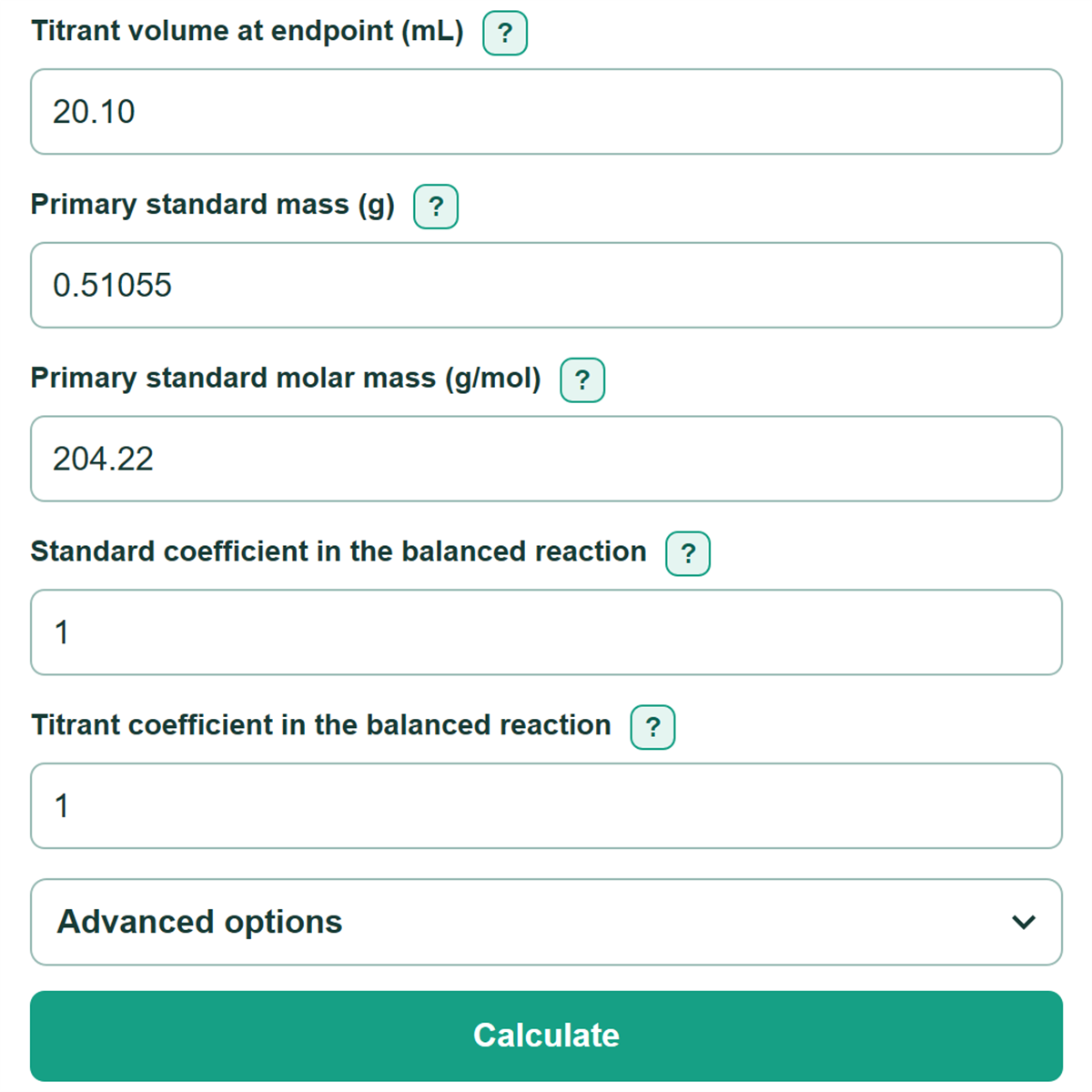
With 0.51055 g of a 204.22 g/mol primary standard at 100 percent purity, standard moles are 0.0025 mol. For a 1-to-1 reaction, 20.10 mL at endpoint, and a 0.10 mL blank, corrected volume is 20.00 mL or 0.02000 L. The corrected titrant concentration is 0.0025 divided by 0.02000, or 0.1250 mol/L. If nominal concentration is 0.1000 mol/L, the correction factor is 1.250.
Calculation boundaries
The calculator stops if a required value is zero or negative, if purity is above 100 percent, or if blank volume is not smaller than endpoint volume. It calculates stoichiometry from entered values; it does not verify chemical identities, endpoint choice, or laboratory method suitability.