
Convert one temperature into Celsius, Fahrenheit, Kelvin, and Rankine at the same time with clear formulas and absolute-zero checks.
Table of contents
How to use our Temperature Conversion Calculator
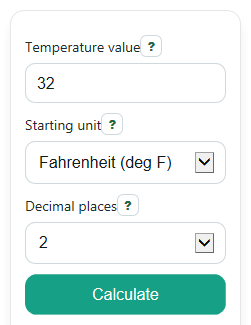
- Enter a number in Temperature value.
- Choose the original scale in Starting unit.
- Pick how many digits to show in Decimal places, then click Calculate.
- Read the four converted results and the Formula used card to see how the tool changed your value.
- Sanity-check the answer with Quick reference or a known point such as water freezing at 32 deg F, 0 deg C, and 273.15 K.
Definitions
Temperature value: The one number you want to convert from its original scale.
Starting unit: The scale your entered number is already using, such as Fahrenheit, Celsius, Kelvin, or Rankine.
Decimal places: How many digits appear after the decimal point in each converted result.
Celsius (deg C): A common metric temperature scale used in science and in most countries outside the US.
Fahrenheit (deg F): A temperature scale commonly used for weather and cooking in the US.
Kelvin (K): An absolute temperature scale used in science. Its zero point is absolute zero, so it cannot be negative in physical reality [3].
Rankine (deg R): An absolute scale like Kelvin, but it uses Fahrenheit-sized degree steps [1].
Absolute zero: The lowest possible physical temperature: 0 K, 0 deg R, -273.15 deg C, and -459.67 deg F.
Common mistakes and quick fixes
Mistake: Leaving Temperature value blank or typing letters instead of a number.
Fix: Enter one numeric value, such as 32, 100, or -40.
Mistake: Entering a Kelvin number in Temperature value but keeping Starting unit set to Fahrenheit.
Fix: Make sure Starting unit matches the scale of the number you typed.
Mistake: Typing a negative value with Starting unit set to Kelvin or Rankine.
Fix: Kelvin and Rankine cannot go below zero, so use 0 or higher for those starting units.
Mistake: Thinking the Kelvin or Rankine result is wrong because it has no degree sign like Celsius or Fahrenheit .
Fix: Read the unit label shown on each result card; Kelvin is written as K, while Rankine is shown as deg R.
Mistake: Assuming rounded values in Celsius , Fahrenheit , Kelvin , or Rankine are exact.
Fix: Increase Decimal places if you need more detail for science or engineering work.
Limitations & Key Assumptions / Boundary Conditions
- The calculator uses exact linear conversion formulas and standard offsets, so it is for temperature scale conversion only, not for heat transfer or weather forecasting.
- Negative inputs are allowed for Celsius and Fahrenheit, but negative Temperature value entries are not physically valid when Starting unit is Kelvin or Rankine.
- Results are rounded to the selected Decimal places, so displayed values can look slightly different from the full exact decimal.
- Very large or very small finite values can be converted, but rounded display may hide tiny differences near important boundaries such as absolute zero.
- The Quick reference note is a simple comparison to familiar temperatures, so it is meant for interpretation, not as a full scientific classification.
Methodology
Conversion method
The calculator converts your input into one canonical temperature first, then computes all four output scales from that shared value. This keeps the Celsius, Fahrenheit, Kelvin, and Rankine results internally consistent.
C = (F - 32) * 5 / 9
F = C * 9 / 5 + 32
K = C + 273.15
C = K - 273.15
R = F + 459.67
F = R - 459.67
R = K * 9 / 5
K = R * 5 / 9
Implementation path by starting unit
If Starting unit is Celsius, Fahrenheit, or Kelvin, the tool finds Celsius first, then derives Kelvin, Fahrenheit, and Rankine from that. If Starting unit is Rankine, the tool finds Kelvin first, then derives Celsius and Fahrenheit. The constant 273.15 is the Celsius-to-kelvin offset, and 459.67 is the Fahrenheit-to-rankine offset.
Worked example
If Temperature value is 32 and Starting unit is Fahrenheit, first convert to Celsius: (32 - 32) * 5 / 9 = 0 deg C. Then convert to Kelvin: 0 + 273.15 = 273.15 K. Fahrenheit stays 32 deg F, and Rankine is 32 + 459.67 = 491.67 deg R. With Decimal places set to 2, those are the displayed results.
Warnings and boundaries
The calculator blocks negative Kelvin and negative Rankine inputs because those are below absolute zero in physical terms [2][2]. It also normalizes negative zero, so a rounded value like -0.00 is shown as 0.00 instead. Warning logic is based on the unrounded math, which helps avoid misleading boundary messages when a value is extremely close to absolute zero.
Assumptions and limits
This tool assumes standard textbook temperature scales and exact conversion formulas. Real measurement systems can still differ because of sensor error, rounding in source data, or display precision chosen by the user.
Sources
- Fahrenheit temperature scale | Definition, Formula, & Facts | Britannica - Encyclopedia Britannica
- Celsius | Definition, Conversion to Fahrenheit, & Facts | Britannica - Encyclopedia Britannica
- Kelvin temperature scale | measurement | Britannica - Encyclopedia Britannica
- Rankine temperature scale | Description, Symbol, Conversion, & Facts | Britannica - Encyclopedia Britannica