
Convert teaspoons to liters fast and pick the teaspoon type that matches your recipe, label, or class work.
Table of contents
How to use our Teaspoons to Liters Converter
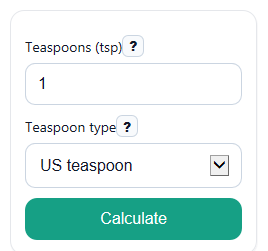
- Enter the amount in Teaspoons (tsp). You can use whole numbers or decimals.
- Choose the right Teaspoon type: use US teaspoon for many US recipes, metric teaspoon for 5 mL kitchen measures, or nutrition label teaspoon when a label uses that standard.
- Click Calculate to see Liters, Milliliters, the Conversion used, and the Teaspoon note.
- Sanity-check the result: small kitchen amounts should usually give a small decimal in Liters, and the Milliliters value should be easier to read for small amounts because 1 L = 1,000 mL.
Definitions
Teaspoons (tsp): The volume you enter in teaspoons.
Teaspoon type: The teaspoon definition used for the math. Different contexts can treat 1 teaspoon as slightly different sizes.
Liters (L): The main converted volume. 1 liter equals 1,000 milliliters.
Milliliters (mL): A smaller metric volume unit that is easier to read for small kitchen amounts.
Conversion used: The liters-per-teaspoon factor applied to your entry.
US teaspoon: A teaspoon based on 4.92892159375 mL.
Metric teaspoon: A teaspoon based on 5 mL [1].
Nutrition label teaspoon: A 5 mL teaspoon used in nutrition labeling contexts [2].
Common mistakes and quick fixes
Mistake: Leaving Teaspoons (tsp) blank or typing words instead of a number.
Fix: Enter a numeric value in Teaspoons (tsp) , such as 1, 0.5, or 3.25.
Mistake: Picking the wrong Teaspoon type for your source.
Fix: Match Teaspoon type to the source before you calculate, then read the Teaspoon note to confirm the standard used.
Mistake: Reading Liters as if it were milliliters.
Fix: Check both Liters and Milliliters ; for small recipe amounts, Milliliters is often easier to read.
Mistake: Assuming the same answer works for every recipe or label.
Fix: Look at Conversion used each time, because the factor changes when Teaspoon type changes.
Mistake: Thinking a negative Liters result is impossible math.
Fix: Negative Liters or Milliliters means your Teaspoons (tsp) entry was negative, which can make sense for a change or difference.
Limitations & Key Assumptions / Boundary Conditions
- The result depends on the selected Teaspoon type. Choosing a different standard changes the answer.
- This converter handles only teaspoons to liters, with milliliters shown as a second display. It does not convert from liters back to teaspoons on this page.
- Negative values are allowed as math, but a negative volume usually means a change or difference, not a physical poured amount.
- Very small inputs can produce very small decimal results in Liters. Use Milliliters if that is easier to interpret.
- The calculator assumes exact fixed factors: US teaspoon = 4.92892159375 mL, metric teaspoon = 5 mL, nutrition label teaspoon = 5 mL. Real measuring tools can still vary a little in practice.
Methodology
How the conversion works
The calculator multiplies your entered teaspoons by the liters-per-teaspoon factor for the selected Teaspoon type.
liters = teaspoons * liters_per_teaspoon
liters_per_teaspoon_us = 4.92892159375 / 1000 = 0.00492892159375 L per tsp
liters_per_teaspoon_metric = 5 / 1000 = 0.005 L per tsp
milliliters = liters * 1000
Teaspoon type used
US teaspoon uses 4.92892159375 mL per teaspoon. Metric teaspoon uses 5 mL per teaspoon [1]. Nutrition label teaspoon also uses 5 mL per teaspoon in this calculator [2].
Mini example
If you enter 3 in Teaspoons (tsp) and choose US teaspoon, the math is:
liters = 3 * 0.00492892159375 = 0.01478676478125 L
milliliters = 0.01478676478125 * 1000 = 14.78676478125 mL
If you choose Metric teaspoon instead, the same 3 teaspoons becomes 0.015 L, or 15 mL. That small difference is why the teaspoon selector matters.
Calculation choices
The calculator accepts zero and negative numbers. Blank, non-numeric, infinite, or undefined entries are rejected as errors. Large values should display with normal comma formatting instead of scientific notation.
Assumptions and limits
This tool uses fixed standard conversion factors and does not adjust for measurement error, rounded recipe writing, or spoon size differences in real kitchens. Results are unit conversions, not a check of whether a measuring spoon was filled exactly.