
Convert liters and teaspoons fast, choose US or metric teaspoon, and see both the exact result and an easy kitchen-friendly rounding.
Advanced options
Table of contents
How to use our Liters to Teaspoons Converter
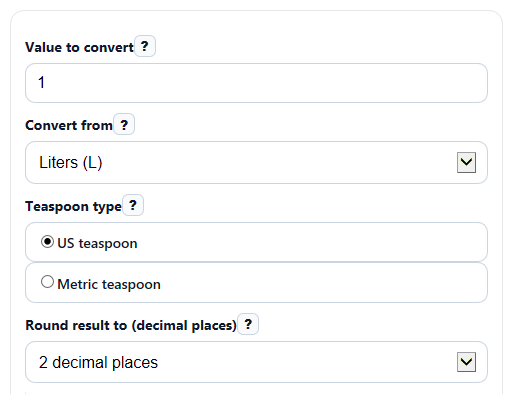
- Enter your number in Value to convert.
- Pick the starting unit in Convert from, then choose Teaspoon type so the calculator uses the right teaspoon size.
- If you want a different display style, change Round result to to 0, 1, 2, 3, or 6 decimal places.
- Click Calculate to see Converted amount, Kitchen-friendly result, Factor used, and Teaspoon standard used.
- Sanity-check the answer by looking at Factor used: 1 liter should be about 202.88 US tsp or exactly 200 metric tsp, so a very different result usually means the wrong direction or teaspoon type was chosen.
Definitions
Liter (L): A metric volume unit equal to 1000 milliliters [1].
Teaspoon (tsp): A small volume unit used in cooking and labels. Its size depends on the standard you choose.
US teaspoon: A teaspoon equal to 4.92892159375 milliliters in this calculator.
Metric teaspoon: A teaspoon equal to 5 milliliters in this calculator.
Conversion factor: The number the calculator multiplies by to switch from one unit to the other.
Kitchen-friendly result: A rounded version of the main answer that is easier to read for everyday measuring.
Common mistakes and quick fixes
Mistake: Entering a number in Value to convert but leaving the direction wrong in Convert from .
Fix: If your starting amount is liters, choose Liters (L) . If your starting amount is teaspoons, choose Teaspoons (tsp) .
Mistake: Using US teaspoon when your recipe or label expects metric teaspoons.
Fix: Check Teaspoon type before you calculate. The Teaspoon standard used result confirms which one was applied.
Mistake: Thinking Kitchen-friendly result is the exact same as Converted amount .
Fix: Use Converted amount for more precise work, and use Kitchen-friendly result for rough measuring in cooking.
Mistake: Choosing too few digits in Round result to and losing detail on a small conversion.
Fix: Switch Round result to to 3 or 6 decimal places when the amount is tiny or you need more precision.
Mistake: Treating a negative Converted amount as a physical volume.
Fix: A negative result usually means a signed change, like removing volume, not an actual container amount.
Limitations & Key Assumptions / Boundary Conditions
- This converter uses only two teaspoon standards: US teaspoon and metric teaspoon. If a recipe uses another local convention, results can differ.
- The math is a pure unit conversion. It does not account for measuring spoon error, ingredient density, packing, or meniscus reading.
- Negative values are allowed for math consistency, but they usually mean a signed change in volume rather than a physical amount.
- The Kitchen-friendly result is rounded for readability, so use Converted amount when you need more exact mixing.
- Very small or very large values are still converted directly, but practical kitchen measuring may not match the displayed precision.
Methodology
How the conversion works
The calculator first picks the teaspoon size from Teaspoon type, then converts between liters, milliliters, and teaspoons. It uses 1 liter = 1000 milliliters [1].
US tsp from liters = L x (1000 / 4.92892159375)
Liters from US tsp = tsp x (4.92892159375 / 1000)
Metric tsp from liters = L x (1000 / 5)
Liters from metric tsp = tsp x (5 / 1000)
Factor used in results
If you convert from liters to US teaspoons, the factor is about 202.884136211 tsp per liter. If you convert from liters to metric teaspoons, the factor is exactly 200 tsp per liter. The reverse direction uses the inverse factor in liters per teaspoon.
Worked mini-example
Example: convert 1 liter using US teaspoon. Divide 1000 mL by 4.92892159375 mL per tsp.
1 x (1000 / 4.92892159375) = 202.884136211 tsp
If Round result to is set to 2 decimal places, the Kitchen-friendly result becomes 202.88 tsp.
Rounding and display choices
Converted amount is calculated from the full internal value. Kitchen-friendly result is the same conversion rounded to your chosen number of decimal places. This keeps the main math consistent while giving you an easier reading for cooking.
Assumptions and limits
This method assumes the selected teaspoon standard is correct for your recipe or label. Real measuring spoons, pouring technique, and ingredient handling can cause small real-world differences even when the unit conversion is exact.