
Estimate your starter replacement bill by itemizing parts, labor, fees, tax, core money, refunds, and credits.
Table of contents
How to use our Starter Replacement Cost Calculator
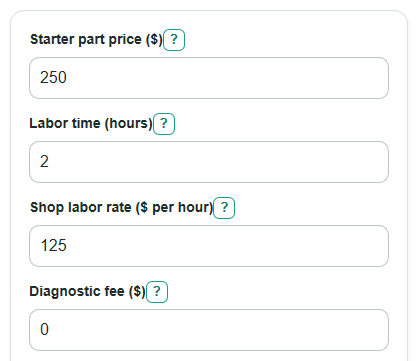
- Enter the Starter part price ($), Labor time (hours), Shop labor rate ($ per hour), and any Diagnostic fee ($) from the estimate.
- If you have a full shop total, enter it in Shop quote to compare ($) so the calculator can show whether the quote is above or below your itemized estimate.
- Open Advanced options when your quote lists shop supplies, sales tax, a core charge, an expected core refund, or a warranty, coupon, or shop credit.
- Check Final cost after expected refund for the long-term cost, then check Estimated amount due now for what you may need at pickup.
- Sanity-check the result by comparing Labor charge to the labor line on your estimate and by making sure tax and core money are not entered twice.
Definitions
Starter part price ($): The price of the replacement starter before tax, labor, and added fees.
Labor time (hours): The billed repair time, not the number of hours your vehicle is parked at the shop.
Shop labor rate ($ per hour): The shop's hourly charge for technician labor.
Diagnostic fee ($): A charge for testing the no-start problem before parts are replaced.
Shop supplies fee: An added fee for supplies or environmental costs, calculated here as a percent of parts plus labor.
Sales tax (percent): The tax rate used on the taxable base selected in Tax applies to.
Core charge paid now ($): A temporary deposit connected to the old starter; it may be refunded after the old starter is returned [1].
Expected core refund ($): The amount you expect to get back later from the core charge.
Quote compared with this estimate: The shop quote minus the calculator's final cost after refund; positive means the quote is higher.
Common mistakes and quick fixes
Mistake: Entering the total repair quote in Starter part price ($) .
Fix: Put only the starter part line in Starter part price ($) and use Shop quote to compare ($) for the full quote.
Mistake: Using the time the car stays at the shop for Labor time (hours) .
Fix: Enter the billed repair time shown on the estimate in Labor time (hours) .
Mistake: Leaving Shop labor rate ($ per hour) blank because the quote only lists a labor total.
Fix: Divide the labor total by Labor time (hours) , then enter that hourly amount in Shop labor rate ($ per hour) .
Mistake: Subtracting the refund from Core charge paid now ($) before entering it.
Fix: Enter the full deposit in Core charge paid now ($) and the later refund in Expected core refund ($) .
Mistake: Choosing the wrong Tax applies to setting when labor is not taxed on the quote.
Fix: Match Tax applies to to your estimate, often Part price and supply fee if only parts and fees are taxed.
Mistake: Putting a discount into Diagnostic fee ($) as a negative number.
Fix: Keep Diagnostic fee ($) at the actual fee and enter the discount in Warranty, coupon, or shop credit ($) .
Limitations & Key Assumptions / Boundary Conditions
- The calculator estimates a starter replacement quote. It does not diagnose whether the starter is actually the failed part.
- Tax rules vary by state and by invoice setup, so Sales tax (percent) and Tax applies to must match the written estimate.
- Actual labor time can change if the starter is hard to reach or if other parts must be removed first.
- The result does not include extra repairs such as battery cables, ignition switch work, flywheel damage, towing, storage, or rental car costs unless you add them through the available fee fields.
- Expected core refund ($) assumes the old starter is accepted for refund. A damaged, missing, or late core return can reduce or remove that refund.
- Final cost after expected refund is blocked if refunds and credits make the total negative, because a negative repair cost is not realistic.
Methodology
How the estimate is built
The calculator follows the same basic structure used in most starter estimates: starter part price plus labor, then added fees, tax, deposits, refunds, and credits. Published starter replacement ranges can be broad because part price and labor access vary by vehicle [2].
labor_charge = labor_hours * labor_rate
shop_supplies_fee = (part_price + labor_charge) * shop_supplies_percent / 100
If Tax applies to is Part price and supply fee, the calculator taxes only the starter part and shop supplies fee.
sales_tax = (part_price + shop_supplies_fee) * sales_tax_percent / 100
If Tax applies to is All repair items, the calculator taxes the part, labor, diagnostic fee, and shop supplies fee.
sales_tax = (part_price + labor_charge + diagnostic_fee + shop_supplies_fee) * sales_tax_percent / 100
amount_due_now = part_price + labor_charge + diagnostic_fee + shop_supplies_fee + sales_tax + core_charge_paid - credit_amount
final_cost_after_refund = amount_due_now - core_refund_expected
quote_gap = quote_total - final_cost_after_refund
taxes_and_shop_fees = shop_supplies_fee + sales_tax
core_net_effect = core_charge_paid - core_refund_expected
Mini example
Suppose the starter part is $320, labor time is 3.5 hours, the shop labor rate is $150 per hour, the diagnostic fee is $85, shop supplies are 3%, sales tax is 8.25% on the part and supply fee, the core charge is $75, and the expected core refund is $75. Labor is 3.5 * $150 = $525. Shop supplies are ($320 + $525) * 3% = $25.35. Sales tax is ($320 + $25.35) * 8.25% = $28.49. The estimated amount due now is $1,058.84, and the final cost after the expected $75 refund is $983.84.
Input checks
Money and percent fields must be zero or positive. Blank required fields, invalid numbers, negative values, unsupported tax choices, and a negative final repair cost stop the calculation. The optional quote comparison is shown only when Shop quote to compare ($) is entered.