
Choose the brake work and wheel location to estimate brake pad replacement cost, then compare an optional matching shop quote.
Table of contents
How to use our Brake Pad Replacement Cost Calculator
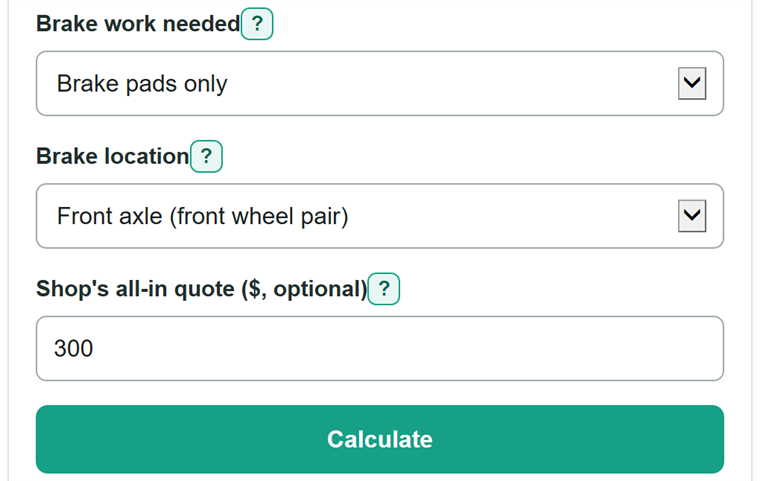
- Choose Brake work needed from the inspection note or repair estimate. Select pads and rotors only when rotor replacement is included.
- Choose Brake location. Front or rear means one wheel pair; both axles means all four wheels.
- If you have a written estimate, enter the shop's final all-in quote. Leave it blank if you only need a planning estimate.
- Select Calculate. Read the estimated brake service cost, then use the lower and upper planning estimates as the possible range.
- Before judging a quote, make sure it covers the same work and axle count you selected. A quote that includes rotors, taxes, or extra repairs cannot be fairly compared with a pads-only estimate.
Definitions
Axle: The front pair or rear pair of wheels. Both axles means all four wheels.
Brake pads: Friction parts that press against the rotors to slow the vehicle.
Brake rotors: Metal discs attached to the wheels. Rotor replacement is separate from pads-only work.
Planning estimate: A broad cost range for budgeting, not a price promised by a specific shop.
All-in quote: The full total quoted by a shop for the repair, including any listed parts, labor, taxes, and fees.
Midpoint: The value halfway between the lower and upper planning estimates. The estimated brake service cost uses this value.
Common mistakes and quick fixes
Mistake: Treating one axle as one wheel.
Fix: Check Brake work needed and then recalculate. Choose front or rear for a pair of wheels. Choose both axles only for all four wheels.
Mistake: Selecting pads only when the shop estimate includes new rotors.
Fix: Check Brake work needed and then recalculate. Choose brake pads and rotors so the estimate covers the listed repair scope.
Mistake: Comparing a quote for both axles with a one-axle estimate.
Fix: Make Brake location match the wheel pairs included in the shop quote before comparing totals.
Mistake: Treating the estimated brake service cost as a guaranteed shop price.
Fix: Check Brake work needed and then recalculate. Use the lower and upper planning estimates for budgeting, then get a written estimate for your vehicle.
Mistake: Assuming a negative shop quote difference is an error.
Fix: Check Brake work needed and then recalculate. A negative difference means the entered quote is below the estimated midpoint.
Mistake: Entering a quote with commas in the wrong places, such as 1,00.
Fix: Check Brake work needed and then recalculate. Use a plain amount such as 1000 or standard grouping such as 1,000.00.
Limitations & Key Assumptions / Boundary Conditions
- The range is a broad US planning estimate for professional brake service, not a vehicle-specific quote.
- The calculation uses the same per-axle range for front and rear brakes, although actual parts and labor can differ by vehicle and axle.
- Only pads-only and pads-and-rotors service are included. Calipers, brake fluid service, resurfacing, sensors, seized hardware, and other repairs are excluded.
- The shop quote comparison uses the planning-range midpoint. It is useful only when the quote has the same repair scope and axle count.
- Local labor rates, taxes, shop supplies, disposal fees, part quality, warranty coverage, and vehicle design can change the final invoice.
Methodology
Cost calculation
The calculator uses a broad US planning range of $150 to $350 per axle for brake pads only and $250 to $500 per axle for brake pads and rotors. Front-only and rear-only work count as one axle. Both-axle work counts as two axles.
axle_count = 2 for both axles; otherwise 1
lower_total = selected_lower_per_axle * axle_count
upper_total = selected_upper_per_axle * axle_count
estimated_brake_service_cost = (lower_total + upper_total) / 2
Quote comparison
If an all-in shop quote is entered, the calculator subtracts the estimated midpoint from that quote. A positive result means the quote is above the midpoint. A negative result means it is below the midpoint.
shop_quote_difference = shop_quote_total - estimated_brake_service_cost
shop_quote_percent_difference = shop_quote_difference / estimated_brake_service_cost * 100
Worked example
For pads only on the front axle, the range is $150 to $350. The midpoint is $250. A matching all-in quote of $300 is $50 above the midpoint, or 20% higher.
Calculation choices
The calculator multiplies the planning range by the number of serviced axles. It does not multiply a shop's all-in quote, because that quote is already a total.