
Estimate how many solar panels you need to cover EV charging, with optional battery storage for overnight charging plans.
Table of contents
How to use our Solar Panels Needed for EV Charging Calculator
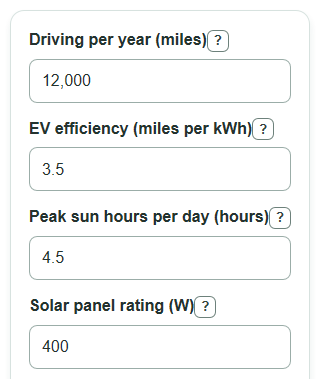
- Enter Driving per year in miles. Use your expected EV miles, not your total household driving if some miles are in a gas car.
- Enter EV efficiency, Peak sun hours per day, and Solar panel rating. If your EV shows kWh per 100 miles, divide 100 by that number to get miles per kWh.
- Choose Charging setup. Pick grid-tied for annual energy offset, daytime solar only if you plan to plug in while the sun is producing, or solar plus battery if charging will use stored solar energy.
- Open Advanced options only if you want to change Solar system loss, Battery coverage, or Battery round-trip efficiency.
- Click Calculate, then sanity-check the result: more miles, lower EV efficiency, fewer sun hours, smaller panels, higher losses, or battery mode should not reduce the panels needed.
Definitions
kWh: Kilowatt-hour, a unit of electrical energy. EV driving energy and solar production are both counted in kWh.
EV efficiency: How many miles the car drives on 1 kWh. A higher number means less electricity is needed for the same miles.
Peak sun hours per day: The average number of full-strength sun hours your panels receive in one day. It is not the same as total daylight hours.
Solar panel rating: The DC watt rating of one solar panel under standard test conditions.
Solar system loss: The percent of possible panel energy not delivered as usable output because of real-world effects such as heat, inverter loss, wiring, and dirt.
Battery round-trip efficiency: The percent of energy you get back after storing energy in a battery and using it later.
Usable battery storage needed: The battery energy available for EV charging after the battery's allowed usable range is considered. It can be lower than the battery nameplate capacity.
kW DC: Kilowatts of direct-current solar panel nameplate size. It equals panel count times panel watts divided by 1,000.
Common mistakes and quick fixes
Mistake: Entering daily miles in Driving per year .
Fix: Multiply daily miles by 365, then enter the yearly miles.
Mistake: Typing kWh per 100 miles into EV efficiency .
Fix: Use miles per kWh. If the car says 28 kWh per 100 miles, enter 100 / 28 = 3.57.
Mistake: Using daylight hours for Peak sun hours per day .
Fix: Use peak sun hours, which means average full-strength sun hours per day, not sunrise-to-sunset time.
Mistake: Entering total system size in Solar panel rating .
Fix: Enter the watt rating of one panel, such as 400, not the total watts for all panels.
Mistake: Choosing Daytime solar only and assuming the car can charge at night.
Fix: Check Driving per year and then recalculate. Choose Solar plus battery if you want the estimate to include stored energy for charging when the sun is not out.
Mistake: Setting Battery round-trip efficiency to 100 when real battery charging and discharging has losses.
Fix: Use a realistic percent, or keep the default if you do not have a battery spec sheet yet.
Limitations & Key Assumptions / Boundary Conditions
- The result is a planning estimate, not a final solar design. Roof shape, panel direction, tilt, shade, snow, equipment limits, and local code can change the installed panel count.
- Peak sun hours per day must come from a local solar estimate or a trusted rough average. A small change in this input can change the panel count.
- Grid-tied with net metering treats yearly solar production as an energy offset. It does not model utility bill rules, time-of-use rates, export credits, or monthly true-ups.
- Daytime solar only covers annual energy, but it does not prove the EV will be plugged in during solar production or that the charger can use all available solar power.
- Solar plus battery assumes EV charging energy passes through the battery and uses Battery round-trip efficiency to add extra solar energy for battery loss.
- Usable battery storage needed is not the same as battery nameplate capacity. Real systems may need more nameplate kWh because batteries often reserve some capacity.
- The calculator uses 365 days per year and a steady daily average. It does not model weekday driving, trips, seasonal solar swings, or changing EV efficiency in cold weather.
Methodology
Calculation steps
The calculator first turns yearly driving into EV electricity use. Electricity use is measured in kilowatt-hours, or kWh [3].
EV electricity needed per year = Driving per year / EV efficiency
Average EV electricity needed per day = EV electricity needed per year / 365
Next it estimates how much usable energy one panel makes in a year from panel watts, peak sun hours, and the solar system loss percent.
Annual energy from one panel = (Solar panel rating / 1000) * Peak sun hours per day * 365 * (1 - Solar system loss / 100)
The solar energy target is the yearly EV electricity need for grid-tied and daytime solar setups. In solar plus battery mode, the target is higher because some energy is lost while charging and discharging the battery.
Solar energy target per year = EV electricity needed per year
Battery mode solar energy target per year = EV electricity needed per year / (Battery round-trip efficiency / 100)
The panel count rounds up because you cannot install a fraction of a panel.
Solar panels needed for EV charging = ceiling(Solar energy target per year / Annual energy from one panel)
Array size and extra yearly production are then calculated from the rounded panel count.
Solar array size from panel count = Solar panels needed for EV charging * Solar panel rating / 1000
Extra solar production after EV charging target = Solar panels needed for EV charging * Annual energy from one panel - Solar energy target per year
When Charging setup is solar plus battery, usable storage is based on average daily EV electricity and the selected number of battery coverage days.
Usable battery storage needed = Average EV electricity needed per day * Battery coverage
Mini-example
For 12,000 miles per year, 3.5 miles per kWh, 4.5 peak sun hours per day, 400 W panels, and 14.08 percent solar system loss, EV electricity is 12,000 / 3.5 = 3,428.57 kWh per year. One panel makes about (400 / 1000) * 4.5 * 365 * (1 - 14.08 / 100) = 564.49 kWh per year. In grid-tied mode, 3,428.57 / 564.49 = 6.07, so the calculator rounds up to 7 panels. Those 7 panels equal 2.8 kW DC and make about 522.89 kWh more than the EV charging target because the panel count is rounded up.