
Calculate pasture area per move or time between moves, then check paddock count, recovery time, and available grazeable acres.
Table of contents
How to use our Rotational Grazing Paddock Size and Move Frequency Calculator
- Choose whether to find paddock size or move timing, then choose how you will enter forage.
- Enter the herd's Number of animals, Average live weight, and Dry matter intake from current herd and ration records.
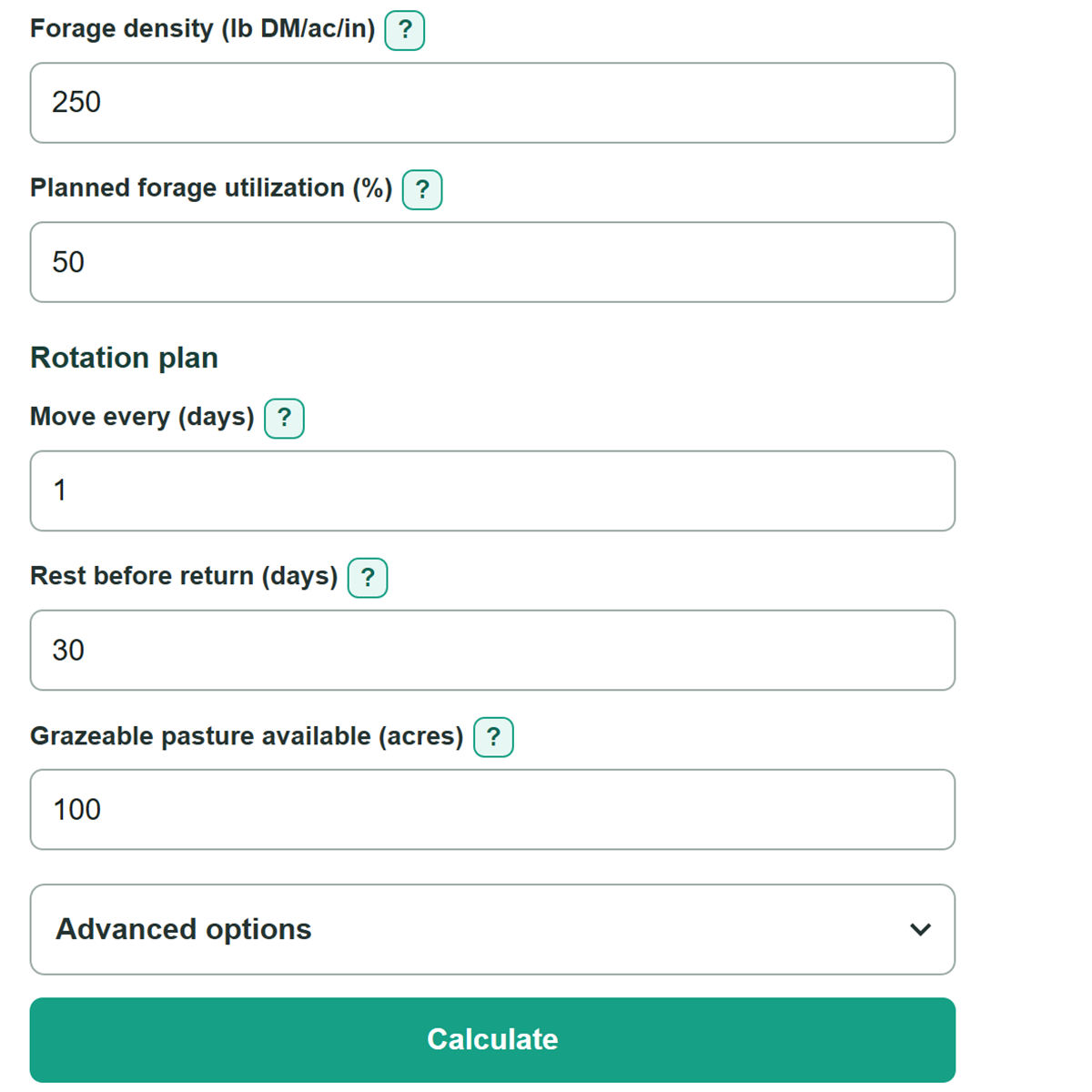
- Enter either Move every or Known paddock area, then add Rest before return, Grazeable pasture available, and Planned forage utilization.
- Enter either measured Forage canopy height and Forage density, or a direct Forage inventory. Add Supplemental feed dry matter or Extra forage reserve only if they apply.
- Check the Grazeable acreage balance: a positive number means the entered pasture covers this plan, while a negative number shows the acres short.
Definitions
Dry matter (DM): Feed weight after its water is removed. The calculator uses lb DM so forage supply and herd demand use the same basis.
Dry matter intake: The share of an animal's live weight eaten as dry matter each day, entered as a percent.
Forage inventory: Standing forage dry matter per acre before Planned forage utilization and Extra forage reserve reduce it.
Forage density: Dry matter per acre for each inch of forage canopy height, entered as lb DM/ac/in.
Planned forage utilization: The share of standing forage planned for livestock use.
Extra forage reserve: An additional share held out after utilization to allow for uncertainty or changing conditions.
Rest before return: Recovery time after livestock leave a paddock and before they return.
Grazeable acreage balance: Grazeable pasture available minus total rotation area required. A negative balance is a shortfall.
Common mistakes and quick fixes
Mistake: Entering wet forage weight as Forage inventory.
Fix: Enter dry matter per acre in Forage inventory, labeled lb DM/ac, not as-fed or wet forage weight.
Mistake: Using total farm acres for Grazeable pasture available.
Fix: Exclude woods, ponds, lanes, buildings, and sacrifice areas from Grazeable pasture available.
Mistake: Treating Rest before return as the same thing as Move every.
Fix: Use Move every for time livestock stay in one paddock and Rest before return for pasture recovery time.
Mistake: Entering total lb DM/ac in Forage density.
Fix: Forage density must be lb DM/ac/in; use Forage inventory instead if you already have total dry matter per acre.
Mistake: Counting hay or grain twice.
Fix: Put only the dry-matter part of non-pasture feed in Supplemental feed dry matter (lb DM/day for the herd).
Mistake: Reading a negative Grazeable acreage balance as zero.
Fix: A negative Grazeable acreage balance is an acreage shortfall for the entered plan.
Limitations & Key Assumptions / Boundary Conditions
- This is a forage-budget planning calculation, not a guarantee of animal performance or pasture regrowth.
- Forage inventory depends on representative field measurements. Canopy height and forage density can vary across species, season, moisture, and pasture areas.
- The calculation treats herd weight, dry matter intake, forage inventory, utilization, supplemental feed, and reserve as constant during the rotation.
- Planned forage utilization and Extra forage reserve are separate reductions. Changing either one changes usable forage and the required area.
- The minimum paddock count is a mathematical minimum for the entered Rest before return. Fence layout, water access, lanes, uneven paddock shape, and management flexibility can require more paddocks.
- A zero Rest before return is allowed by the formula and produces one paddock, but it does not describe a recovery-based rotation.
- If supplemental feed equals herd dry-matter demand, no pasture allocation is required. Move timing cannot be calculated from a zero pasture demand.
Methodology
Calculation method
First, the calculator estimates the herd's daily dry-matter need from head count, average live weight, and Dry matter intake. Supplemental feed dry matter is then subtracted because it is supplied outside the pasture.
herd_dm_demand_lb_day = animal_count * average_weight_lb * dmi_percent / 100
pasture_dm_demand_lb_day = herd_dm_demand_lb_day - supplemental_dm_lb_day
Forage inventory comes from the selected entry method. Measured forage multiplies average canopy height by the matching density estimate; direct forage uses the entered inventory.
forage_inventory_lb_ac = canopy_height_inches * forage_density_lb_ac_in
usable_forage_lb_ac = forage_inventory_lb_ac * utilization_percent / 100 * (1 - reserve_percent / 100)
To find paddock size, daily pasture demand is multiplied by time between moves and divided by usable forage per acre. To find move timing, known paddock acres are multiplied by usable forage per acre and divided by daily pasture demand.
paddock_size_acres = pasture_dm_demand_lb_day * calculated_move_days / usable_forage_lb_ac
calculated_move_days = entered_paddock_acres * usable_forage_lb_ac / pasture_dm_demand_lb_day
The paddock count includes the paddock currently being grazed, so it is one more than the rest-period ratio rounded up.
minimum_paddocks = ceil(rest_days / calculated_move_days) + 1
total_acres_required = paddock_size_acres * minimum_paddocks
acreage_balance_acres = grazeable_acres - total_acres_required
Worked example
A herd of 50 animals at 1,200 lb each and 2.5% Dry matter intake needs 1,500 lb DM/day. With 6 inches of forage and 250 lb DM/ac/in, inventory is 1,500 lb DM/ac. At 50% Planned forage utilization and no reserve, usable forage is 750 lb DM/ac. A one-day move therefore needs 2 acres. With 30 rest days, the calculation needs 31 paddocks, 62 total acres, and leaves a positive 38-acre balance from 100 grazeable acres.
Calculation boundaries
The calculator blocks a supplemental amount above herd demand, zero utilization, a reserve of 100% or more, and nonpositive active forage inputs. It keeps decimal move times during the paddock-count calculation and keeps a negative acreage balance visible instead of changing it to zero.