
Calculate cubic log volume with Smalian, Huber, or Newton measurements, then estimate gross value from a matching buyer rate.
Table of contents
How to use our Log Volume and Value Calculator
- Choose the Volume method named on your scale ticket, buyer instructions, or assignment.
- Enter Log length (feet) and Extra log length (inches), using the same scaling-length rule as the buyer quote.
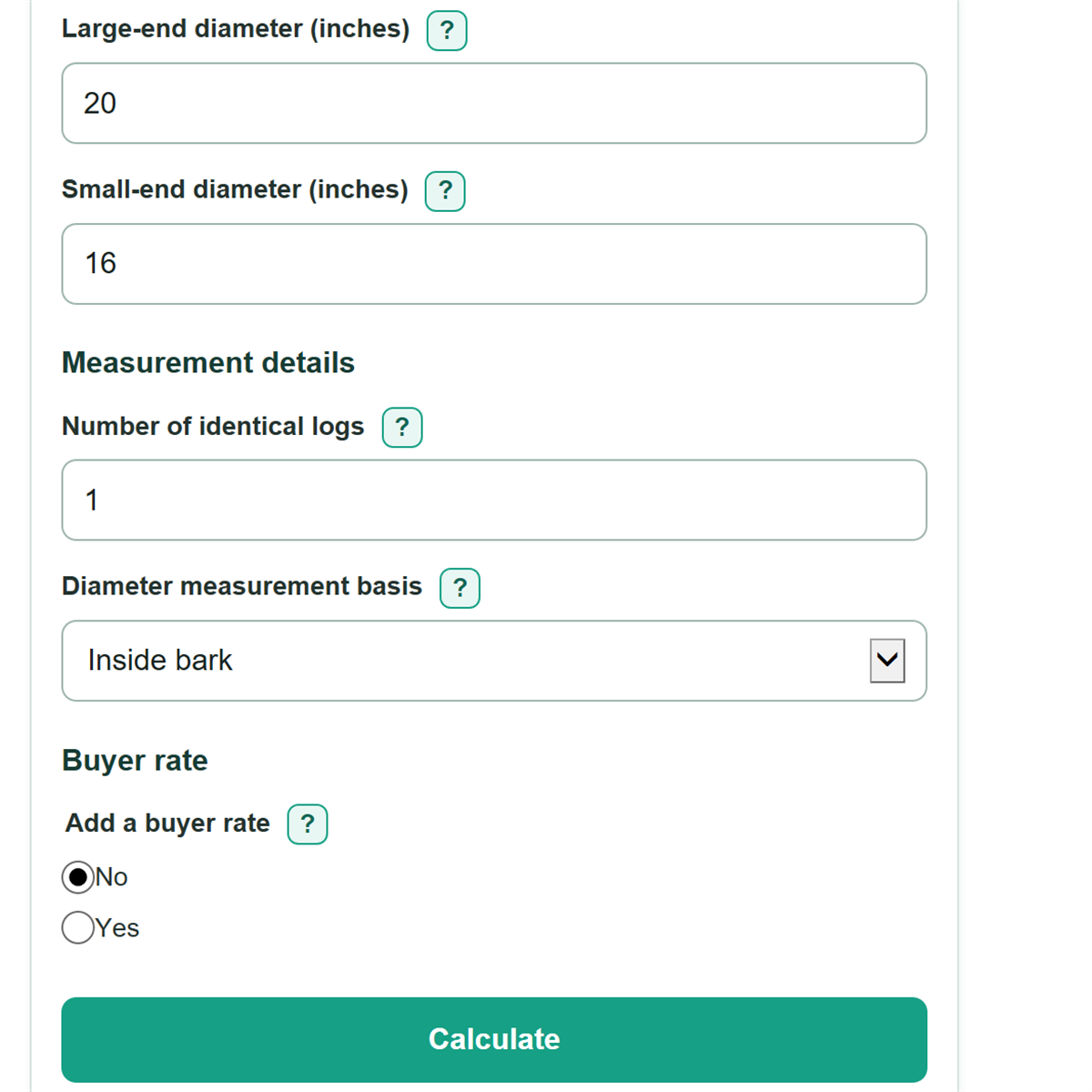
- Enter only the diameter measurements shown for your method, choose the Diameter measurement basis, and enter the Number of identical logs.
- Choose Yes for Add a buyer rate only if your quote is per cubic foot, per cunit, or per identical log; then enter Buyer rate ($ per selected unit) and Buyer rate basis.
- Check that Total selected-method volume is cubic feet, not board feet, and confirm the displayed method and bark basis match your measurements before using the estimate.
Definitions
Smalian method: Finds volume from the average of the large-end and small-end cross-sectional areas, multiplied by length.
Huber method: Finds volume from the cross-sectional area at the physical midpoint, multiplied by length.
Newton method: Uses both end areas and the midpoint area; the midpoint area receives four times the weight in the formula.
Cross-sectional area: The area of a circular cut across the log, measured here in square feet.
Diameter measurement basis: Inside bark excludes bark thickness. Outside bark includes it. The calculator records the basis but does not convert between them.
Cubic foot (ft3): A volume unit equal to a space one foot long, one foot wide, and one foot high.
Cunit: A forestry volume unit equal to 100 cubic feet.
Gross log value: The entered buyer rate multiplied by its matching volume or log quantity before deductions.
Common mistakes and quick fixes
Mistake: Entering a tape length that includes trim when the buyer uses a shorter scaling length.
Fix: Use the length basis required by the quote in Log length (feet) and Extra log length (inches).
Mistake: Using the small-end diameter where Large-end diameter (inches) is requested, or the reverse.
Fix: Measure each end separately and enter it under its matching label.
Mistake: Choosing Huber or Newton without a true midpoint measurement.
Fix: Enter Midpoint diameter (inches) from the physical halfway point and choose Estimated in Midpoint diameter source if it was not measured directly.
Mistake: Applying a board-foot, MBF, ton, or cord quote as Buyer rate ($ per selected unit).
Fix: Use only a compatible quote and select Per cubic foot, Per cunit (100 cubic feet), or Per identical log in Buyer rate basis.
Mistake: Multiplying one set of measurements by Number of identical logs for a mixed load.
Fix: Use a quantity greater than 1 only for logs with the same entered length and diameters; calculate other measurement sets separately.
Mistake: Mixing inside-bark and outside-bark diameters in one calculation.
Fix: Use one consistent basis for every diameter and select the matching Diameter measurement basis.
Limitations & Key Assumptions / Boundary Conditions
- The calculation treats each log as a solid shape with circular cross sections. Crook, sweep, oval ends, defects, voids, and irregular shape can make an actual scale differ.
- The selected method uses only its required measurements: Smalian uses both ends, Huber uses the midpoint, and Newton uses both ends plus the midpoint.
- Inside-bark and outside-bark diameters produce different volumes. No bark-thickness estimate or conversion is applied.
- The entered length is used exactly as entered. The calculator does not remove trim, round length, or apply a regional scaling rule.
- Number of identical logs multiplies one measurement set. Do not use it for logs with different lengths or diameters.
- Estimated gross log value excludes hauling, loading, scaling, brokerage, taxes, and all other deductions. It is not net proceeds.
- Buyer rates per board foot, MBF, ton, or cord cannot be applied because this calculator produces geometric cubic volume and does not make those conversions.
Methodology
Calculation steps
The calculator changes feet plus inches into decimal feet, then calculates the circular area for each diameter needed by the selected method. Diameter is entered in inches and area is converted to square feet.
L = feet + inches / 12
A = π × d2 / (4 × 144)
In these formulas, L is log length in feet, A is cross-sectional area in square feet, and d is diameter in inches.
Smalian volume = L × (A_large + A_small) / 2
Huber volume = L × A_mid
Newton volume = L × (A_large + 4 × A_mid + A_small) / 6
The selected per-log volume is multiplied by Number of identical logs for Total selected-method volume. Total selected-method volume in cunits is cubic feet divided by 100.
Total cubic volume = per-log volume × quantity
Total cunit volume = total cubic volume / 100
If Add a buyer rate is Yes, gross value uses the matching basis: cubic feet times a per-cubic-foot rate, cunits times a per-cunit rate, or log count times a per-identical-log rate.
Gross value = matching quantity × buyer rate
Worked example
For one 16-foot-6-inch log with a 20-inch large end and 16-inch small end, Smalian volume is about 29.52 cubic feet. Three identical logs total about 88.55 cubic feet. At $2.50 per cubic foot, the estimated gross value is about $221.38.
Calculation choices
Only diameter fields required by the selected method are used. A midpoint marked Estimated remains part of the formula, but the result identifies that the midpoint was estimated. A larger number entered as the large end than the small end is expected in many logs; if the large end is smaller, the calculator keeps the entered math and prompts you to check the end labels.