
Compare the estimated cost of repairing your current car or replacing it over the same number of years.
Advanced options
Fuel costs are added only when all four fields are entered. This fuel detail supports gasoline MPG, not electric energy use.
Calculation details
Table of contents
How to use our Repair vs Replace Car Lifetime Cost Calculator
- Choose Cash purchase or Finance for the replacement car.
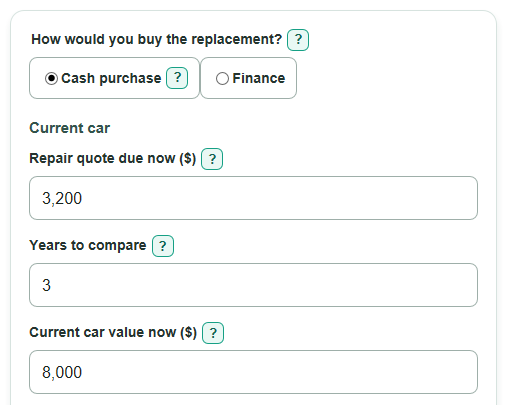
- Enter the shop total in Repair quote due now, then set Years to compare to the time you expect to keep either car.
- Enter each car's current or purchase value, estimated value at the end, and maintenance per year. Use the full Replacement out-the-door price, not just the advertised price.
- For a replacement purchase, enter Net sale or trade proceeds. In Finance mode, also enter Cash down payment, Replacement loan APR, and Replacement loan term.
- Check the Cost advantage of repairing and both lifetime costs. Change uncertain end values or maintenance estimates to see whether the lower-cost choice stays the same.
Definitions
Out-the-door price: The full replacement-car purchase total, including applicable taxes, title, registration, and dealer fees.
Net sale or trade proceeds: Cash or trade credit available after selling or trading the current car and paying any loan payoff. It can differ from Current car value now.
Current-car disposition gap: Current car value now minus net sale or trade proceeds. It keeps the two choices on the same economic basis when a payoff, selling cost, or trade amount makes those values different.
Value loss: Value now or purchase price minus estimated value at the end of the comparison period. A negative value loss means the entered end value is higher.
APR: Annual percentage rate, the yearly borrowing rate used to calculate auto-loan interest. [1]
Monthly equivalent: Lifetime cost divided by the number of months compared. It is a planning comparison, not a scheduled loan payment.
Break-even repair quote: The highest immediate repair quote that makes repairing and replacing have the same estimated lifetime cost, with all other entries unchanged.
Common mistakes and quick fixes
Mistake: Entering the advertised vehicle price instead of the full Replacement out-the-door price.
Fix: Use the buyer's order total, including tax, title, registration, and dealer fees.
Mistake: Using Current car value now as Net sale or trade proceeds.
Fix: Enter the cash or trade credit left after any current loan payoff in Net sale or trade proceeds.
Mistake: Adding the Repair quote due now again to Current car maintenance per year.
Fix: Put the quoted repair in Repair quote due now once. Use Current car maintenance per year for routine future spending.
Mistake: Comparing only a replacement payment with the repair bill.
Fix: In Finance mode, enter Cash down payment, Replacement loan APR, and Replacement loan term so the calculator can include interest and show the Replacement loan balance at the end.
Mistake: Filling in only some fuel fields.
Fix: To include fuel, enter Miles driven per year, Current car fuel economy, Replacement car fuel economy, and Gas price. Leave all four blank to exclude fuel.
Mistake: Treating a negative Cost advantage of repairing as an error.
Fix: A negative amount means replacing is estimated to cost less over the selected years.
Limitations & Key Assumptions / Boundary Conditions
- This is a planning comparison, not a safety, reliability, or transportation-need assessment. A car with unsafe conditions or frequent breakdowns may need replacement even when repairing costs less.
- Results depend on your estimates for Current car value at the end, Replacement car value at the end, Net sale or trade proceeds, and yearly maintenance. Change these estimates to test the decision.
- Fuel costs are included only for gasoline vehicles when all four fuel inputs are completed. Electric vehicle charging costs and mixed fuel types are outside this calculator.
- Insurance, fuel price, and maintenance can change over time. The calculator applies each entered annual amount and gas price across the full comparison period.
- Finance mode includes interest paid during the selected years and shows the remaining loan balance separately. It does not add loan principal again because vehicle value loss already measures the asset cost.
- Taxes, registration, and dealer fees are included only when they are part of the entered Replacement out-the-door price.
Methodology
Same-horizon comparison
Both choices use the same whole-number Years to compare. The calculator estimates costs that are used up during that period, rather than comparing a one-time repair bill with only a monthly payment.
comparison months = years to compare * 12
current car value loss = current car value now - current car value at the end
replacement car value loss = replacement out-the-door price - replacement car value at the end
current-car disposition gap = current car value now - net sale or trade proceeds
Lifetime costs
The repair choice includes the immediate quote once, other likely current-car repairs when entered, value loss, yearly maintenance, yearly insurance when entered, and optional fuel cost.
repair choice lifetime cost = repair quote due now + other likely current-car repairs + current car value loss + current car maintenance per year * years + current car insurance per year * years + current fuel cost
The replacement choice includes the current-car disposition gap, replacement value loss, maintenance, insurance when entered, optional fuel cost, and finance interest when Finance is selected. This accounts for any current-car value not recovered in net proceeds. Loan principal is not added as a separate cost because it becomes vehicle equity reflected by the end value.
replacement choice lifetime cost = current-car disposition gap + replacement car value loss + replacement car maintenance per year * years + replacement car insurance per year * years + replacement fuel cost + financing interest
cost advantage of repairing = replacement choice lifetime cost - repair choice lifetime cost
A positive cost advantage means repairing costs less. A negative amount means replacing costs less.
Fuel and financing
Fuel is included only if Miles driven per year, both MPG values, and Gas price are all entered. This keeps an incomplete fuel comparison from changing the answer.
fuel cost = miles driven per year / MPG * gas price * years to compare
For Finance, the financed amount is the out-the-door price minus net sale or trade proceeds and cash down payment. Monthly interest is based on APR divided by 12, and payments are applied until the comparison ends or the loan is paid off. Auto-loan comparisons should consider more than the monthly payment because term, rate, and total financing cost can differ. [1]
amount financed = replacement out-the-door price - net sale or trade proceeds - cash down payment
monthly rate = replacement loan APR / 1200
financing interest = payments made during comparison - principal repaid during comparison
Worked example
With a $3,200 repair quote, $8,000 current value, $4,000 current end value, and $1,200 yearly maintenance for 3 years, the repair choice is $10,800 before optional costs. With $7,000 in net sale proceeds, a $30,000 cash replacement, $22,000 end value, and $600 yearly maintenance, the replacement choice is also $10,800. The $1,000 difference between current value and net proceeds is included, so the example is a tie.
$10,800 = $3,200 + ($8,000 - $4,000) + ($1,200 * 3)
$10,800 = ($8,000 - $7,000) + ($30,000 - $22,000) + ($600 * 3)
$0 = $10,800 - $10,800