
Compare selling your home now with renting it out, then selling later, using cash flow, mortgage, cost, and growth assumptions.
Advanced options
Growth and sale assumptions
Rental costs
Mortgage details
Tax and reinvestment assumptions
Conservative and optimistic changes
| Scenario | Home growth | Rent growth | Rent-then-sell advantage |
|---|
| Year | Rent collected | Owner costs and fees | Mortgage paid | Rental cash flow | Home value | Mortgage balance | Rent-then-sell wealth | Sell-now wealth |
|---|
Table of contents
How to use our Rent vs Sell Calculator
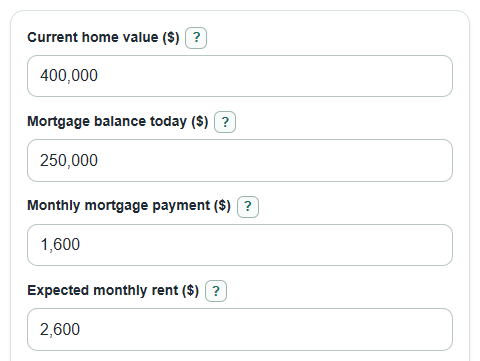
- Enter Current home value, Mortgage balance today, Monthly mortgage payment, Expected monthly rent, and Years before you sell.
- Open Advanced options if you want to change Home price growth, Rent growth, owner costs, selling costs, taxes, mortgage rate, or scenario changes.
- Click Calculate to see the Base rent-then-sell advantage, the Gap between best and worst scenario, and the Conservative and Optimistic results.
- Review the Year-by-year rent and wealth table to see rent collected, cash flow, home value, mortgage balance, and the wealth comparison for each year.
- Sanity-check the output: if rent, home value growth, or selling costs are guesses, try lower and higher inputs and see whether the decision still points the same way.
Definitions
Current home value: The sale price you think the home could get today before selling costs.
Mortgage balance today: The unpaid amount you still owe on the home loan. A mortgage is a loan secured by the home [4].
Expected monthly rent: The rent you expect to charge before empty time, management fees, and repair reserves.
Home price growth: The yearly percent change used to estimate the home's future sale value.
Rent growth: The yearly percent change used to estimate future rent.
Percentage points: A direct add-on to a percent rate. If Base Home price growth is 3 percent and Conservative home growth change is -1 percentage point, the Conservative rate is 2 percent.
Rental cash flow: Rent collected minus management fees, repairs, owner costs, mortgage payments, and tax on positive rental cash flow.
Rent-then-sell advantage: Rent-then-sell wealth minus sell-now wealth. Positive favors renting then selling. Negative favors selling now.
Common mistakes and quick fixes
Mistake: Entering the original loan amount in Mortgage balance today.
Fix: Use the unpaid balance from your latest mortgage statement.
Mistake: Putting taxes, insurance, or HOA dues into Monthly mortgage payment and again into Taxes, insurance, and HOA.
Fix: Use principal and interest for Monthly mortgage payment when possible, then put yearly owner costs in Taxes, insurance, and HOA.
Mistake: Using take-home rent after fees as Expected monthly rent.
Fix: Enter the full rent before vacancy, Property management fee, and Repairs and maintenance.
Mistake: Reading a negative Base rent-then-sell advantage as an error.
Fix: Negative means selling now is higher by that dollar amount under the Base assumptions.
Mistake: Setting Home price growth or Rent growth below -100 percent.
Fix: Use a rate greater than -100 percent, because values cannot compound through a 100 percent loss in this model.
Mistake: Ignoring the Gap between best and worst scenario when it is large.
Fix: Treat a large gap as a sign that small changes in growth assumptions can change the rent-or-sell decision.
Limitations & Key Assumptions / Boundary Conditions
- This is an estimate for comparing two choices. It is not tax, legal, investment, or real estate advice.
- The model uses yearly rent growth and home price growth. Real rent, sale prices, and repair costs can change unevenly.
- Taxes are simplified. Tax on positive rental cash flow and Tax on home price gain when sold later use the rates you enter and do not model deductions, depreciation, exclusions, passive loss limits, or state rules.
- Mortgage results are estimated from Mortgage balance today, Monthly mortgage payment, Mortgage interest rate, and Mortgage months left. Adjustable-rate loans, escrow changes, fees, and loan modifications are not modeled.
- Selling costs are entered as percent inputs. Actual agent commissions, concessions, transfer taxes, and closing costs may be fixed, negotiated, or location-specific.
- The sell-now money is grown with one Return on money if sold now. It does not model market volatility, taxes on investment returns, or different risk levels.
- Holding period is whole years. The calculator does not split partial years or month-by-month rent changes.
- Negative cash flow and negative sell-now proceeds stay negative. A negative sell-now value means selling could require cash to close before any investment return is applied.
Methodology
Core comparison
The calculator compares projected wealth at the end of Years before you sell. One path sells now and grows the net proceeds. The other path rents the home, tracks cash flow and mortgage balance, then sells at the end of the holding period.
sale_now_net = Current home value * (1 - Selling cost if you sell now / 100) - Mortgage balance today
Base wealth if you sell now = sale_now_net * (1 + Return on money if sold now / 100) ^ Years before you sell
Mortgage and rental cash flow
Each month, mortgage interest is added to the loan balance, the actual payment is subtracted, and the final payment is capped so the balance does not go below zero when the payment is enough to pay the loan off. If the monthly payment is less than or equal to the first month's interest, the balance can grow and the calculator shows Estimate warning.
monthly_rate = Mortgage interest rate / 100 / 12
interest_due = starting_balance * monthly_rate
ending_balance = starting_balance + interest_due - actual_payment
For each year, rent is grown from Expected monthly rent, then reduced for Expected empty time. Management and repair costs are based on collected rent. Positive rental cash flow can be reduced by Tax on positive rental cash flow, but rental losses stay negative.
collected_rent = Expected monthly rent * 12 * (1 + Rent growth / 100) ^ (year - 1) * (1 - Expected empty time / 100)
aftertax_cash_flow = collected_rent - fees - Taxes, insurance, and HOA - mortgage_paid - rental_tax
Rent then sell wealth
Future home value is based on Current home value and Home price growth. Future sale costs, remaining mortgage, estimated capital gains tax, startup costs, and accumulated rental cash flow are included in rent-then-sell wealth.
future_home_value = Current home value * (1 + Home price growth / 100) ^ Years before you sell
taxable_gain = max(0, future_home_value - Original purchase price)
Base wealth if you rent then sell = future_home_value - remaining_mortgage - future_sale_cost - capital_gains_tax + cash_account
Base rent-then-sell advantage = Base wealth if you rent then sell - Base wealth if you sell now
Scenario comparison
Base uses the growth rates you enter. Conservative and Optimistic add the scenario change inputs to Home price growth and Rent growth. The Gap between best and worst scenario is the highest rent-then-sell advantage minus the lowest rent-then-sell advantage.
scenario_home_growth = Home price growth + scenario home growth change
scenario_rent_growth = Rent growth + scenario rent growth change
Gap between best and worst scenario = max(all three advantages) - min(all three advantages)
Mini example
If Current home value is $400,000, Mortgage balance today is $250,000, Selling cost if you sell now is 7 percent, and Return on money if sold now is 0 percent, selling now starts with $400,000 * 0.93 - $250,000 = $122,000. If the Base wealth if you rent then sell after the holding period is $155,000, the Base rent-then-sell advantage is $155,000 - $122,000 = $33,000, so the Base case favors renting then selling by $33,000.
Calculation choices
Money inputs may include commas. Percent inputs are divided by 100 before math. Growth and return rates must be greater than -100 percent. The year-by-year table uses whole years, and negative cash flow remains signed so the comparison includes cash you may need to add during the rental years.
Sources
- What is a mortgage? | Consumer Financial Protection Bureau - Consumerfinance
- Rent vs. Buy Comparison: Methodology - Zillow Research - Zillow
- Measuring Price Change in the CPI: Rent and Rental Equivalence : U.S. Bureau of Labor Statistics - BLS
- Is It Cheaper to Rent or Buy a Home? Comparing the Costs | The Motley Fool - FOOL