
Use this photography lighting calculator to find manual flash aperture, distance, flash power, or guide number for a shot.
Table of contents
How to use our Photography Lighting Calculator
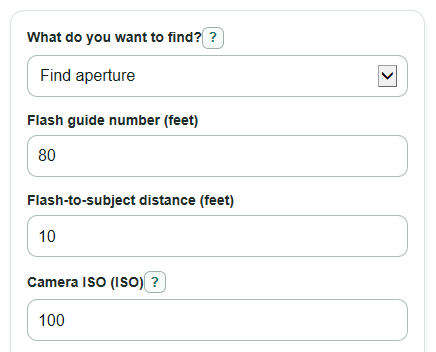
- Choose What do you want to find? so the calculator knows which manual flash setting is missing.
- Enter the known values, such as Flash guide number, Flash-to-subject distance, Aperture, Camera ISO, and Flash power setting.
- Open Advanced options if you need to set Distance unit for distance and guide number, Guide number rating ISO, Light lost to modifier, rounding, or Number display format.
- Select Calculate, then use Best setting first and Closest camera-friendly setting if your camera or flash cannot dial the exact value.
- Sanity-check the result: if Full-power amount needed is over 100% or Power room left is negative, the setup needs more light, a wider aperture, higher ISO, a closer flash, or less modifier loss.
Definitions
Guide number: A flash strength number. In the basic guide-number rule, guide number equals f-number times flash-to-subject distance for a stated ISO [2].
Flash-to-subject distance: The distance from the flash head to the subject, not always the distance from the camera.
Aperture: The f-number, such as 5.6 for f/5.6. A smaller f-number lets in more flash light.
Camera ISO: The camera sensitivity setting used for the shot. Higher ISO needs less flash light for the same aperture and distance.
Flash power setting: The manual flash output fraction. Full power is 1/1, 1/2 power is one stop less light, and 1/4 power is two stops less light.
Light lost to modifier: Light removed by a softbox, umbrella, gel, bounce, grid, or similar item. One stop means half the light reaches the subject.
Effective guide number after ISO, power, and light loss: The guide number after the calculator adjusts for Camera ISO, Flash power setting, and Light lost to modifier.
Power room left: The spare flash power in stops. Positive means extra power is available. Negative means the setup needs more than full power.
Common mistakes and quick fixes
Mistake: Using Flash guide number in feet while Flash-to-subject distance is measured in meters.
Fix: Set Distance unit for distance and guide number to the same unit used by both numbers, or re-enter both values in the new unit.
Mistake: Measuring Flash-to-subject distance from the camera when the flash is off-camera.
Fix: Measure from the flash head to the subject, then enter that value in Flash-to-subject distance.
Mistake: Entering f/5.6 or f 5.6 in Aperture.
Fix: Enter only the f-number, such as 5.6, in Aperture.
Mistake: Leaving Guide number rating ISO at 100 when the flash manual gives a guide number rated at ISO 200 or ISO 400.
Fix: Enter the manual's rating in Guide number rating ISO so the effective guide number is corrected.
Mistake: Ignoring Light lost to modifier when using a softbox, umbrella, gel, bounce, or grid.
Fix: Add the loss in stops under Light lost to modifier, or test the setup if the exact loss is unknown.
Mistake: Treating a negative Power room left as a bug.
Fix: A negative Power room left means the requested Aperture and Flash-to-subject distance need more than full power.
Limitations & Key Assumptions / Boundary Conditions
- The math is for manual flash exposure using guide numbers. It does not model TTL flash metering, ambient light, high-speed sync behavior, flash duration, or camera brand exposure choices.
- Flash guide number, Flash-to-subject distance, and Distance unit for distance and guide number must match. Changing the unit does not magically change the meaning of numbers you already typed.
- Published guide numbers are often measured under ideal direct-flash conditions. Real output can change with zoom head position, bounce angle, batteries, temperature, and manufacturer test methods.
- Light lost to modifier is only as accurate as the stop loss you enter. A large softbox, double diffusion, colored gel, or bounce can need a test shot or light meter reading.
- Shutter speed is not included because the guide-number formula handles flash exposure, not ambient exposure. Stay within your camera's flash sync limits.
- Closest camera-friendly setting is rounded from the exact math. If a rounded power suggestion is over full power, it is a warning, not a usable flash setting.
Methodology
Core idea
A guide number is used to connect flash strength, aperture, and distance. The common direct-flash rule is:
guide_number = f_number * distance
The calculator first normalizes the entered Flash guide number to ISO 100 when Guide number rating ISO is not 100:
GN100 = GN_input / sqrt(GN_rating_ISO / 100)
It then adjusts for Camera ISO, Flash power setting, and Light lost to modifier:
GN_eff = GN100 * sqrt(camera_ISO / 100) * sqrt(power_fraction) * 2^(-modifier_loss_stops / 2)
Solving the missing setting
For Best setting, the calculator uses the formula that matches What do you want to find?. Hidden mode fields are not read for that mode.
f_number = GN_eff / distance
distance = GN_eff / f_number
power_fraction_needed = (f_number * distance / (GN100 * sqrt(camera_ISO / 100) * 2^(-modifier_loss_stops / 2)))^2
GN_input_needed = (f_number * distance / (sqrt(camera_ISO / 100) * sqrt(power_fraction) * 2^(-modifier_loss_stops / 2))) * sqrt(GN_rating_ISO / 100)
Full-power amount needed is the power fraction times 100. Power room left is:
power_margin_stops = -log2(power_fraction_needed)
This sign is intentional. A value of 2 means two stops of spare power. A value of -2 means the setup needs four times full power.
Rounding for real camera settings
If Round camera setting to is not Exact math only, the calculator rounds the exact answer to common stop spacing for the displayed Closest camera-friendly setting. The exact Best setting is still kept as the main answer.
rounded_f = 2^(round(log2(f_number^2) * steps_per_stop) / steps_per_stop / 2)
rounded_power = 2^(round(log2(power_fraction) * steps_per_stop) / steps_per_stop)
Mini example
Suppose Flash guide number is 80, Flash-to-subject distance is 10 feet, Camera ISO is 100, Flash power setting is full power, and Light lost to modifier is 0 stops. The effective guide number is 80, so the aperture is:
f_number = 80 / 10 = 8
Best setting is f/8. If the same setup loses 1 stop in a modifier, the effective guide number becomes about 56.57, so the aperture becomes about f/5.66.