
Estimate the electricity cost for one oven use, an average month, and a year from your oven power, time, and rate.
Table of contents
How to use our Oven Running Cost Calculator
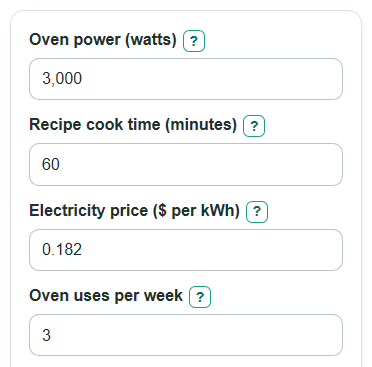
- Enter Oven power (watts). If your oven label lists amps and volts instead, multiply amps by volts to estimate watts.
- Enter Recipe cook time (minutes), Electricity price ($ per kWh), and Oven uses per week. Use the total kWh price from your electric bill if you have it.
- Open Advanced options only if you want to include Warm-up time (minutes) or adjust Heating element on time (percent) for an oven that cycles on and off.
- Select Calculate, then read Estimated cost for one oven use first. Use Estimated cost per month and Estimated cost per year for budgeting.
- Sanity-check Oven-on time used in the estimate and Electricity used for one oven use. If the time, kWh, or cost looks too high, check whether warm-up time or heating-on percent was entered twice or set too high.
Definitions
Watt: A unit of power. For this calculator, Oven power (watts) is how fast the oven can use electricity at its rated power.
Kilowatt: 1 kilowatt equals 1,000 watts.
kWh: Kilowatt-hour. It measures electricity used over time, which is why power bills often price electricity as dollars per kWh [3].
Electricity price ($ per kWh): The amount you pay for each kilowatt-hour. Your bill may call this an energy charge, supply charge, or total effective rate.
Heating element on time (percent): The share of oven-on time treated as full-power heating. A thermostat-controlled oven may cycle the heating element on and off.
Oven-on time used in the estimate: The total minutes counted in the estimate, equal to recipe cook time plus warm-up time.
Common mistakes and quick fixes
Mistake: Entering oven size or temperature in Oven power (watts) instead of wattage.
Fix: Use the watts from the oven label or manual, or estimate watts by multiplying amps by volts.
Mistake: Putting the full time from turning the oven on into Recipe cook time (minutes) and also entering the same preheat in Warm-up time (minutes) .
Fix: Put food cooking time in Recipe cook time (minutes) and preheat time only in Warm-up time (minutes) .
Mistake: Entering cents, such as 18.2, in Electricity price ($ per kWh) when the field needs dollars.
Fix: Enter 18.2 cents as 0.182.
Mistake: Setting Heating element on time (percent) to 40 because the oven is set to 40 percent of its maximum temperature.
Fix: Use this field only for the share of time the heating element is actually on; leave 100 if you do not know.
Mistake: Counting dishes instead of cooking sessions in Oven uses per week .
Fix: Count each time you turn the oven on as one use, even if you cook more than one dish.
Mistake: Reading Estimated cost per month as the exact charge on your bill.
Fix: Treat it as an average based on 52 weeks divided by 12 months, before taxes, fees, and seasonal changes in use.
Limitations & Key Assumptions / Boundary Conditions
- The calculator estimates electric oven energy only. It does not include gas ovens, range-top burners, microwave use, or kitchen heat loss.
- Oven power (watts) is treated as the rated power when the heating element is on. Actual draw can change by oven model, temperature setting, convection fan use, and door openings.
- Heating element on time (percent) is a user estimate. Leaving it at 100 percent gives a simple high-side estimate for many ovens, but it may overstate real use if the oven cycles often.
- Electricity price ($ per kWh) should include the cost you want to compare against. Bills may also include fixed monthly fees, taxes, delivery charges, demand charges, or time-of-use rates.
- Estimated cost per month uses 52 weeks divided by 12 months, so a real calendar month can differ.
- Estimated cost per year assumes the same Oven uses per week all year.
- If Oven-on time used in the estimate is 0 minutes, the cost and kWh results are 0 because no oven-on time was entered.
Methodology
Core method
The calculator uses the standard appliance-cost method: convert watts to kilowatts, multiply by time in hours to get kWh, then multiply by the electricity price. Electricity use over time is measured in watt-hours or kilowatt-hours [2].
total_minutes = cook_time_minutes + warmup_time_minutes
active_hours = (total_minutes / 60) * (heating_on_percent / 100)
kwh_per_use = (oven_power_watts / 1000) * active_hours
cost_per_use = kwh_per_use * electricity_rate_per_kwh
monthly_cost = cost_per_use * uses_per_week * 52 / 12
yearly_cost = cost_per_use * uses_per_week * 52
cost_per_oven_on_hour = (oven_power_watts / 1000) * (heating_on_percent / 100) * electricity_rate_per_kwh
Worked mini-example
For a 3,000 watt oven, 60 minutes of recipe cook time, 10 minutes of warm-up time, an electricity price of $0.182 per kWh, 3 uses per week, and 100 percent heating element on time, the total oven-on time is 70 minutes. Active heating time is 70 / 60 = 1.1667 hours. Electricity used is 3,000 / 1,000 * 1.1667 = 3.5 kWh. The estimated cost for one oven use is 3.5 * $0.182 = $0.637, which rounds to about $0.64. The monthly estimate is $0.637 * 3 * 52 / 12 = about $8.28, and the yearly estimate is about $99.37.
How to read the outputs
Estimated cost for one oven use is the main session cost. Electricity used for one oven use shows the energy amount behind that cost. Cost for 1 hour with these settings lets you scale a recipe up or down without re-entering every value. Estimate note explains the biggest accuracy choice, especially when the heating-on percent is left at 100.