
Estimate your dishwasher cost per run, month, and year using the energy number you have and your local utility price.
Table of contents
How to use our Dishwasher Running Cost Calculator
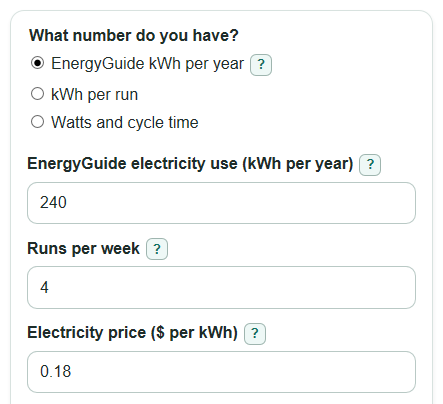
- Choose What number do you have? based on the energy information you can find: EnergyGuide electricity use (kWh per year), Electricity used each run (kWh), or Power while running (watts) with Cycle length (hours).
- Enter Runs per week and Electricity price ($ per kWh). If your bill shows cents per kWh, divide by 100 before entering it.
- Open Advanced options only if you want a fuller running cost. Add Water used each run (gallons), Water plus sewer price ($ per 1,000 gallons), and Soap and rinse aid cost ($ per run) if you know them.
- Click Calculate and read Estimated yearly running cost first, then check Cost for one run and Estimated monthly running cost for everyday budgeting.
- Sanity-check the result: if Electricity used in one year is far above your EnergyGuide label even though you run the dishwasher only a few times per week, recheck Runs per week, Electricity price ($ per kWh), and the selected energy method.
Definitions
kWh: A kilowatt-hour is the electricity used by 1,000 watts running for 1 hour. Electric bills usually charge by kWh [1].
EnergyGuide electricity use (kWh per year): The yearly electricity estimate from the yellow EnergyGuide label. The label is meant to help compare appliance energy use and operating cost [2].
Electricity price ($ per kWh): The amount you pay for each kWh of electricity. Use the total per-kWh price from your bill when possible.
Runs per week: The number of full dishwasher cycles you run in a typical week.
Water plus sewer price ($ per 1,000 gallons): Your combined water and sewer charge for 1,000 gallons, used only when both water fields are entered.
Cost for one run: The estimated cost of one dishwasher cycle, including electricity and any optional water or soap costs you entered.
Common mistakes and quick fixes
Mistake: Entering cents in Electricity price ($ per kWh), such as 18 instead of 0.18.
Fix: Divide cents by 100, so 18 cents becomes 0.18 in Electricity price ($ per kWh).
Mistake: Choosing EnergyGuide electricity use (kWh per year) and then entering your own yearly use after already adjusting for Runs per week.
Fix: Enter the label value in EnergyGuide electricity use (kWh per year); the calculator adjusts it using Runs per week.
Mistake: Using Power while running (watts) from a heater rating instead of average running power.
Fix: If you do not know average watts, use EnergyGuide electricity use (kWh per year) or Electricity used each run (kWh) instead.
Mistake: Filling Water used each run (gallons) but leaving Water plus sewer price ($ per 1,000 gallons) blank.
Fix: Enter both water fields, or clear both fields to leave water cost out.
Mistake: Comparing Estimated yearly running cost from one run setting with Cost for one run from another setting.
Fix: Recalculate each cycle type with matching Electricity used each run (kWh), Cycle length (hours), and Soap and rinse aid cost ($ per run).
Limitations & Key Assumptions / Boundary Conditions
- EnergyGuide mode divides the label kWh per year by 215 cycles per year, then scales it to your Runs per week. Your real cycle choice, soil level, and heated dry setting can change the result.
- The Watts and cycle time method is rough because dishwashers do not use the same power for the whole cycle. Heaters, pumps, and drying stages turn on and off.
- Electricity price ($ per kWh) should include the supply and delivery charges you pay per kWh. Fixed monthly utility fees are not included.
- Water and sewer cost is included only when both Water used each run (gallons) and Water plus sewer price ($ per 1,000 gallons) are entered.
- Soap and rinse aid cost is a simple per-run add-on. It does not account for sales tax, bulk discounts, half-tablets, or different detergent amounts by cycle.
- The monthly result is a yearly average divided by 12. It will not match every monthly bill if your use changes by season or month.
Methodology
How the calculator chooses energy per run
The calculator first turns your selected energy entry into kWh per run. Watts measure power at one moment, while watt-hours and kWh measure electricity used over time [1].
runs_per_year = runs_per_week * 52
kwh_per_run = annual_kwh / 215
kwh_per_run = entered_kwh_per_run
kwh_per_run = (power_watts / 1000) * cycle_hours
The EnergyGuide method uses 215 cycles per year for dishwasher label scaling [4]. The watts method uses 1,000 watts per kilowatt [1].
How costs are calculated
After kWh per run is known, the calculator multiplies by your Electricity price ($ per kWh). Optional water and soap costs are added per run only when you enter those fields.
electricity_cost_per_run = kwh_per_run * electricity_rate
water_cost_per_run = (water_gallons_per_run * water_sewer_rate) / 1000
cost_per_run = electricity_cost_per_run + water_cost_per_run + soap_cost_per_run
yearly_total_cost = cost_per_run * runs_per_year
monthly_total_cost = yearly_total_cost / 12
yearly_electricity_kwh = kwh_per_run * runs_per_year
Mini-example
If the EnergyGuide label says 240 kWh per year, the calculator estimates 240 / 215 = 1.116 kWh per run. At 4 runs per week and $0.18 per kWh, yearly runs are 4 * 52 = 208, electricity use is 1.116 * 208 = 232.19 kWh per year, and electricity cost is about $41.79 per year. With no water or soap costs entered, Estimated yearly running cost is the same $41.79.
Rounding and validation
Money is rounded to cents for display, while calculations keep more precision until the final output. The calculator reads only the energy fields for the selected method, allows 0 Runs per week, requires Electricity price ($ per kWh) to be greater than 0, and requires both water fields together if water cost is used.