
Convert US fluid ounces to quarts fast, or switch to weight ounces and use an ingredient or density so the answer makes sense.
Advanced options
Table of contents
How to use our Ounces to Quarts Converter
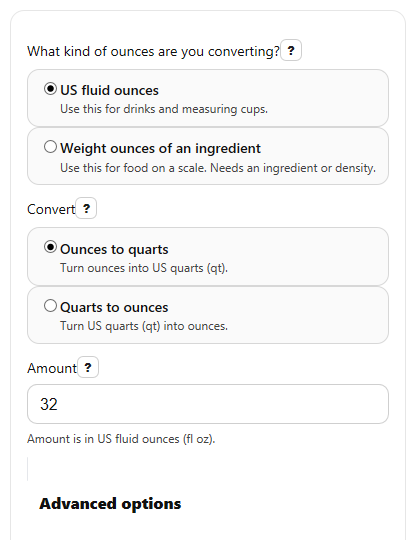
- Choose What kind of ounces are you converting? Pick US fluid ounces for liquid volume, or Weight ounces of an ingredient for food weight.
- Set Convert to Ounces to quarts or Quarts to ounces, then enter your Amount.
- If you picked weight ounces, choose Ingredient input. Use Common ingredient and pick an Ingredient, or use Custom density (g/mL) if you know it.
- Open the advanced section only if you want to change Number display or Decimal places (optional), then click Calculate.
- Check Converted amount first, then read Conversion rule used and Important note to make sure you used the right kind of ounce and US units.
Definitions
US fluid ounce: A unit of volume for liquids. In this converter, 32 US fluid ounces equal 1 US quart.
Weight ounce: A unit of mass or weight. It tells how heavy something is, not how much space it takes up.
US quart: A US volume unit equal to 32 US fluid ounces.
Density (g/mL): How much 1 milliliter of a substance weighs in grams. Higher density means the same volume weighs more.
Ingredient: The food or liquid used for weight conversions, such as water, milk, oil, flour, or sugar.
Kitchen-friendly amount: A rounded cooking-style hint, such as about 1/2 qt or 1 1/4 qt, shown only when the result is close to a simple fraction.
Common mistakes and quick fixes
Mistake: Leaving What kind of ounces are you converting? on US fluid ounces when your recipe means weight ounces.
Fix: Switch to Weight ounces of an ingredient before using Amount .
Mistake: Entering quarts in Amount while Convert is still set to Ounces to quarts .
Fix: Change Convert to Quarts to ounces if your starting value is in quarts.
Mistake: Using Ingredient values for flour or sugar when you really have a liquid measured in US fluid ounces .
Fix: For volume-only liquid conversions, use US fluid ounces mode and ignore ingredient settings.
Mistake: Choosing Custom density in Ingredient input but leaving Custom density (g/mL) blank or at 0.
Fix: Enter a density greater than 0 in Custom density (g/mL) .
Mistake: Reading only Converted amount and missing why the answer changed in weight mode.
Fix: Also read Ingredient note and Conversion rule used to see which density was used.
Mistake: Expecting the same answer for US and Imperial units.
Fix: Use the Important note card as a reminder that this converter uses US quarts and US fluid ounces.
Limitations & Key Assumptions / Boundary Conditions
- This converter uses US units only. US quarts and US fluid ounces are not the same as Imperial units.
- Weight-ounce conversions depend on density. If the ingredient is packed, sifted, warm, cold, or measured differently, the real result can change.
- Preset ingredient values are estimates meant for practical kitchen use, so different brands or conditions can give slightly different answers.
- Custom density (g/mL) must be greater than 0 for weight-mode calculations.
- Negative values are allowed for math, but they usually describe a signed change rather than a real physical amount.
- Kitchen-friendly amount appears only when the result is very close to a common fraction, so it will not show for every conversion.
Methodology
How the converter decides which formula to use
If you choose US fluid ounces, the calculator treats ounces as volume and converts directly to or from US quarts.
If you choose Weight ounces of an ingredient, the calculator treats ounces as weight and uses the selected ingredient density or your Custom density (g/mL) to connect weight and volume.
Formulas
US quarts = US fluid ounces / 32
US fluid ounces = US quarts x 32
US quarts = weight ounces / (density in g/mL x 33.3814022702)
weight ounces = US quarts x density in g/mL x 33.3814022702
What the constants mean
The fluid conversion uses the US volume rule that 1 US quart equals 32 US fluid ounces [1].
The weight conversion uses the factor 33.3814022702, which tells you how many weight ounces fit in 1 US quart when density is 1 g/mL.
Mini examples
Fluid example: if Amount is 12 and you choose US fluid ounces plus Ounces to quarts, the result is 12 / 32 = 0.375 US quarts.
0.375 qt = 12 fl oz / 32
Weight example: if Amount is 33.3814022702, you choose Weight ounces of an ingredient, and Custom density (g/mL) is 1.00, the result is 1 US quart.
1 qt = 33.3814022702 oz / (1.00 x 33.3814022702)
How extra outputs are chosen
Also equals gives a nearby kitchen unit to save time. For quart results, that may be pints or cups. For fluid-ounce results, it may restate the liquid amount in a familiar way.
Kitchen-friendly amount appears only when the decimal result is close to a common cooking fraction, so the hint stays useful instead of misleading.
Assumptions behind the result
This method assumes US customary volume units, not Imperial units. In weight mode, the result is only as good as the ingredient density used, so real kitchen measurements can differ a little from the estimate.