
Enter a pressure in mmHg or psi to convert it to the other unit while keeping the same pressure reference.
Advanced options
Table of contents
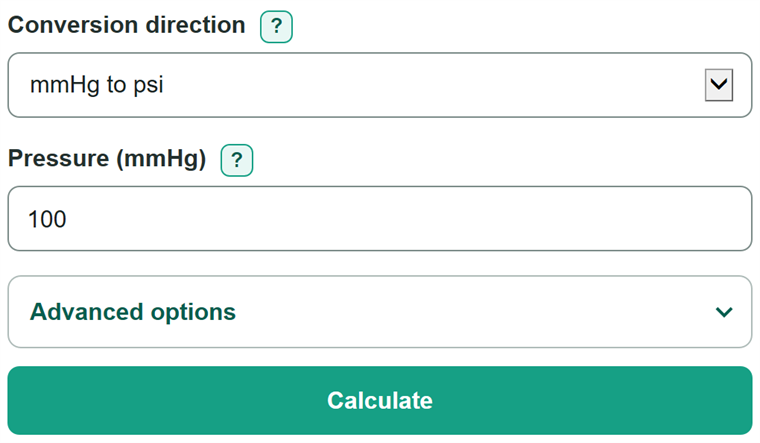
How to use our mmHg to PSI Converter
- Choose the direction that matches the unit shown beside your source pressure reading.
- Enter the pressure from a gauge, monitor, report, worksheet, or specification. You may type the matching unit after the number.
- Open Advanced options if you need a different number of decimal places in the displayed answer.
- Select Calculate, then check that the result uses the unit you need and that any reading you compare it with has the same pressure reference.
Definitions
mmHg: Millimeters of mercury, a unit of pressure used on some medical, vacuum, and weather readings.
psi: Pounds per square inch, a pressure unit used on many US gauges and technical specifications.
Pressure reference: The zero point for a pressure reading. Gauge pressure, absolute pressure, and vacuum-relative pressure can have different zero points.
Decimal places: Digits shown to the right of the decimal point. Changing this setting changes visible rounding, not the conversion.
Common mistakes and quick fixes
Mistake: Choosing mmHg to psi but entering a reading labeled psi.
Fix: Change the conversion direction or enter a value in the selected starting unit.
Mistake: Typing a unit suffix that conflicts with the selected direction, such as "100 psi" when the starting unit is mmHg.
Fix: Remove the suffix or use the unit that matches the selected starting unit.
Mistake: Using a comma as a decimal mark, such as "1,01".
Fix: Use a decimal point for decimals, such as "1.01". Use commas only for thousands, such as "1,000".
Mistake: Comparing a converted gauge reading with an absolute-pressure reading.
Fix: Check the pressure reference on both readings. Converting units does not change the zero point.
Mistake: Treating a rounded display as the exact converted value.
Fix: Select more decimal places when your worksheet, instrument, or report requires more detail.
Limitations & Key Assumptions / Boundary Conditions
- This tool converts pressure units only. It does not convert gauge pressure to absolute pressure, absolute pressure to gauge pressure, or vacuum-relative pressure to another reference.
- The converted value keeps the uncertainty of the source measurement. More displayed decimal places do not make the original reading more precise.
- Signed values are accepted because gauge or differential pressure can be negative. The conversion preserves the sign.
- Zero is a valid pressure value and converts to zero.
- A number by itself does not identify its pressure reference. Check the source label before comparing readings.
Methodology
Conversion method
The calculator uses a fixed factor of 0.0193367747043 psi per mmHg.
pressure in psi = pressure in mmHg x 0.0193367747043
pressure in mmHg = pressure in psi / 0.0193367747043
Worked example
For 100 mmHg, multiply 100 by 0.0193367747043. The unrounded answer is 1.93367747043 psi. With four decimal places selected, the displayed answer is 1.9337 psi.
The calculator keeps the unrounded converted value and rounds only for display. A source value of 0 converts to 0, and a negative source value stays negative.