
Enter minutes to see their decimal-month equivalent using an average Gregorian month or a specific calendar month and year.
Table of contents
How to use our Minutes to Months Converter
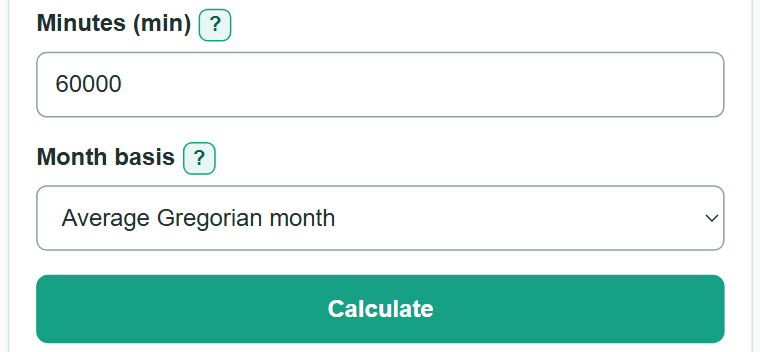
- Enter the duration in "Minutes (min)." You can use decimals, conventional commas such as 60,000, or a suffix such as "60000 min."
- Keep "Average Gregorian month" for a general conversion based on 30.436875 days per month.
- Select "Selected calendar month" when a report, deadline, or contract refers to a particular month.
- Choose the calendar month and enter its year. The year is needed because February can have 28 or 29 days.
- Select "Calculate."
- Read "Minutes converted to months" as a fraction or multiple of the stated month basis. Check "Minutes in the active month basis" to confirm the divisor used.
Definitions
Decimal months: A duration written as a fraction or multiple of the chosen month length. For example, 1.5 means one and one-half chosen months.
Average Gregorian month: One-twelfth of an average Gregorian year. This converter uses 30.436875 days, or 43,829.1 minutes.
Selected calendar month: The full length of one named month in one named year, from 28 to 31 days.
Leap year: In the Gregorian calendar, a year divisible by 4 is a leap year, except a century year must also be divisible by 400.
Common mistakes and quick fixes
Mistake: Treating every month as the same number of minutes.
Fix: Use "Average Gregorian month" for a general duration, or choose "Selected calendar month" when a particular month is named.
Mistake: Entering 1,01 to mean one point zero one minutes.
Fix: Use a decimal point for decimals, such as 1.01. Use commas only as thousands separators, such as 60,000.
Mistake: Leaving out the year for February.
Fix: Enter the actual calendar year. February has 29 days in a Gregorian leap year and 28 days otherwise.
Mistake: Treating the selected-month result as elapsed time between dates.
Fix: This converter divides by the full length of the selected month. Use date arithmetic for time between two dates.
Limitations & Key Assumptions / Boundary Conditions
- This converter accepts nonnegative durations only. It does not represent time before a reference point.
- The average basis uses 43,829.1 minutes per month. Actual calendar months contain 40,320, 41,760, 43,200, or 44,640 minutes.
- A selected calendar-month result is a fraction of that month's full length. It does not calculate elapsed time between dates, use a start date, or count calendar boundaries.
- Calendar calculations support Gregorian years from 1582 through 9999. The entered year changes February's length; other month lengths do not change by year.
- The displayed months value is rounded to nine decimal places. The calculation uses the unrounded entered value.
Methodology
Month length
For "Average Gregorian month," the converter divides an average Gregorian year of 365.2425 days into 12 equal parts. This gives 30.436875 days, or 43,829.1 minutes, per average month.
average_month_minutes = (365.2425 / 12) * 1440 = 43829.1
For "Selected calendar month," the converter uses the full number of days in the chosen month. February has 29 days in a Gregorian leap year and 28 days in other years.
is_leap_year = year % 400 == 0 ? 1 : (year % 100 == 0 ? 0 : (year % 4 == 0 ? 1 : 0))
calendar_month_minutes = selected_month_days * 1440
Conversion
The converter divides entered minutes by the active month length, then rounds only the displayed answer.
months = minutes / month_basis_minutes
Worked example
With the average setting, 60,000 minutes divided by 43,829.1 minutes per month equals 1.368953503 months after display rounding. With February 2024 selected, the divisor is 29 * 1,440 = 41,760 minutes, so 60,000 minutes equals 1.436781609 months.