
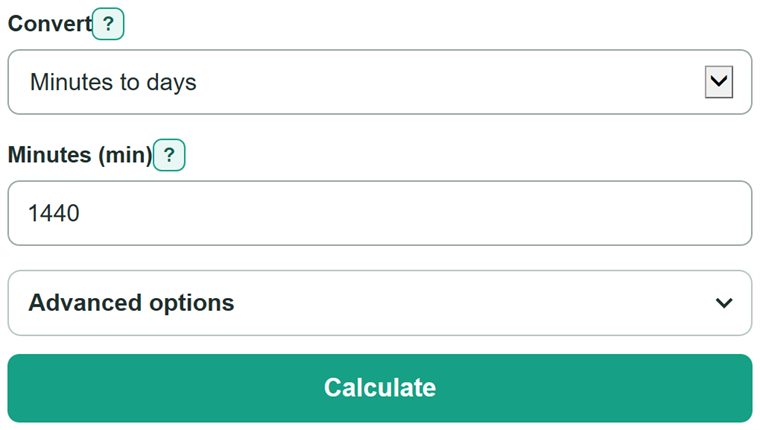
Enter minutes to find the equivalent number of fixed 24-hour days, or switch directions to convert days into minutes.
Advanced options
This uses fixed 24-hour days. It does not calculate calendar dates, workdays, time zones, or daylight-saving changes.
Table of contents
How to use our Minutes to Days Converter
- Choose "Minutes to days" for the usual conversion, or choose "Days to minutes" if your starting value is in days.
- Enter one nonnegative duration in the field shown. Large values can use commas, such as 1,440, and you can add a matching suffix such as min or days.
- Open "Advanced options" only if you need more or fewer digits after the decimal point.
- Select "Calculate" to see the converted elapsed duration.
- Check the scale of the answer: 1,440 minutes equals 1 day, and 0.5 day equals 720 minutes.
Definitions
Minute (min): A unit of elapsed time equal to 60 seconds.
Day: In this converter, a fixed elapsed duration of 24 hours, or 1,440 minutes.
Decimal day: A day amount written with a decimal part. For example, 0.5 day equals 12 hours, while 1.5 days equals 36 hours.
Result decimal places: The number of digits shown after the decimal point. It controls displayed rounding only.
Common mistakes and quick fixes
Mistake: Entering 1,01 or 1,44 and expecting a whole-number minute value.
Fix: Check Convert and then recalculate. Use commas only for thousands, such as 1,440. Use a decimal point for decimal values.
Mistake: Typing a range such as 60-90 in the minutes field.
Fix: Check Convert and then recalculate. Enter one duration. Calculate each endpoint separately if you need to compare a range.
Mistake: Entering a negative number.
Fix: Check Convert and then recalculate. Enter 0 or a positive elapsed duration. Negative durations are not accepted.
Mistake: Reading 1.5 days as 1 day and 5 hours.
Fix: Check Convert and then recalculate. Decimal days use base 10. A value of 1.5 days is 1 day plus 12 hours.
Mistake: Expecting a change in "Result decimal places" to change the conversion.
Fix: This setting changes only the rounded display. The underlying conversion stays the same.
Limitations & Key Assumptions / Boundary Conditions
- Each day is treated as exactly 24 hours, or 1,440 minutes.
- This converter handles elapsed durations, not calendar dates, business days, or event schedules.
- It does not account for time zones, daylight-saving clock changes, leap seconds, or local calendar rules.
- The displayed answer is rounded to the selected number of decimal places, so use more places if a small fraction matters.
- The active field accepts one nonnegative duration only; formulas, ranges, and multiple values are not accepted.
Methodology
Conversion method
The converter uses a fixed day of 24 hours and an hour of 60 minutes, so one day contains 1,440 minutes. [1]
Time in days = Minutes (min) / 1,440
Time in minutes = Days (days) x 1,440
Worked example
For 720 minutes, divide 720 by 1,440 to get 0.5 days. For 2.5 days, multiply 2.5 by 1,440 to get 3,600 minutes.
Displayed rounding
The converter keeps the unrounded value for the calculation, then rounds only the displayed answer to the selected number of decimal places.