
Estimate direct reagent cost per performed test, planned batch, annual use, and whole-package purchases from a known cost or package details.
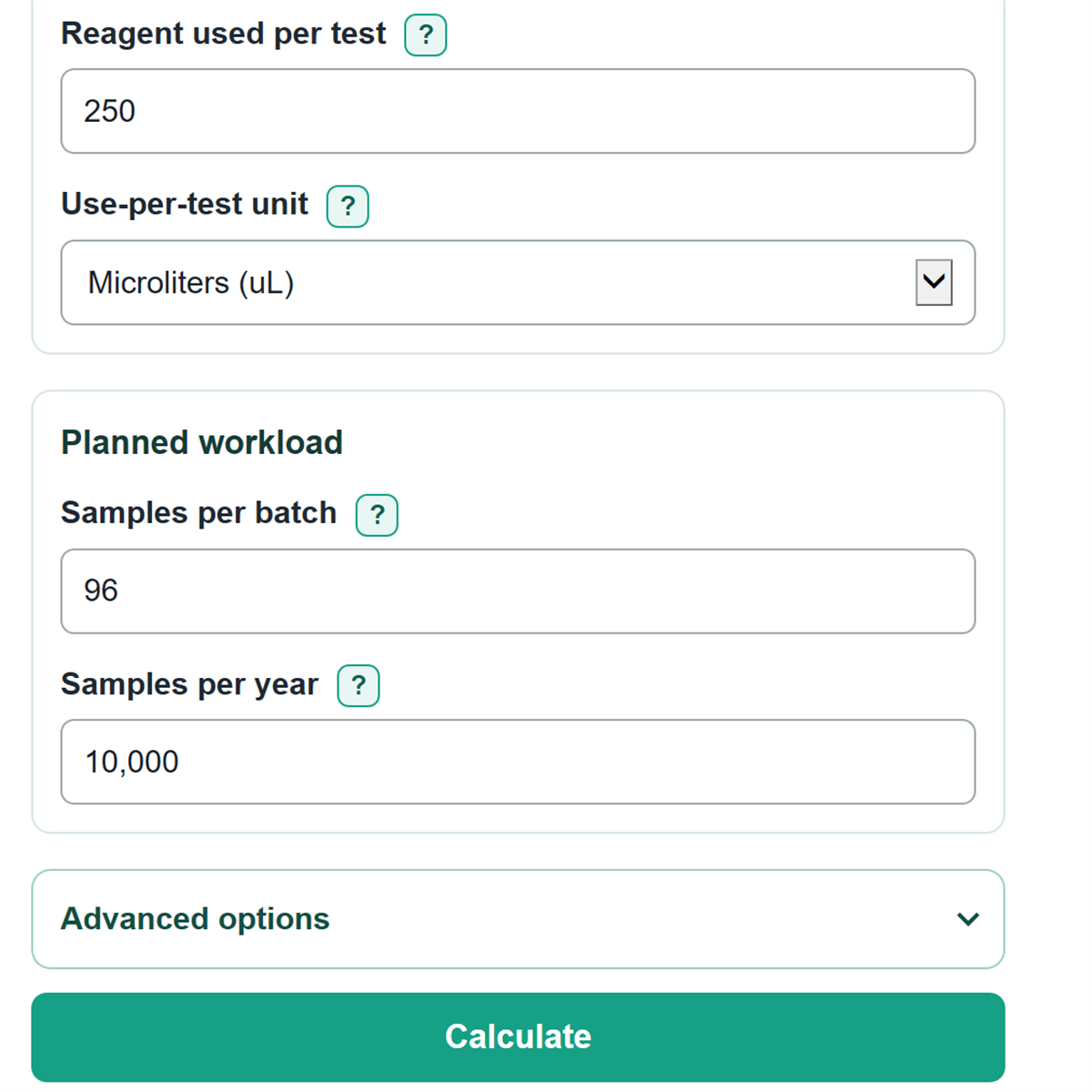
Planned workload
Advanced options
Table of contents
How to use our Laboratory Reagent Cost per Test Calculator
- Choose "I have package details" if you have a package price, amount, and protocol use, or choose "I know the cost per test" for a direct reagent-only cost.
- In package details mode, enter Price per package, Amount in one package, Reagent used per test, and the unit shown for each amount.
- Enter Samples per batch and Samples per year as performed samples. Enter 0 for Samples per year if no annual work is planned.
- Open Advanced options only if you need to include Extra reagent allowance (%) or calculate cost per reportable result from Unreportable results (%).
- Check that Reagent cost per performed test looks reasonable against your existing cost record, and compare Calculated annual reagent use cost with Annual whole-package purchase spending before setting a budget.
Definitions
Performed test: A test that uses reagent, including a test that later has no reportable result.
Reportable result: A usable result after subtracting the entered share of unreportable tests.
Extra reagent allowance: A percent added to the normal reagent use per test for documented overage or handling loss.
Package amount unit: The unit printed for the amount in one package, such as mL, mg, tests, reactions, or each.
Use-per-test unit: The unit used in the procedure for reagent used per test. It must be convertible to the package amount unit.
Whole-package purchase spending: Annual spending after the calculated reagent requirement is rounded up to a purchasable whole package.
Common mistakes and quick fixes
Mistake: Entering 100 mL for Amount in one package and 250 mg for Reagent used per test.
Fix: Choose Package amount unit and Use-per-test unit from the same family: volume, mass, or count.
Mistake: Using a price that includes shipping, labor, or instrument service in Price per package.
Fix: Enter the reagent package price only so Reagent cost per performed test stays a direct reagent cost.
Mistake: Treating Samples per batch as reportable results when the batch count is actually performed samples.
Fix: Enter performed samples in Samples per batch; use Unreportable results (%) to estimate Expected reportable results per year.
Mistake: Reading Calculated annual reagent use cost as the amount that must be purchased.
Fix: In package mode, use Annual whole-package purchase spending for the cash amount after whole-package rounding.
Mistake: Entering 1,01 in Samples per year.
Fix: Use commas only for thousands, such as 10,000, and use a decimal point only where decimals are allowed.
Mistake: Setting Unreportable results (%) to 100.
Fix: Enter a rate from 0 up to but not including 100 because some reportable results are needed to calculate Reagent cost per reportable result.
Limitations & Key Assumptions / Boundary Conditions
- This estimate covers direct reagent cost only. It excludes labor, instruments, maintenance, service contracts, shipping, taxes, storage, and overhead.
- Package details mode assumes the entered package amount is fully usable and that the procedure use per test is accurate for the planned work.
- Samples, tests, reactions, and reportable results can mean different things in a laboratory. Use counts that match the assay workflow.
- Whole packages are rounded up only for annual purchasing. Actual spending can differ because of discounts, inventory on hand, expiration, minimum order rules, or package changes.
- Extra reagent allowance and Unreportable results (%) are planning inputs, not predictions. Replace them with documented local data when available.
- Package and use units must be in the same measurement family. The calculator cannot convert volume to mass or either one to a count.
Methodology
Calculation method
In package details mode, the calculator first converts the package amount and reagent use per test to the same base unit. Volume uses mL, mass uses mg, and tests, reactions, and each use counts. It then divides the package price by the number of tests the package can supply.
allowance_factor = 1 + extra_reagent_allowance_percent / 100
reagent_cost_per_test = package_price * test_use_base / package_amount_base * allowance_factor
In known-cost mode, the entered direct cost is used instead of package conversion. The extra reagent allowance still applies when entered.
reagent_cost_per_test = known_reagent_cost_per_test * allowance_factor
The batch and annual consumption costs scale the cost per performed test by the entered sample counts.
batch_reagent_cost = reagent_cost_per_test * samples_per_batch
annual_reagent_use_cost = reagent_cost_per_test * annual_samples
For package details, the annual reagent requirement is divided by package amount and rounded upward because a fraction of a package cannot be purchased.
annual_packages_required = ceil(annual_samples * test_use_base * allowance_factor / package_amount_base)
annual_package_purchase_spend = annual_packages_required * package_price
When Unreportable results (%) is above zero, the calculator divides the performed-test cost by the expected reportable share. This spreads reagent used by unreportable tests across expected reportable results.
expected_reportable_results = annual_samples * (1 - unreportable_rate_percent / 100)
reagent_cost_per_reportable_result = reagent_cost_per_test / (1 - unreportable_rate_percent / 100)
Worked example
A $120 package containing 100 mL, with 250 uL used per test, supplies 400 tests before allowance. Its base reagent cost is $0.30 per test. With a 10% extra reagent allowance, the cost is $0.33 per performed test. For 96 samples, the batch cost is $31.68. For 10,000 annual samples, calculated use costs $3,300; 27.5 packages are needed, so purchasing rounds up to 28 packages, or $3,360.