
Estimate your monthly house hack cost after rent from other units, rooms, parking, or an ADU offsets your mortgage and property costs.
Advanced options
Table of contents
How to use our House Hack Calculator
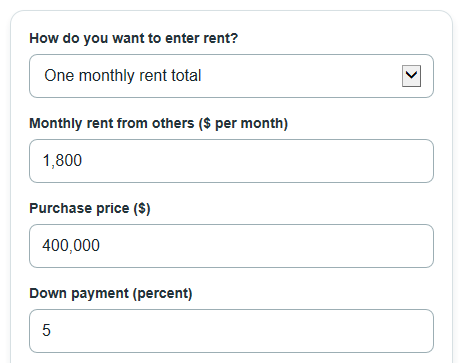
- Choose One monthly rent total if you already know the combined rent, or choose Detailed rent roll to list each rentable space.
- Enter Purchase price, Down payment, Interest rate, Loan term, Property tax, and Home insurance using monthly costs where the label says per month.
- If needed, open Advanced options and add HOA dues, PMI or mortgage insurance, Utilities you pay, Vacancy cushion, and Maintenance reserve.
- Select Calculate and read Owner housing cost after rent first; a positive number is your estimated monthly cost, and a negative number is an estimated monthly surplus before taxes and personal costs.
- Sanity-check Monthly rent counted and Monthly property cost before rent; if either looks too high or too low, review the rent lines, monthly-vs-yearly costs, and percent inputs.
Definitions
House hack: A live-in rental setup where rent from other units, rooms, an ADU, parking, or similar spaces helps offset your housing cost.
Rent roll entries: Separate monthly rent lines for each rentable space, such as Unit B, Basement room, Garage, or Parking spot.
Monthly rent counted: The rent total used by the calculator before the vacancy cushion is applied.
Vacancy cushion: A percent of rent held back for planning in case a space is empty or rent is not collected.
Maintenance reserve: A monthly repair set-aside based on a percent of the home price per year.
Monthly loan payment before taxes and insurance: The principal and interest part of the mortgage payment only.
Owner housing cost after rent: The estimated monthly property cost minus vacancy-adjusted rent; negative means rent is estimated to exceed the listed property costs.
Share of property cost covered by rent: The percent of monthly property cost before rent that is covered by vacancy-adjusted rent.
Common mistakes and quick fixes
Mistake: Entering yearly tax in Property tax.
Fix: Use the monthly amount in Property tax; divide the yearly bill by 12 before entering it.
Mistake: Typing a dollar down payment into Down payment.
Fix: Enter Down payment as a percent of Purchase price, such as 5 for 5 percent.
Mistake: Using Detailed rent roll but leaving Rent roll entries without a name and amount.
Fix: Enter each line like Unit B, 1600 or Garage, 150 so Monthly rent counted can be added correctly.
Mistake: Putting tenant-paid bills into Utilities you pay.
Fix: Include only utilities the owner pays in Utilities you pay, because tenant-paid bills are not part of your monthly property cost.
Mistake: Reading Owner housing cost after rent as profit after all real-life expenses.
Fix: Treat Owner housing cost after rent as housing cost before income taxes, closing costs, personal living costs, and expenses not entered in the calculator.
Limitations & Key Assumptions / Boundary Conditions
- The calculator estimates monthly cash flow from the inputs shown. It does not include closing costs, appraisal fees, inspection costs, loan points, or repairs needed before move-in.
- Property tax, Home insurance, HOA dues, PMI or mortgage insurance, and Utilities you pay can change after purchase, so updated quotes will change the answer.
- The rent roll is a planning estimate. Real rent can differ because of lease terms, turnover time, local rental rules, concessions, late payments, and collection losses.
- Vacancy cushion reduces rent in the calculation. Do not also enter the same vacancy loss as a separate monthly expense elsewhere.
- Maintenance reserve is a steady monthly set-aside, not a prediction of when repairs will happen. Large repairs can arrive in one month even if the reserve is averaged over the year.
- Owner housing cost after rent is before income taxes, depreciation, tax deductions, insurance claims, and personal living expenses.
- The mortgage math assumes a fixed-rate loan with level monthly principal and interest payments for the full Loan term.
Methodology
Calculation steps
The calculator starts with the home price and down payment percent to estimate the loan amount.
loan_amount = purchase_price - purchase_price * down_payment_percent / 100
It then converts the annual interest rate and loan term into monthly payment inputs.
monthly_rate = interest_rate_percent / 100 / 12
number_of_payments = loan_term_years * 12
For a zero percent interest rate, the loan amount is divided evenly across the payment count. Otherwise, the standard fixed-payment mortgage formula is used.
monthly_loan_payment = loan_amount / number_of_payments
monthly_loan_payment = loan_amount * (monthly_rate * (1 + monthly_rate)^number_of_payments) / ((1 + monthly_rate)^number_of_payments - 1)
Rent is counted from either the single Monthly rent from others field or the added Rent roll entries, depending on the rent entry method.
rent_roll_monthly_total = rent_total_monthly
rent_roll_monthly_total = sum(each detailed rent line amount)
The vacancy cushion reduces the rent offset before rent is compared with property costs.
rent_after_vacancy_cushion = rent_roll_monthly_total * (1 - vacancy_percent / 100)
The maintenance reserve converts a yearly percent of the home price into a monthly dollar amount.
monthly_maintenance_reserve = purchase_price * maintenance_percent_annual / 100 / 12
Monthly property cost before rent adds the mortgage principal and interest payment plus the monthly property cost inputs.
monthly_property_cost_before_rent = monthly_loan_payment + property_tax_monthly + insurance_monthly + hoa_monthly + pmi_monthly + utilities_owner_pays + monthly_maintenance_reserve
The main answer subtracts vacancy-adjusted rent from the monthly property cost before rent. The sign is kept, so a negative answer means estimated rent is higher than the listed property costs.
owner_housing_cost_after_rent = monthly_property_cost_before_rent - rent_after_vacancy_cushion
Rent coverage compares vacancy-adjusted rent with the cost before rent. If the cost before rent is zero, the calculator blocks this step to avoid dividing by zero.
rent_covers_percent = rent_after_vacancy_cushion / monthly_property_cost_before_rent * 100
Mini-example
For a $400,000 purchase, 5 percent down, 6.5 percent interest, a 30-year loan, $500 monthly property tax, $150 monthly insurance, $200 PMI, $250 utilities, a 5 percent vacancy cushion, and a 1 percent yearly maintenance reserve, the estimated monthly loan payment is about $2,401.86 and the maintenance reserve is about $333.33.
If Monthly rent from others is $1,800, rent after the vacancy cushion is $1,710. Monthly property cost before rent is about $3,835.19, so Owner housing cost after rent is about $2,125.19 per month and Share of property cost covered by rent is about 44.59 percent.