
Estimate a hard money loan's monthly interest-only payment, upfront fees, closing cash, payoff balance, and lending-limit gap.
Table of contents
How to use our Hard Money Loan Calculator
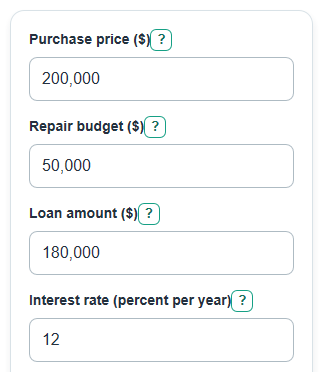
- Enter the Purchase price, Repair budget, and Loan amount for the deal you want to check.
- Enter the Interest rate and Loan term from the lender quote, using the yearly rate, not APR.
- Open Advanced options if you want to change Loan points, Fixed lender fees, Max loan-to-value limit, or Max loan-to-cost limit.
- Click Calculate and read the Monthly interest-only payment first, then check the Loan limit gap or cushion to see if the requested loan is under or over the entered limits.
- Sanity-check the output: if Loan-to-value from your numbers is far above Max loan-to-value limit, or cash needed looks negative, recheck the Loan amount, Purchase price, and fees before using the estimate.
Definitions
Hard money loan: A short-term real estate loan often used for purchases or repairs. It is commonly priced with a high interest rate, points, and fees.
Interest-only payment: A monthly payment that covers interest but does not reduce the Loan amount.
Loan points: An upfront fee based on a percent of the Loan amount. One point means 1 percent of the loan.
Interest rate: The yearly rate used to calculate interest. It is not the same as APR, which can include some fees [1].
Loan-to-value: Loan amount divided by Purchase price, shown as a percent.
Loan-to-cost: Loan amount divided by Purchase price plus Repair budget, shown as a percent.
Loan limit gap or cushion: Max loan by entered limits minus Loan amount. A positive number is room under the cap. A negative number is the amount over the cap.
Principal due at end of term: The Loan amount still owed at maturity if no principal is paid down during the term.
Common mistakes and quick fixes
Mistake: Entering APR in Interest rate.
Fix: Use the stated yearly Interest rate if the calculator asks for interest-only payment, because APR can include fees.
Mistake: Leaving Repair budget out when the project has planned work.
Fix: Put the planned repair amount in Repair budget so Loan-to-cost from your numbers and Estimated cash needed at closing match the deal.
Mistake: Treating Loan points as dollars.
Fix: Enter Loan points as a percent of loan; 2 means 2 percent, not $2.
Mistake: Ignoring Max loan-to-value limit or Max loan-to-cost limit.
Fix: Match those limits to the lender quote so Loan limit gap or cushion shows whether the requested Loan amount is over the tightest cap.
Mistake: Reading Principal due at end of term as a total payoff including interest.
Fix: Add any unpaid interest and other costs separately; Principal due at end of term is the original Loan amount under the interest-only assumption.
Limitations & Key Assumptions / Boundary Conditions
- The calculator estimates an interest-only loan. It does not model principal paydown, draws, escrow holdbacks, extensions, late fees, default interest, or prepayment terms.
- Interest is calculated from the entered Interest rate, not APR. Real APR can differ because APR may include certain loan costs.
- Loan-to-value uses Purchase price only. It does not use appraisal value, after-repair value, or a lender's internal valuation.
- Loan-to-cost uses Purchase price plus Repair budget. If your lender uses a different cost base, the Max loan by entered limits can differ.
- Estimated cash needed at closing includes Purchase price, Repair budget, Loan points, Fixed lender fees, and Loan amount only. It excludes title costs, taxes, insurance, legal fees, recording fees, reserves, and sale costs.
- A negative Estimated cash needed at closing is kept as a signed result. It means the Loan amount is greater than the entered costs and fees, not that a lender will give cash back.
- The Loan limit check message is only an arithmetic check against the entered limits. It is not lender approval.
- If the loan is paid off early, Total interest over the loan term and Estimated total financing cost may be lower than shown.
Methodology
Calculation steps
The calculator first changes the yearly Interest rate into a monthly interest-only rate by dividing by 12 months. It then calculates interest, points, fees, cash needed, and the two entered lending caps.
monthly_interest_payment = loan_amount * (annual_interest_rate_percent / 100) / 12
total_interest_over_term = monthly_interest_payment * loan_term_months
loan_points_fee = loan_amount * (points_percent / 100)
estimated_total_financing_cost = total_interest_over_term + loan_points_fee + fixed_lender_fees
estimated_cash_needed_at_closing = purchase_price + repair_budget + loan_points_fee + fixed_lender_fees - loan_amount
loan_to_value_percent = (loan_amount / purchase_price) * 100
loan_to_cost_percent = (loan_amount / (purchase_price + repair_budget)) * 100
max_loan_by_entered_limits = min(purchase_price * max_ltv_percent / 100, (purchase_price + repair_budget) * max_ltc_percent / 100)
loan_limit_gap_or_cushion = max_loan_by_entered_limits - loan_amount
payoff_due_at_end = loan_amount
Worked mini-example
For a $200,000 purchase, $50,000 repair budget, $180,000 loan, 12 percent yearly interest rate, 12-month term, 2 loan points, $1,500 fixed lender fees, 70 percent max loan-to-value, and 90 percent max loan-to-cost, the monthly interest-only payment is $1,800.
The loan-to-value cap is $140,000, and the loan-to-cost cap is $225,000, so the Max loan by entered limits is $140,000. The Loan limit gap or cushion is $140,000 - $180,000 = -$40,000, which means the requested loan is $40,000 over the tightest entered cap.
Total interest over the term is $21,600. Loan points fee is $3,600. Estimated total financing cost is $26,700. Estimated cash needed at closing is $75,100, and Principal due at end of term is $180,000.