
Calculate GRM from a property price and rent, or work backward to estimate price or needed rent.
Advanced options
Table of contents
How to use our Gross Rent Multiplier Calculator
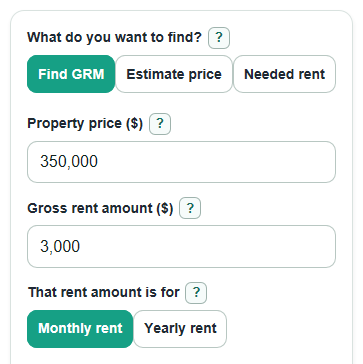
- Choose What do you want to find?: Find GRM, Estimate price, or Needed rent.
- Enter the visible required fields, such as Property price ($), Gross rent amount ($), Target GRM, and That rent amount is for.
- Use Advanced options only if you want separate checks for Other yearly property income ($) or Estimated empty-unit loss (percent).
- Select Calculate and read the first result first, then check Gross rent yield, Yearly rent used, and any Check before using this number note.
- Sanity-check Yearly rent used before trusting the answer. If monthly rent was entered, it should be 12 times the monthly Gross rent amount ($).
Definitions
Gross rent multiplier: Property price divided by yearly gross rent. It is often shortened to GRM and is shown as a multiplier, such as 9.7x [1].
Gross rent amount ($): Rent before expenses are subtracted. It should not be net operating income, mortgage payment cash flow, or rent after repairs and taxes.
That rent amount is for: The time period for the rent you entered. Monthly rent is multiplied by 12; yearly rent is used as entered.
Target GRM: The multiplier you want to test when estimating a price or finding the rent needed for a price.
Gross rent yield: Yearly gross rent divided by the price, shown as a percent. It is the inverse view of GRM.
Price-to-total-income multiplier: Price divided by yearly rent plus Other yearly property income ($). This is not the same as rent-only GRM.
After empty-unit loss multiplier: Price divided by income after the Estimated empty-unit loss (percent) is applied. It still ignores expenses.
Common mistakes and quick fixes
Mistake: Entering monthly rent in Gross rent amount ($) while That rent amount is for is set to Yearly rent.
Fix: Change That rent amount is for to Monthly rent, or enter the full yearly rent in Gross rent amount ($).
Mistake: Using rent after expenses in Gross rent amount ($).
Fix: Enter gross rent before taxes, insurance, repairs, loan payments, management fees, and other costs.
Mistake: Leaving Target GRM unchanged when using Estimate price or Needed rent.
Fix: Enter the Target GRM you actually want to test, usually from similar nearby properties.
Mistake: Adding parking, laundry, or storage income into Gross rent amount ($) and then also entering it in Other yearly property income ($).
Fix: Keep Gross rent amount ($) as rent only, and put non-rent income only in Other yearly property income ($).
Mistake: Treating Price-to-total-income multiplier or After empty-unit loss multiplier as the same number as Gross rent multiplier.
Fix: Compare Gross rent multiplier to other rent-only GRM numbers, and use the extra multipliers only as separate screening checks.
Mistake: Entering 100 or more in Estimated empty-unit loss (percent).
Fix: Use a percent below 100, or enter 0 if you do not want an empty-unit loss check.
Limitations & Key Assumptions / Boundary Conditions
- GRM is a quick screening number, not a full investment return. It ignores operating expenses, repairs, property taxes, insurance, financing, closing costs, reserves, and income taxes.
- Normal GRM levels vary by local market, property type, rent level, and building condition. A lower GRM usually means more rent per dollar of price, but it does not prove the property is better.
- The main Gross rent multiplier uses rent only. Other yearly property income ($) and Estimated empty-unit loss (percent) are shown as separate checks so they do not change the rent-only GRM.
- The calculator assumes 12 months per year and does not model rent growth, lease-up timing, seasonal rents, partial-year ownership, or future resale value.
- Inputs should be single numbers. Ranges, formulas, and mixed units can produce errors because the calculator needs one price, one rent amount, and one target GRM at a time.
- If Estimated empty-unit loss (percent) is 100 or more, income after loss is zero or negative, so the after-loss multiplier is not meaningful.
Methodology
Core calculation
The standard GRM calculation divides property price by gross rent, using yearly gross rent as the rent figure [2]. If you enter monthly rent, the calculator first converts it to yearly rent so a monthly amount is not accidentally treated as a yearly amount.
annual_gross_rent = rent_amount * 12 if rent_period = monthly, else rent_amount
grm = property_price / annual_gross_rent
Gross rent yield shows the same relationship from the other direction. In Find GRM mode, the price is Property price ($). In Estimate price mode, the price is Estimated price at target GRM. In Needed rent mode, the rent is Needed yearly rent.
gross_yield_percent = annual_gross_rent / price_used * 100
Reverse modes
Estimate price mode uses the Target GRM and the yearly rent to solve for a quick price screen.
estimated_price = target_grm * annual_gross_rent
Needed rent mode uses the Property price ($) and Target GRM to solve for the yearly and monthly rent needed to hit that target.
needed_annual_rent = property_price / target_grm
needed_monthly_rent = needed_annual_rent / 12
Advanced screening checks
Other yearly property income ($) is kept separate from rent-only GRM. If it is greater than zero, the calculator can show a price-to-total-income multiplier.
total_income_multiplier = property_price / (annual_gross_rent + other_annual_income)
If Estimated empty-unit loss (percent) is greater than zero and less than 100, the calculator applies that percent to rent plus other income, then divides the price by the remaining income.
effective_income_multiplier = property_price / ((annual_gross_rent + other_annual_income) * (1 - vacancy_rate_percent / 100))
Mini-example
For a $350,000 property with $3,000 monthly gross rent, yearly rent is $36,000. GRM is $350,000 / $36,000 = 9.72x. Gross rent yield is $36,000 / $350,000 * 100 = 10.29%.
If a $500,000 property has $60,000 yearly rent, $5,000 other yearly income, and 5% empty-unit loss, the rent-only GRM is 8.33x. The price-to-total-income multiplier is $500,000 / $65,000 = 7.69x. The after empty-unit loss multiplier is $500,000 / $61,750 = 8.10x.
Validation and rounding
Required visible inputs must be positive single numbers. Money fields may include commas, spaces, or a leading dollar sign. Percent fields may include a percent sign. Results are rounded for display, but the formulas use the unrounded numbers during calculation.