
Convert gallons to milliliters fast, choose US liquid or Imperial gallon, and check the result in liters so you do not mix them up.
Table of contents
How to use our Gallons to mL Converter
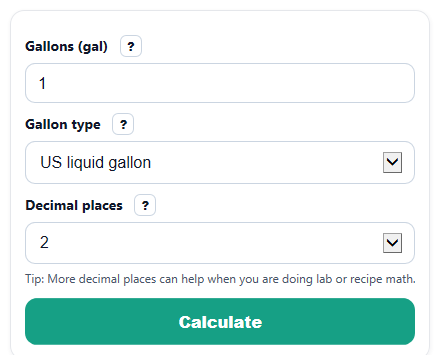
- Enter the amount in Gallons.
- Choose the correct Gallon type: US liquid gallon for standard US use, or Imperial gallon for the larger UK-style gallon.
- Pick Decimal places if you want more or less rounding in the displayed results.
- Click Calculate to see Milliliters, Liters, the Conversion factor used, and the Gallon type note.
- Sanity-check the answer by comparing Milliliters with Liters: 1 liter always equals 1,000 mL, so the two results should match that relationship.
Definitions
Gallons: The starting volume amount you want to convert.
Gallon type: Which gallon definition to use. A US liquid gallon is smaller than an Imperial gallon.
Milliliters (mL): The main converted volume. There are 1,000 milliliters in 1 liter.
Liters (L): The same volume shown in liters to make the size easier to check.
Conversion factor used: The number of milliliters in 1 gallon for the selected gallon type.
Decimal places: How many digits appear after the decimal point in the displayed results.
Gallon type note: A short reminder of which gallon definition was applied.
Common mistakes and quick fixes
Mistake: Leaving Gallon type on the wrong setting and converting a UK-style value as a US value.
Fix: Check Gallon type before you calculate. Use US liquid gallon for standard US volume and Imperial gallon for the larger UK-style gallon.
Mistake: Entering text, symbols, or a blank entry in Gallons .
Fix: Type a number only in Gallons , such as 1, 2.5, or 0.75.
Mistake: Typing a negative value in Gallons for a real volume amount.
Fix: Enter Gallons as 0 or greater, since this converter treats volume amount as non-negative.
Mistake: Thinking the Conversion factor used is the final answer.
Fix: Read Milliliters as the main converted result. The Conversion factor used only shows the mL per gallon value applied.
Mistake: Reading Liters and Milliliters as different amounts instead of the same volume in two units.
Fix: Use Liters as a quick check only. The same volume should follow 1 L = 1,000 mL.
Mistake: Choosing too few Decimal places and thinking the conversion is inaccurate.
Fix: Increase Decimal places if you need more detail. The calculator still uses the full conversion factor internally.
Limitations & Key Assumptions / Boundary Conditions
- This converter handles only gallons to milliliters, with a liters check shown as a second output.
- You must choose the correct Gallon type; using the wrong gallon definition changes the result.
- The calculator disallows negative Gallons because real volume amounts are normally not negative.
- Decimal places changes only how results are displayed, not the internal conversion math.
- Very large values are formatted for readability, but you should still review the selected unit and gallon definition if the result looks unexpectedly large or small.
- This tool converts units exactly from the listed factors, but a real container label or recipe may use rounded values instead of exact definitions.
Methodology
How the conversion works
The calculator first reads the number entered in Gallons. It then checks Gallon type and applies the matching conversion factor. After that, it shows the same volume in Milliliters and in Liters.
mL = gal x 3785.411784
Use this when Gallon type is US liquid gallon.
mL = gal x 4546.09
Use this when Gallon type is Imperial gallon.
L = mL / 1000
This converts the milliliter result into liters for an easier reality check.
Worked example
If you enter 0.75 for Gallons and choose US liquid gallon, the calculator multiplies 0.75 by 3785.411784.
mL = 0.75 x 3785.411784 = 2839.058838
L = 2839.058838 / 1000 = 2.839058838
With 4 Decimal places, that displays as 2839.0588 mL and 2.8391 L.
Factor notes
The US gallon and Imperial gallon are not the same size, so the selected factor matters. The metric relationship between liters and milliliters is exact, with 1 L = 1,000 mL. Standard conversion-factor practice is to multiply by a unit ratio that changes units without changing the quantity represented [1].
Assumptions used
This tool assumes the input is a volume amount in gallons, not a flow rate or a container name. It also assumes you want a non-negative volume and that display rounding should not change the underlying calculation.