
Calculate stand density index and relative density from trees per acre, quadratic mean diameter, and your stand-specific maximum SDI reference.
Table of contents
How to use our Forest Stand Density Index and Relative Density Calculator
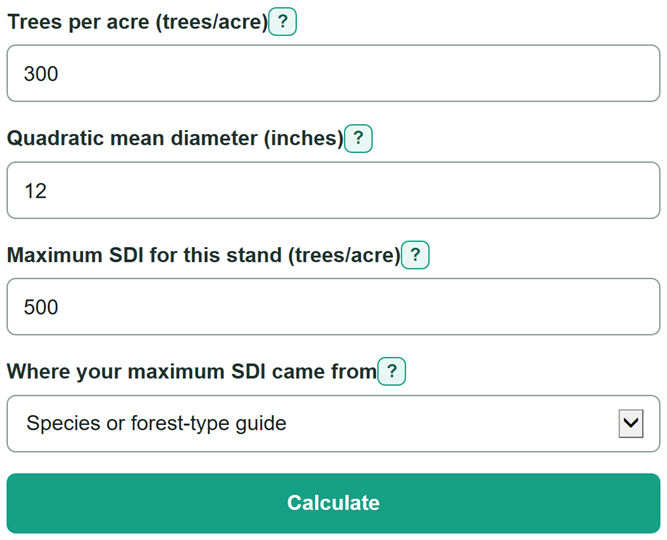
- Enter Trees per acre from a cruise summary or an expanded fixed-area plot tally.
- Enter Quadratic mean diameter in inches from the inventory summary, not the arithmetic-average DBH.
- Enter Maximum SDI for this stand from a reference that fits the species, forest type, region, and stand composition.
- Choose Where your maximum SDI came from, then select Calculate.
- Sanity-check that the displayed Stand density index at a 10-inch reference diameter is in trees/acre and that the maximum SDI source is appropriate before using the relative density for planning.
Definitions
Trees per acre: The expanded number of live trees in one acre of the stand.
Quadratic mean diameter (QMD): A stand-level diameter that gives more weight to larger trees. It is commonly reported in inches and is not usually the same as arithmetic-average DBH.
Stand density index (SDI): A Reineke density measure that expresses the stand as an equivalent number of 10-inch trees per acre. SDI is not unitless, so its area and measurement units matter when comparing values. [1]
Maximum SDI: The reference SDI used as the denominator for relative density. It can vary with species, forest type, region, and stand composition. [2]
Relative density: Current SDI divided by maximum SDI, shown by this calculator as a percent.
DBH: Diameter at breast height, usually measured at 4.5 feet above ground on the uphill side of a tree.
Common mistakes and quick fixes
Mistake: Entering a tree count from a small sample plot as Trees per acre.
Fix: Expand the plot tally to trees/acre first, or use the trees-per-acre value from the cruise summary.
Mistake: Using arithmetic-average DBH for Quadratic mean diameter.
Fix: Use QMD from the inventory summary. Average DBH and QMD are different measurements.
Mistake: Leaving the example value in Maximum SDI for this stand without checking its fit.
Fix: Replace it with a documented value for the stand's species, forest type, region, and composition.
Mistake: Treating Relative density based on entered maximum SDI as a universal thinning prescription.
Fix: Use the percent as planning information and apply local silvicultural guidance to the stand.
Mistake: Comparing Stand density index at a 10-inch reference diameter with a value reported per hectare.
Fix: Compare only SDI values reported with compatible area and measurement units.
Mistake: Typing a malformed number such as 1,01 in Trees per acre.
Fix: Use commas only for thousands, such as 1,200, and use a decimal point for fractional values.
Limitations & Key Assumptions / Boundary Conditions
- This calculator uses one QMD and one trees-per-acre value, which is the direct even-aged stand workflow. Strongly uneven-aged, mixed, or multi-storied stands may need a diameter-class or tree-level SDI method.
- Relative density changes directly with the entered maximum SDI. The calculator cannot verify that the reference fits the stand.
- The result is in US units: trees per acre at a 10-inch reference diameter. Do not directly compare it with SDI reported per hectare or under a different diameter convention.
- Live-tree definitions, plot expansion methods, measurement error, and which trees are included in the inventory can change trees per acre, QMD, and the calculated SDI.
- A relative-density percent is planning information. It does not account for site conditions, species-specific objectives, tree health, harvest constraints, or local thinning guidance.
Methodology
Calculation method
The calculator uses the conventional Reineke equation for a stand summarized by trees per acre and QMD. The reference diameter is 10 inches and the exponent is 1.605. [1]
SDI = trees per acre * (QMD in inches / 10) ^ 1.605
It then divides the calculated SDI by the maximum SDI you entered and changes the ratio to a percent.
Relative density percent = 100 * SDI / maximum SDI
The selected source category for maximum SDI is displayed with the interpretation, but it does not change either equation.
Worked example
For 300 trees/acre, a QMD of 12 inches, and a maximum SDI of 500 trees/acre, the calculated SDI is about 401.98 trees/acre. Relative density is about 80.40 percent because 401.98 divided by 500 times 100 equals 80.40.