
Compare a fixed electricity plan with a variable plan using your monthly kWh use, fees, and 12 expected variable rates.
| Month | Rate | Fixed bill | Variable bill | Variable minus fixed |
|---|
Table of contents
How to use our Fixed vs Variable Electricity Rate Calculator
- Enter Monthly electricity use in kWh from a recent bill, or use a typical month if you want a quick estimate.
- Enter Fixed plan energy rate in cents per kWh and Fixed plan monthly fee in dollars.
- Enter Variable plan monthly fee, then add exactly 12 numbers in Variable rates for 12 months in month order.
- Select Calculate and read Variable plan 12-month extra cost first; positive means the variable plan costs more, and negative means it saves money.
- Sanity-check the 12-month bill comparison table: months with higher variable rates should show higher variable bills, and a flat variable rate should give the same variable bill each month.
Definitions
kWh: Kilowatt-hour, the amount of electricity used over time. Home electric bills usually show use in kWh [1].
Cents per kWh: The energy price for each kWh used. A rate of 15 cents per kWh means 1,000 kWh costs $150 before monthly fees.
Monthly fee: A fixed dollar charge that repeats each month, separate from the energy charge.
Variable rates for 12 months: The 12 energy rates you expect for the variable plan, entered in month order.
Variable plan 12-month extra cost: Variable plan total cost minus fixed plan total cost over the 12 entered months.
Typical monthly swing: The standard deviation of the 12 variable bills. A larger value means the variable bills move around more.
Break-even average variable rate: The average variable cents per kWh that would make the fixed and variable plans have the same 12-month cost.
Common mistakes and quick fixes
Mistake: Entering Fixed plan energy rate as dollars per kWh, such as 0.15 instead of 15.
Fix: Use cents per kWh for Fixed plan energy rate, so 15 cents per kWh is entered as 15.
Mistake: Putting a yearly base charge into Fixed plan monthly fee or Variable plan monthly fee.
Fix: Enter the repeating monthly charge only; divide a yearly fee by 12 before entering it.
Mistake: Entering fewer or more than 12 numbers in Variable rates for 12 months.
Fix: Add one rate for each month, in order, until the field has exactly 12 rates.
Mistake: Using total yearly electricity in Monthly electricity use.
Fix: Use one month's kWh, or divide yearly kWh by 12 before entering Monthly electricity use.
Mistake: Reading Variable plan 12-month extra cost as a savings number.
Fix: A positive Variable plan 12-month extra cost means the variable plan costs more; a negative number means it costs less.
Limitations & Key Assumptions / Boundary Conditions
- The comparison uses the same Monthly electricity use for all 12 months. Real usage often changes with weather, heating, cooling, and household schedules.
- Variable rates for 12 months are user-entered guesses or plan terms. The calculator does not forecast market prices.
- Taxes, delivery charges, late fees, bill credits, minimum-use fees, early termination fees, and tiered rates are not included unless you build them into the entered rates or monthly fees.
- The calculator treats the 12 entered months as the full scenario, so Typical monthly swing uses population standard deviation across those 12 bills.
- Break-even average variable rate can be negative if the Variable plan monthly fee is high enough. That means the variable plan cannot tie the fixed plan unless the energy rate would be below zero.
- Results are estimates rounded to cents for dollar amounts. Your utility bill may round line items differently.
Methodology
Bill formulas
The calculator converts cents per kWh to dollars per kWh by dividing by 100, then adds the monthly fee.
fixed_monthly_bill = monthly_kwh * fixed_rate_cents / 100 + fixed_monthly_fee
variable_monthly_bill_i = monthly_kwh * variable_rate_cents_i / 100 + variable_monthly_fee
The fixed plan uses the same monthly bill 12 times. The variable plan calculates one bill for each entered monthly rate.
fixed_annual_cost = 12 * fixed_monthly_bill
variable_annual_cost = add all 12 variable_monthly_bill_i values
Comparison formulas
The main answer keeps its sign.
variable_extra_cost = variable_annual_cost - fixed_annual_cost
A positive extra cost means the variable plan costs more over the 12 months. A negative extra cost means the variable plan costs less.
highest_variable_monthly_bill = maximum of the 12 variable_monthly_bill_i values
average_variable_monthly_bill = variable_annual_cost / 12
variable_monthly_bill_spread = sqrt(add((variable_monthly_bill_i - average_variable_monthly_bill)^2) / 12)
The break-even rate solves for the average variable energy rate that would make the variable 12-month total equal the fixed 12-month total.
breakeven_variable_average_rate = ((fixed_annual_cost - 12 * variable_monthly_fee) / (12 * monthly_kwh)) * 100
Mini-example
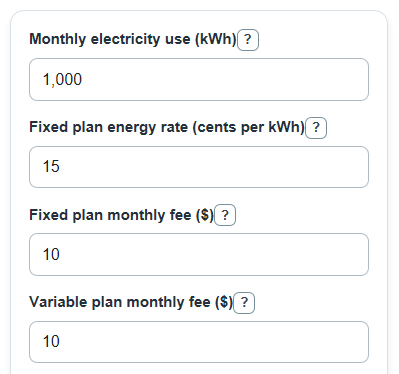
If Monthly electricity use is 1,000 kWh, Fixed plan energy rate is 15 cents per kWh, and Fixed plan monthly fee is $10, the fixed bill is $160 per month and the Fixed plan 12-month cost is $1,920.
If Variable plan monthly fee is $10 and the 12 variable rates average 14 cents per kWh, each variable bill is $150 when all rates are 14. The Variable plan 12-month cost is $1,800, so Variable plan 12-month extra cost is $1,800 - $1,920 = -$120. The negative sign means the variable plan is cheaper for that set of inputs.