
Convert feet and inches to meters, or meters back to feet and inches, with clear rounding and check values.
Table of contents
How to use our Feet and Inches to Meters Converter
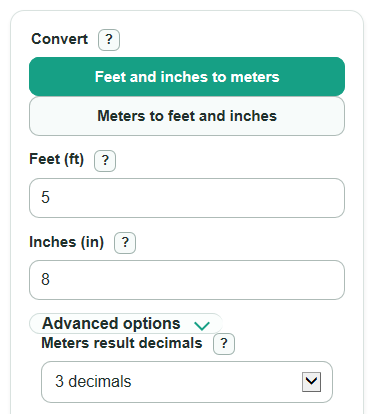
- Choose Convert to pick Feet and inches to meters or Meters to feet and inches.
- Enter the visible length fields: Feet (ft) and Inches (in), or Meters (m) in reverse mode.
- Open Advanced options only if you need to change Meters result decimals or Round reverse inches to nearest.
- Select Calculate, then read the main answer first and use Centimeters, Decimal feet, and Total inches to check the same length another way.
- Sanity-check the result: 5 ft 8 in should be about 1.73 m, and 1.73 m should come back to about 5 ft 8.1 in with 0.1 in rounding.
Definitions
Feet (ft): The whole-foot part of a US-style height or length.
Inches (in): The leftover inch part. One foot has 12 inches [2].
Meters (m): The metric length unit used for the main conversion result.
Centimeters: The same length in centimeters. There are 100 centimeters in 1 meter.
Decimal feet: Feet and inches written as one feet value, such as 5.667 ft instead of 5 ft 8 in.
Total inches: The full length written only in inches, such as 68 in for 5 ft 8 in.
Meters result decimals: How many digits appear after the decimal point in the Meters answer.
Round reverse inches to nearest: The step used to round the Inches part when converting from Meters (m) back to feet and inches.
Common mistakes and quick fixes
Mistake: Typing a full height into Feet (ft), such as 5.8 for 5 ft 8 in.
Fix: Put 5 in Feet (ft) and 8 in Inches (in); use Decimal feet only as a result for other tools.
Mistake: Leaving Meters (m) blank after choosing Meters to feet and inches.
Fix: Enter a number in Meters (m), such as 1.73, before selecting Calculate.
Mistake: Thinking Inches (in) must always be 0 through 11.
Fix: Values like 14 are accepted; check Input note to see the normalized feet-and-inches split.
Mistake: Using Meters result decimals to change the actual math.
Fix: Use Meters result decimals only to change how many digits show; the converter still calculates from exact factors.
Mistake: Choosing Round reverse inches to nearest 1 in when a form needs tenths of an inch.
Fix: Set Round reverse inches to nearest to 0.1 in for a more detailed Inches part.
Limitations & Key Assumptions / Boundary Conditions
- The converter is for ordinary international feet, inches, meters, and centimeters, not survey feet or older local units.
- Displayed values are rounded, so a value converted forward and then backward may differ slightly in the last digit.
- Inches (in) values of 12 or more are allowed and normalized; this helps with entries like 5 ft 14 in, but it may also reveal a typing mistake.
- Negative lengths are blocked because this converter treats the input as a physical height or length.
- Very large values are accepted when numeric, but the tool is meant for everyday heights and lengths rather than engineering survey work.
- The reverse Inches part depends on Round reverse inches to nearest, so whole-inch rounding can hide smaller fractions of an inch.
Methodology
How the conversion works
The converter uses exact length relationships for ordinary feet and inches: 1 foot equals 0.3048 meters, 1 inch equals 0.0254 meters, and 1 foot equals 12 inches. It keeps the full calculated value internally and rounds only what it shows on screen.
meters = feet * 0.3048 + inches * 0.0254
centimeters = meters * 100
decimal_feet = feet + inches / 12
total_inches = feet * 12 + inches
Reverse conversion
When converting from meters, the calculator first changes meters into total inches. Then it splits that total into whole feet and leftover inches.
total_inches = meters / 0.0254
feet_part = floor(total_inches / 12)
inches_raw = total_inches - feet_part * 12
rounded_inches = round(inches_raw / inch_rounding) * inch_rounding
If rounded_inches reaches 12, the converter adds 1 to Feet part and shows 0 for Inches part. This avoids results like 5 ft 12 in.
Mini-example
For 5 ft 8 in, the total inches are 5 * 12 + 8 = 68 in. The meters value is 5 * 0.3048 + 8 * 0.0254 = 1.7272 m, which shows as 1.727 m when Meters result decimals is set to 3. The same length is 172.72 cm and 5.6667 decimal feet, which the result rounds for display.