
Convert degrees Fahrenheit to kelvin with clear rounding, optional scientific notation, and a quick check for values below absolute zero.
Advanced options
Table of contents
How to use our Fahrenheit to Kelvin Converter
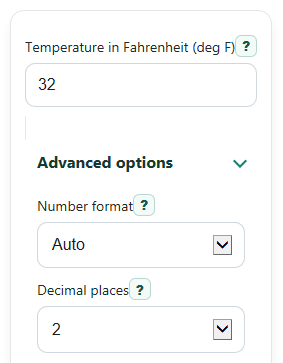
- Enter your value in Temperature in Fahrenheit (deg F).
- Open Advanced options if you want to change Number format or Decimal places.
- Click Calculate to see Temperature in kelvin, the Formula used, and the Validity note.
- Sanity-check the result: 32 deg F should give 273.15 K, 68 deg F should give 293.15 K, and no physically possible result should be below 0 K.
Definitions
Fahrenheit (deg F): A temperature scale commonly used in the US.
Kelvin (K): An absolute temperature scale used in science; it starts at absolute zero and does not use a degree symbol [1][2].
Absolute zero: The lowest possible temperature, equal to 0 K and -459.67 deg F.
Number format: How the result is written, such as plain decimals or scientific notation.
Scientific notation: A compact way to write very large or very small numbers, such as 2.7315 x 10^2.
Decimal places: How many digits appear to the right of the decimal point in plain decimal results.
Common mistakes and quick fixes
Mistake: Leaving Temperature in Fahrenheit (deg F) blank.
Fix: Enter a number such as 32 before you click Calculate.
Mistake: Typing words or symbols into Temperature in Fahrenheit (deg F) , such as "cold" or extra text.
Fix: Enter numbers only, with an optional minus sign or decimal point.
Mistake: Reading Temperature in kelvin as if it should use a degree symbol.
Fix: Write the result as K, not deg K, because kelvin does not use the degree symbol.
Mistake: Picking Scientific notation in Number format and thinking the answer changed.
Fix: The value is the same temperature; only the way it is written changed.
Mistake: Ignoring the Validity note when the input is below -459.67 deg F.
Fix: Treat the math result as a calculated extension only, because temperatures below absolute zero are not physically possible.
Limitations & Key Assumptions / Boundary Conditions
- This tool converts only from Fahrenheit to kelvin; it is not a general temperature converter.
- The calculation uses the standard exact relationship between Fahrenheit, Celsius, and kelvin, but the displayed result may be rounded based on Decimal places.
- If the entered Fahrenheit value is below -459.67 deg F, the tool still shows the math result for transparency, but that temperature is not physically possible.
- Number format changes only how the answer is displayed, not the underlying converted value.
- Auto formatting is meant for readability, so very large or very small values may appear in scientific notation while ordinary values stay in plain decimals.
Methodology
Conversion formula
The calculator converts Fahrenheit to kelvin using the standard relationship between the temperature scales [1].
K = (F - 32) * 5 / 9 + 273.15
Here, K is temperature in kelvin and F is temperature in degrees Fahrenheit.
F_abs_zero = -459.67
If the entered Fahrenheit value is less than -459.67 deg F, the calculator still computes the math result but adds a validity note because kelvin is an absolute scale with a lower bound of 0 K [2][4].
Worked mini-example
For 32 deg F:
K = (32 - 32) * 5 / 9 + 273.15
K = 0 + 273.15 = 273.15 K
That matches the freezing point of water on the kelvin scale.
Display and rounding
The calculator first computes the conversion, then formats the answer based on your selected Number format and Decimal places. Plain decimal mode rounds to the chosen number of decimal places. Scientific notation writes the same value in a science-friendly form. Auto mode keeps everyday results easy to read and switches to scientific notation only for very large or very small magnitudes.
If rounding would create -0, the display is normalized to 0 so the result is easier to read.
Assumptions used
The method assumes a standard temperature-scale conversion with constants 273.15, -459.67, and the factor 5/9 [1]. Real measurements can differ slightly from a displayed value only because of rounding, not because the conversion formula changes.