
Compare exhaust-only and balanced ventilation costs over time using your airflow, weather, equipment, utility prices, and contractor quotes.
Equipment performance
Heating and energy prices
Quotes and comparison period
Advanced options
Yearly maintenance
Scheduled replacements
Future prices and value
Table of contents
How to use our Exhaust-Only vs Balanced Ventilation Lifetime Cost Calculator
- Enter the continuous Whole-house ventilation rate from your plans, commissioning report, or quote, plus local Annual heating degree days using a 65 F base.
- Enter both fan power values at the continuous operating speed and the balanced unit's Balanced heat recovery efficiency.
- Choose the Heating method, then enter the matching efficiency, COP, or AFUE and your utility usage price.
- Enter complete installed quotes and choose Years to compare. Open Advanced options to add maintenance, replacements, energy price increases, and a discount rate.
- Calculate, then check the signed Balanced lifetime cost minus exhaust-only cost: a negative number favors balanced ventilation, while a positive number favors exhaust-only ventilation under your entries.
Definitions
Whole-house ventilation rate: Continuous airflow for the home, measured in CFM (cubic feet per minute). It is separate from short-term local kitchen or bathroom exhaust.
Heating degree days: A yearly measure of cold-weather exposure. More F-days generally mean more energy is needed to warm incoming ventilation air.
Balanced heat recovery efficiency: The percent of modeled sensible heat transferred from outgoing air to incoming air by the balanced system.
COP: Coefficient of performance. For a heat pump, it is heat delivered divided by electricity used.
AFUE: Annual fuel utilization efficiency. It is the percentage of natural-gas fuel energy turned into useful seasonal heat.
Present value: A way to express future costs in today's dollars using the entered annual discount rate.
Catch-up year: The first year when cumulative balanced-system cost is no greater than cumulative exhaust-only cost.
Common mistakes and quick fixes
Mistake: Entering a kitchen hood or a bathroom fan's occasional airflow as Whole-house ventilation rate .
Fix: Use the continuous whole-house CFM from the ventilation design, controls, commissioning report, or contractor quote.
Mistake: Using a fan's maximum rating for Exhaust-only fan power or Balanced system fan power .
Fix: Use watts at the continuous speed that delivers the entered airflow.
Mistake: Treating Balanced heat recovery efficiency as a reduction in the whole heating bill.
Fix: Enter the sensible recovery percentage from product data; it only reduces the modeled ventilation heating load.
Mistake: Entering fixed monthly utility fees in Electricity price or Natural gas price .
Fix: Enter only the usage price per kWh or per therm, because account fees usually do not change with the ventilation choice.
Mistake: Comparing incomplete quotes in Exhaust-only installed cost and Balanced system installed cost .
Fix: Include equipment, ducts, electrical work, controls, permits, labor, balancing, and commissioning for each option.
Mistake: Reading a positive Balanced lifetime cost minus exhaust-only cost as savings.
Fix: A positive value means balanced ventilation costs more in this estimate; a negative value means it costs less.
Limitations & Key Assumptions / Boundary Conditions
- This is a planning estimate for continuous whole-house ventilation, not ventilation sizing, code compliance, indoor-air-quality certification, or equipment selection.
- The heating model uses sensible heat only. It does not include cooling, humidity, latent energy, defrost cycles, duct leakage, infiltration changes, or changes in occupant behavior.
- The 1.08 air-heating factor is an approximation. Actual air density, heat capacity, indoor temperature, and operating conditions can change the real load.
- Recovery efficiency and fan power should match the selected continuous airflow and test condition. Product maximum ratings can give misleading costs.
- Maintenance stays flat in entered dollars. Only energy prices change with the entered annual energy price increase.
- Replacement costs occur at each full entered interval within the comparison period. Resale value, rebates after installation, financing, taxes, and utility fixed fees are excluded.
- A negative lifetime difference means balanced ventilation costs less under these inputs. It does not measure comfort, pressure balance, filtration, humidity control, or ventilation performance.
Methodology
Annual energy calculation
The calculator first estimates the sensible heat needed to warm continuous outdoor airflow during the heating season. It uses 24 hours per day and 8,760 hours per year because both systems are modeled as running continuously.
exhaust heat (kWh/year) = 1.08 x airflow (CFM) x heating degree days x 24 / 3412.142
The balanced system applies the entered recovery percentage only to that modeled ventilation heat.
balanced heat (kWh/year) = exhaust heat x (1 - recovery efficiency / 100)
Fan electricity is calculated separately for each option.
fan electricity (kWh/year) = fan power (watts) x 8760 / 1000
Heating cost and ownership cost
For electric resistance heat, delivered ventilation heat is divided by electric resistance efficiency. For a heat pump, it is divided by COP. For natural gas, delivered heat is converted from kWh to Btu, then to therms, and divided by AFUE. Fan electricity always uses Electricity price; gas heating uses Natural gas price.
year energy cost = first-year energy cost x (1 + energy price increase / 100) ^ (year - 1)
lifetime cost = installed cost + yearly energy costs + yearly maintenance + scheduled replacements
Installed cost is paid in year 0. Maintenance is added each year. A replacement is added whenever the year number is a full multiple of that option's replacement interval.
balanced lifetime cost minus exhaust-only cost = balanced lifetime cost - exhaust-only lifetime cost
A negative difference means the balanced option has the lower undiscounted lifetime cost. Present value discounts each future yearly cost, while year-0 installed cost is not discounted.
present value = installed cost + yearly cost / (1 + discount rate / 100) ^ year
Worked mini-example
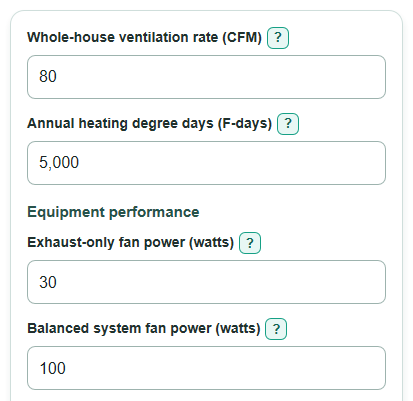
With 80 CFM, 5,000 heating degree days, and 75 percent recovery, the balanced system is modeled with 25 percent of the exhaust-only sensible ventilation heating load. Its fan electricity can still be higher if its Balanced system fan power is higher, so the calculator includes both effects before comparing costs.
Catch-up timing
The calculator adds each option's installed cost and yearly costs one year at a time. The First year balanced ventilation catches up is the earliest year when cumulative balanced cost is no greater than cumulative exhaust-only cost. If that never happens during Years to compare, it shows Not within the selected period.