
Compare yearly HRV and ERV operating costs using your home's airflow, climate, utility prices, fan power, and recovery settings.
Advanced options
Table of contents
How to use our HRV vs ERV Operating Cost Calculator
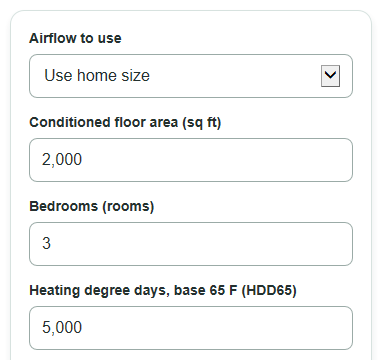
- Choose Airflow to use. Use Conditioned floor area and Bedrooms for a home-size estimate, or choose manual and enter Manual outdoor airflow.
- Enter Heating degree days, base 65 F and Electricity price. Local yearly degree days and your all-in $ per kWh make the estimate more useful.
- Open advanced options if you know your equipment details. Update HRV fan power, ERV fan power, heat recovery percentages, Cooling system rating, and moisture inputs.
- Click Calculate and read ERV yearly cost minus HRV yearly cost first. A negative number means the ERV is cheaper to run; a positive number means the HRV is cheaper to run.
- Sanity-check the result by comparing Outdoor airflow used in the estimate with your design CFM and checking whether ERV moisture cooling credit is zero when you did not enter a moisture cooling load.
Definitions
HRV: A heat recovery ventilator. It brings in outdoor air and exhausts indoor air while transferring normal temperature heat between the two air streams.
ERV: An energy recovery ventilator. It works like an HRV, but it can also transfer some moisture between air streams.
CFM: Cubic feet per minute. It is the airflow rate used for outdoor ventilation.
Heating degree days, base 65 F: A yearly measure of how much and how often outdoor temperatures are below 65 F. More HDD65 usually means more heating load [1].
Cooling degree days, base 65 F: A yearly measure of how much and how often outdoor temperatures are above 65 F. More CDD65 usually means more cooling load [2].
Sensible heat: Temperature-based heat. It is the normal heating or cooling load from air being warmer or colder.
Moisture recovery: The ERV's estimated percent reduction in the cooling electricity caused by outdoor humidity, based on the moisture load you enter.
SEER: Seasonal Energy Efficiency Ratio. It is cooling output in Btu for each watt-hour of electricity over a cooling season.
Common mistakes and quick fixes
Mistake: Using total house size, including garages or unfinished space, in Conditioned floor area .
Fix: Enter only heated and cooled living area in Conditioned floor area .
Mistake: Choosing manual airflow but leaving Manual outdoor airflow blank or using a supply fan rating instead of outdoor ventilation CFM.
Fix: Enter the planned outdoor air rate in Manual outdoor airflow , in CFM.
Mistake: Entering a gas bill price in Electricity price or entering cents as 16 instead of dollars as 0.16.
Fix: Use your electric bill's all-in $ per kWh value for Electricity price .
Mistake: Setting HRV heat recovery or ERV heat recovery above 100 because the product brochure lists several ratings.
Fix: Use a percent from 0 to 100 for each heat recovery field, preferably the rating closest to your design airflow.
Mistake: Expecting ERV moisture cooling credit to appear while Moisture cooling before ERV is 0.
Fix: Enter a yearly kWh estimate in Moisture cooling before ERV if you want the ERV moisture recovery to change the dollar comparison.
Mistake: Reading ERV yearly cost minus HRV yearly cost as a savings amount without checking the sign.
Fix: Negative means the ERV costs less per year; positive means the ERV costs more per year.
Limitations & Key Assumptions / Boundary Conditions
- The estimate uses yearly heating and cooling degree days, not hourly weather, wind, solar gain, or indoor setpoint changes.
- The home-size airflow estimate is a simple floor-area and bedroom method. A code official, designer, or equipment schedule may require a different CFM.
- Heating cost is entered as $ per million Btu of room heat, so fuel price and heating equipment efficiency must already be reflected in that number.
- The moisture credit is only as good as Moisture cooling before ERV. If that input is 0, the calculator does not model latent or humidity savings.
- Fan power is treated as constant whenever ventilation runs. Real fan watts can change with duct pressure, speed settings, filters, and frost-control operation.
- The result compares operating cost only. It does not include purchase price, installation cost, maintenance, comfort, indoor humidity targets, or equipment lifespan.
Methodology
Airflow used
If Airflow to use is set to home size, the calculator estimates outdoor airflow from conditioned floor area and bedrooms.
cfm = 0.03 * floor_area_sqft + 7.5 * (bedrooms + 1)
If manual airflow is selected, the calculator uses Manual outdoor airflow instead and ignores the floor area and bedroom fields.
Heating, cooling, fan, and moisture costs
The temperature-based heating load uses the common HVAC sensible heat factor 1.08, CFM, heating degree days, run time, and the device heat recovery percent.
heating_btu = 1.08 * cfm * heating_degree_days_65f * operating_hours_per_day * (1 - sensible_effectiveness_percent / 100)
heating_cost = heating_btu / 1000000 * heating_cost_per_mmbtu
The sensible cooling cost uses the same style of degree-day load, then converts Btu to cooling electricity with SEER and prices that electricity.
cooling_sensible_cost = (1.08 * cfm * cooling_degree_days_65f * operating_hours_per_day * (1 - sensible_effectiveness_percent / 100)) / (cooling_seer * 1000) * electricity_price_per_kwh
Fan electricity is calculated separately for the HRV and ERV because the watt values can be different.
fan_cost = fan_watts * operating_hours_per_day * 365 / 1000 * electricity_price_per_kwh
The HRV is assigned the full moisture cooling cost you enter. The ERV gets a credit based on its moisture recovery percent.
annual_moisture_cooling_credit = moisture_cooling_kwh_year * electricity_price_per_kwh * erv_moisture_recovery_percent / 100
hrv_total = hrv_heating_cost + hrv_cooling_sensible_cost + hrv_fan_cost + hrv_moisture_cost
erv_total = erv_heating_cost + erv_cooling_sensible_cost + erv_fan_cost + erv_moisture_cost
erv_minus_hrv_annual_cost = erv_total - hrv_total
Mini example
For a 2,000 sq ft home with 3 bedrooms, the home-size airflow is 0.03 * 2000 + 7.5 * (3 + 1) = 90 CFM. With 5,000 HDD65, 1,000 CDD65, 24 hours per day, $0.16 per kWh, $15 per million Btu of room heat, 16 SEER cooling, 80 W HRV fan power, 90 W ERV fan power, 70 percent heat recovery for both units, 500 kWh per year of moisture cooling before ERV, and 50 percent ERV moisture recovery, the HRV fan cost is $112.13 per year and the ERV fan cost is $126.14 per year. The ERV moisture cooling credit is $40.00 per year. The estimated HRV yearly operating cost is $251.61, the estimated ERV yearly operating cost is $225.63, and the signed gap is -$25.98 per year, so the ERV is cheaper to run in that example.