
Estimate fleet EV charging cost, cost per mile, yearly cost, and whether the charger plan fits the daily charging window.
Advanced options
Table of contents
How to use our EV Fleet Charging Cost Calculator
- Enter Number of EVs, Miles per EV per driving day, and Driving days per month for the fleet you want to model.
- Enter Energy use and Electricity price using the same billing units shown in the labels.
- Open Advanced options if you want to add Demand charge, Fixed monthly fee, Number of chargers, Power per charger, Charging window per day, Charging efficiency, or Number display.
- Select Calculate and read Estimated monthly fleet charging cost first, then check Charging window used and Charging power gap to see if the charger plan is practical.
- Sanity-check the output: if Fleet charging cost per mile or Monthly energy from the electric meter looks far from your bill or vehicle data, recheck Energy use, Electricity price, and Charging efficiency.
Definitions
kWh: Kilowatt-hour, a measure of electrical energy. EV batteries and electric bills often use kWh.
kW: Kilowatt, a measure of power. A charger with more kW can move energy faster.
Energy use: The kWh needed to drive 1 mile. A higher Energy use value raises energy cost and charging time.
Electricity price: The $ per kWh charged for energy. It is separate from Demand charge and Fixed monthly fee.
Demand charge: A $ per kW charge based on peak charging power, if your utility or site bill has one.
Charging efficiency: The percent of meter energy that reaches the vehicle battery after charging losses.
Charging window used: The percent of the available daily charging capacity needed by the fleet.
Charging power gap: Needed plug power minus available plug power. Positive means more kW is needed; negative means extra kW is available.
Common mistakes and quick fixes
Mistake: Entering Energy use as miles per kWh instead of kWh per mile.
Fix: Convert it before calculating, or use the vehicle data value that matches the Energy use label.
Mistake: Using the whole business electric bill as Electricity price.
Fix: Use the energy rate in $ per kWh for Electricity price, then enter separate Demand charge or Fixed monthly fee only if they apply to charging.
Mistake: Leaving Charging efficiency at 100 percent when the fleet loses energy during charging.
Fix: Use a realistic Charging efficiency value, such as your measured site value, because it changes Monthly energy from the electric meter.
Mistake: Reading a negative Charging power gap as an error.
Fix: Keep the signed value; a negative Charging power gap means the entered chargers have extra power for the daily window.
Mistake: Ignoring Charging window used when Estimated monthly fleet charging cost looks affordable.
Fix: If Charging window used is over 100 percent, change Number of chargers, Power per charger, Charging window per day, or daily miles before relying on the cost estimate.
Limitations & Key Assumptions / Boundary Conditions
- The calculator uses only the values you enter. It does not look up local utility tariffs, taxes, time-of-use prices, incentives, or site-specific fees.
- Estimated peak charging power assumes all entered chargers can run at their entered Power per charger at the same time.
- Charging window capacity is a simple energy check. It does not schedule vehicles, assign plugs, model blocked chargers, or account for vehicles arriving at different battery levels.
- Estimated yearly fleet charging cost multiplies one monthly estimate by 12, so seasonal route changes or rate changes can make the real yearly cost different.
- Fleet charging cost per mile includes optional Demand charge and Fixed monthly fee when entered, so it can be higher than an energy-only $ per mile value.
- Charging efficiency must be above 0 percent and no more than 100 percent. Charger count, charger power, and charging window must be positive for the capacity check.
Methodology
Core cost math
The calculator first estimates fleet miles for one month from the vehicle count, daily route length, and driving days.
monthly_miles = vehicle_count * miles_per_vehicle_per_day * driving_days_per_month
It then estimates the energy the vehicles need and adjusts it for Charging efficiency to get the energy from the electric meter.
monthly_grid_energy_kwh = monthly_miles * energy_use_kwh_per_mile / (charging_efficiency_percent / 100)
Monthly cost adds energy cost, optional demand charge cost, and optional fixed monthly fee.
estimated_peak_charging_power_kw = charger_count * charger_power_kw
monthly_fleet_charging_cost = monthly_grid_energy_kwh * electricity_rate_per_kwh + estimated_peak_charging_power_kw * demand_charge_per_kw + fixed_monthly_fee
fleet_cost_per_mile = monthly_fleet_charging_cost / monthly_miles
annual_fleet_charging_cost = monthly_fleet_charging_cost * 12
Charging-window check
The daily energy need uses the same vehicle count, daily miles, and energy use. The available daily charger energy uses charger count, charger power, charging hours, and efficiency.
daily_vehicle_energy_kwh = vehicle_count * miles_per_vehicle_per_day * energy_use_kwh_per_mile
charger_utilization_percent = daily_vehicle_energy_kwh / (charger_count * charger_power_kw * charging_window_hours * charging_efficiency_percent / 100) * 100
charging_power_gap_kw = daily_vehicle_energy_kwh / (charging_window_hours * charging_efficiency_percent / 100) - estimated_peak_charging_power_kw
If Charging window used is over 100 percent, the cost math can still be true, but the entered chargers cannot deliver the needed daily energy inside the entered time window. A positive Charging power gap shows how many more kW are needed under the same hours and efficiency.
Mini-example
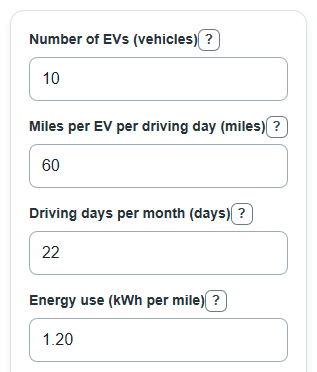
For 10 EVs driving 60 miles per EV per driving day for 22 days, monthly miles are 13,200. At 1.20 kWh per mile and 90 percent Charging efficiency, Monthly energy from the electric meter is 17,600 kWh. At $0.15 per kWh with no Demand charge and no Fixed monthly fee, Estimated monthly fleet charging cost is $2,640, Fleet charging cost per mile is $0.20, and Estimated yearly fleet charging cost is $31,680. With 5 chargers at 19.2 kW for 10 hours, Charging window used is 83.3 percent and Charging power gap is -16.0 kW, meaning the entered charger power is above the simple minimum needed for that daily window.
Calculation choices
Electricity price may be 0, but core driving inputs must be positive. Optional Demand charge and Fixed monthly fee may be 0 but cannot be negative. The Charging power gap stays signed because a negative value is useful: it means the entered charger setup has extra power under the simple capacity check.