
Use this calculator to turn enzyme assay data into enzyme activity, U/mL, specific activity, and SI units from either product data or absorbance slope.
Advanced options
Absorbance settings (for absorbance mode)
Protein (only if you want U per mg)
Display
How to use our Enzyme Activity Calculator
- Choose What do you have?, then enter the matching core inputs: either Product amount with its unit, or absorbance values in Advanced options.
- Enter Measured time, Measured time unit, and Enzyme sample volume (mL) so the calculator can find total activity and Activity per mL of enzyme sample.
- If you used absorbance data, open Advanced options and fill in Absorbance change per minute, Total reaction volume (mL), Extinction coefficient, Extinction coefficient unit, and Path length (cm).
- If you want Specific activity, add Protein concentration (mg/mL) and Protein sample volume used for protein mass (mL).
- Click Calculate, then sanity-check that Reaction rate matches Enzyme activity numerically in U and that the sign makes sense for your assay direction.
Definitions
Enzyme activity (U): Total activity in the assayed portion. One enzyme unit means 1 umol of reaction per minute under the assay conditions.
Activity per mL of enzyme sample (U/mL): Activity divided by Enzyme sample volume (mL). This helps compare enzyme solutions tested at different volumes.
Specific activity (U/mg): Activity divided by protein mass. It shows how much activity you have per mg of protein and is commonly used to judge purification quality [2].
Extinction coefficient: A number that tells how strongly a molecule absorbs light at a chosen wavelength. In absorbance mode, it is used with Beer-Lambert law to convert absorbance change into concentration change [1].
Path length (cm): The distance light travels through the sample. A standard cuvette is often 1 cm, but microplates are often different.
Katal (kat) and nanokatal (nkat): SI units for catalytic activity. They are another way to express the same activity shown in U.
Common mistakes and quick fixes
Mistake: Entering absorbance data while What do you have? is still set to product mode.
Fix: Switch What do you have? to the absorbance option so Absorbance change per minute is used and Product amount is ignored.
Mistake: Typing 300 in Product amount but leaving Product amount unit as umol when the data were really nmol.
Fix: Match Product amount unit to your lab note before calculating.
Mistake: Entering seconds in Measured time but leaving Measured time unit on minutes.
Fix: Change Measured time unit to seconds so the rate is converted correctly.
Mistake: Using the total assay mix instead of the added enzyme volume for Enzyme sample volume (mL) .
Fix: Enter only the enzyme solution volume added to the assay if you want a correct Activity per mL of enzyme sample .
Mistake: Leaving Path length (cm) at 1 for a microplate assay without checking the real optical path.
Fix: Use the actual Path length (cm) for your setup, because the absorbance formula depends on it directly.
Mistake: Entering Protein concentration (mg/mL) but forgetting Protein sample volume used for protein mass (mL) .
Fix: Fill in both protein fields so the calculator can show Protein mass used and Specific activity .
Limitations & Key Assumptions / Boundary Conditions
- Results are only as good as the assay inputs and assume the measured slope or product amount comes from the linear part of the reaction.
- Enzyme activity in U is assay-dependent, so values can change with temperature, pH, substrate level, wavelength, and how the assay defines reaction direction.
- In absorbance mode, the math assumes Beer-Lambert behavior and needs a correct Extinction coefficient, matching unit, and correct Path length (cm).
- Microplate assays often do not have a 1 cm path length, so using 1 cm by default can misstate activity.
- Specific activity is shown only when protein inputs are provided and positive; it reflects the protein amount in the assayed portion, not necessarily the whole sample tube.
- Negative absorbance slopes are allowed and give negative signed activity, which can be valid for depletion assays or opposite sign conventions.
- This calculator converts units consistently, but it does not decide whether your assay chemistry, blank correction, or extinction coefficient choice is appropriate.
Methodology
Core calculation steps
First, the calculator converts all inputs to a common base so the final rate is in umol per minute.
rate_umol_per_min = product_umol / time_min
In product mode, product_umol is the entered Product amount converted to umol, and time_min is Measured time converted to minutes.
activity_u = rate_umol_per_min
Because 1 U is defined as 1 umol per minute, the number for Enzyme activity is the same as the number for Reaction rate.
activity_u_per_ml = activity_u / sample_volume_ml
This gives Activity per mL of enzyme sample by dividing total activity by the entered Enzyme sample volume (mL).
Absorbance mode
For absorbance data, the calculator uses the Beer-Lambert relationship to turn absorbance change into concentration change [2].
ext_coeff_M_inv_cm_inv = ext_coeff
ext_coeff_M_inv_cm_inv = ext_coeff * 1000
If Extinction coefficient unit is mM^-1 cm^-1, the value is multiplied by 1000 so the working unit becomes M^-1 cm^-1.
dc_dt_M_per_min = delta_a_per_min / (ext_coeff_M_inv_cm_inv * path_length_cm)
reaction_volume_L = reaction_volume_ml * 0.001
activity_u = dc_dt_M_per_min * reaction_volume_L * 1000000
This converts concentration change per minute into total umol per minute in the full reaction mixture.
Specific activity and SI units
protein_mass_mg = protein_conc_mg_ml * protein_sample_volume_ml
specific_activity_u_per_mg = activity_u / protein_mass_mg
Specific activity is activity divided by the protein mass present in the assayed sample portion [2].
activity_kat = activity_u / 60000000
activity_nkat = activity_kat * 1000000000
These formulas convert U into the SI unit katal and then into nanokatals.
Mini example
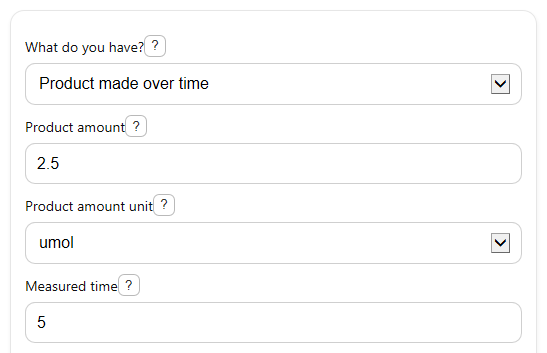
If Product amount is 2.5 umol, Measured time is 5 minutes, and Enzyme sample volume (mL) is 0.1, then the rate is 2.5 / 5 = 0.5 umol/min, so Enzyme activity is 0.5 U and Activity per mL of enzyme sample is 0.5 / 0.1 = 5 U/mL. If protein concentration is 2 mg/mL and protein sample volume is 0.1 mL, then protein mass is 0.2 mg and Specific activity is 0.5 / 0.2 = 2.5 U/mg.
Assumptions behind the math
The calculator assumes your measured time window represents a valid assay rate, ignores hidden fields that do not belong to the chosen mode, and does not force negative rates to zero. If a negative slope is entered, the result stays negative so you can match your assay sign convention or depletion setup.