
Compare combi and separate-system ownership costs, replacement timing, and hot-water capacity over the years you expect to own your home.
Installed quotes
Annual energy
Replacement timing
Hot-water capacity
Advanced options
Maintenance and repairs
Future-cost assumptions
Table of contents
How to use our Combi Boiler vs Separate System Lifetime Cost Calculator
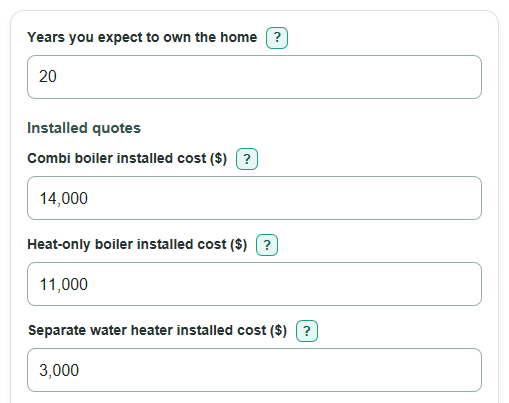
- Enter the years you expect to own the home, then replace the example installed costs with complete contractor quotes for each option.
- Enter annual energy costs from bills, proposals, or estimates. Keep the heat-only boiler and separate water-heater costs separate.
- Enter each appliance's replacement cycle so the calculator can schedule replacements before your ownership period ends.
- Choose the separate water-heater capacity method. For storage, enter busiest-hour gallons and First Hour Rating; for tankless, enter its flow rating at the same temperature rise.
- Check the lower estimated lifetime-cost option and the hot-water-capacity screening result. A negative capacity margin means the entered rating is below your demand.
Definitions
Combi boiler: One appliance that provides space heating and domestic hot water.
Heat-only boiler: A boiler used for space heating that works with a separate water heater for domestic hot water.
First Hour Rating: The gallons of hot water a storage water heater can deliver during a busy one-hour period. It is different from tank size.
Temperature rise: The difference between incoming-water temperature and delivered hot-water temperature, in degrees F. Flow ratings must use the same rise to be compared.
Peak simultaneous hot-water use: The gallons per minute needed when fixtures such as showers or faucets run at the same time.
Replacement cycle: The number of years between planned appliance replacements in this estimate.
Discount rate: A planning rate that reduces the present value of costs paid in later years.
Common mistakes and quick fixes
Mistake: Comparing quotes with different work included in Combi boiler installed cost and Heat-only boiler installed cost.
Fix: Make both quotes include the applicable equipment, labor, venting, piping, permits, and removal work before entering them.
Mistake: Including a fixed utility account fee in Combi annual energy cost even though both choices keep the same account.
Fix: Enter the energy-use portion only, unless one option truly adds or removes a utility account.
Mistake: Using tank size instead of Separate water-heater First Hour Rating for a storage water heater.
Fix: Enter the listed First Hour Rating and compare it with Hot water needed in the busiest hour.
Mistake: Entering a Combi hot-water rating at that rise from a specification measured at a different temperature rise.
Fix: Match the product rating to Temperature rise used for flow ratings before comparing flow values.
Mistake: Treating a negative Separate system cost minus combi cost as an error.
Fix: Keep the signed value. A negative number means the separate system costs less under the entered assumptions.
Mistake: Assuming a passing Hot-water-capacity screening result proves the whole system is sized correctly.
Fix: Use the screen as a demand check, then have a qualified contractor confirm plumbing, heating load, venting, and installation details.
Limitations & Key Assumptions / Boundary Conditions
- This is a planning estimate based on the quotes, annual costs, replacement cycles, and financial assumptions you enter. It does not predict actual equipment failure dates.
- Annual energy and maintenance costs are treated as end-of-year costs. The Annual cost increase applies equally to annual costs and future replacement costs.
- Replacement costs use the current installed cost as the base. A real replacement may have different labor, permit, venting, code, or removal costs.
- A replacement scheduled exactly at the end of Years you expect to own the home is excluded because the estimate ends before that event.
- The hot-water check compares listed capacity with entered demand only. It does not account for pipe sizing, pressure, fixture behavior, incoming-water changes, or a complete heating-load design.
- For a storage unit, use First Hour Rating rather than tank gallons. For combi and tankless units, flow ratings are comparable only at the same Temperature rise used for flow ratings.
- Zero energy or maintenance entries are allowed and are used as entered. They can make the lifetime estimate too low if the cost is unknown rather than truly zero.
Methodology
Lifetime cost calculation
The calculator adds the installed cost, annual running costs, and scheduled replacement costs for each choice. The combi is one appliance. The separate system tracks the heat-only boiler and water heater on independent replacement schedules.
A_c = E_c + M_c
A_s = E_b + E_w + M_b + M_w
In these formulas, A is first-year running cost, E is annual energy cost, and M is annual maintenance and repair allowance. The subscripts c, b, w, and s mean combi, boiler, water heater, and separate system.
F(t) = (1 + g)^t / (1 + d)^t
F(t) adjusts a cost paid t years after installation. The annual cost increase g raises future costs, while discount rate d gives future costs less present-day weight. With both rates set to 0 percent, F(t) equals 1.
T_c = C_c + PV_annual(A_c,H) + PV_replace(C_c,H,L_c)
T_s = C_b + C_w + PV_annual(A_s,H) + PV_replace(C_b,H,L_b) + PV_replace(C_w,H,L_w)
H is the ownership period and L is an appliance replacement cycle. A replacement is counted only when its scheduled year is before H.
G = T_s - T_c
A positive cost gap means the separate system costs more, so the combi costs less. A negative gap means the separate system costs less.
Capacity screen
Combi flow margin = combi rated GPM - peak simultaneous hot-water use
Storage first-hour margin = First Hour Rating - busiest-hour demand
A margin of zero or more passes the entered screen. A negative margin is a shortfall and remains negative in the result.
Worked example
For 20 years, a $14,000 combi with a $2,050 first-year running cost and one $14,000 replacement totals $69,000 when both financial rates are 0 percent. A separate system with $11,000 boiler cost, $3,000 water-heater cost, $2,350 yearly running cost, and one $3,000 water-heater replacement totals $64,000. The signed cost gap is -$5,000, meaning the separate system costs less in this example.
Scope of the estimate
Annual costs are treated as paid at the end of each year. The calculation uses the entered current installed cost as the base for later replacements, then applies the chosen cost increase and discount rate. It does not model repairs as one-time events, changes in household demand, tax credits, financing, resale value, or detailed plumbing and heat-loss design.