
Estimate when business cash may get tight over the next 13 weeks using weekly cash in, weekly cash out, and timed bills.
| Week | Ending cash |
|---|
Table of contents
How to use our Business Cash Flow Calculator
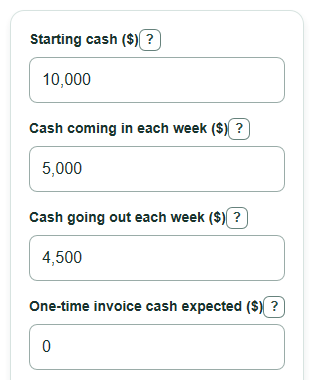
- Enter Starting cash, which is the cash available at the start of week 1. A negative number is allowed if the account is already overdrawn.
- Enter Cash coming in each week and Cash going out each week as weekly cash amounts, not unpaid sales or bills you have not paid yet.
- Add any One-time invoice cash expected and One-time bill cash due. Use 0 if there is no extra invoice receipt or bill payment in the 13-week period.
- Open Advanced options if timing matters. Choose Week invoice cash arrives, Week bill cash is paid, and set a Safety cash target if you want a warning before cash reaches zero.
- After calculating, sanity-check the 13-week ending cash table. Look for the week after a large bill or before a large invoice, because that is often where the lowest cash point appears.
Definitions
Starting cash: Cash available at the start of week 1 before weekly money in, weekly money out, invoice cash, or bill cash is applied.
Cash coming in each week: The average cash you expect to receive each week, such as collected customer payments.
Cash going out each week: The average cash you expect to pay each week, such as payroll, rent, supplies, debt payments, and other bills.
One-time invoice cash expected: Extra cash expected once during the 13 weeks, separate from normal weekly cash coming in.
One-time bill cash due: Extra cash expected to leave once during the 13 weeks, separate from normal weekly cash going out.
Safety cash target: The cash level you do not want the forecast to go below. It can be 0 if you only care about negative cash.
Net cash change over 13 weeks: Ending cash after week 13 minus starting cash. A negative value means cash decreased.
Common mistakes and quick fixes
Mistake: Using sales booked instead of collected money in Cash coming in each week .
Fix: Enter only cash you expect to receive in the bank each week.
Mistake: Leaving a known one-time payment out of One-time bill cash due .
Fix: Add the full bill amount and set Week bill cash is paid to the week the cash leaves.
Mistake: Putting a monthly number into Cash going out each week .
Fix: Convert the amount to a weekly estimate before entering it.
Mistake: Treating First week below safety cash target of 0 as week 0 in the forecast.
Fix: Read 0 as no week below the target during the 13 weeks.
Mistake: Setting Safety cash target too low when you need a cash cushion for payroll, rent, or supplies.
Fix: Enter the lowest cash balance you are comfortable with, not just 0.
Mistake: Ignoring a negative Lowest weekly ending cash because Ending cash after 13 weeks looks acceptable.
Fix: Use the weekly low point to plan short-term funding or payment timing.
Limitations & Key Assumptions / Boundary Conditions
- This is a cash timing forecast. It is not an income statement, tax report, or accrual accounting report.
- The forecast uses the same Cash coming in each week and Cash going out each week for all 13 weeks, except for the one-time invoice and bill entries.
- The one-time invoice and bill are each placed in one selected week. The calculator does not split them across several weeks.
- Actual bank balances can differ if customers pay late, card deposits settle after a delay, checks clear later, or bills are paid earlier than planned.
- Negative cash is not clamped to 0. A negative ending balance is a warning that the plan may need funding, delayed spending, faster collections, or a timing change.
- The First week below safety cash target uses a strict test. If ending cash exactly equals the target, that week is not counted as below the target.
Methodology
How the forecast is built
The calculator starts with Starting cash and moves through weeks 1 to 13. Each week adds Cash coming in each week, subtracts Cash going out each week, and applies the one-time invoice or bill only in the selected week. This matches basic cash planning: track cash coming in, cash going out, and current cash position [1].
ending_cash_w = ending_cash_(w - 1) + weekly_cash_in - weekly_cash_out + one_time_in_w - one_time_out_w
lowest_weekly_ending_cash = min(ending_cash_1, ending_cash_2, ..., ending_cash_13)
first_week_below_target = first w where ending_cash_w < safety_cash_target, or 0 if none
first_negative_cash_week = first w where ending_cash_w < 0, or 0 if none
net_cash_over_13_weeks = ending_cash_after_13_weeks - starting_cash
Mini-example
If Starting cash is $1,000, Cash coming in each week is $500, Cash going out each week is $700, One-time invoice cash expected is $2,000 in week 4, and One-time bill cash due is $1,500 in week 2, week 1 ends at $800. Week 2 then subtracts the normal $200 weekly net plus the $1,500 bill, so it ends at -$900. Week 4 adds the $2,000 invoice, so it ends at $700. After 13 weeks, ending cash is -$1,100, net cash change is -$2,100, and the lowest weekly ending cash is -$1,100.
How to read the timing outputs
First week below safety cash target shows the earliest week that needs attention compared with your chosen cushion. First week ending cash goes below zero is separate because a business may want to act before cash reaches zero. The 13-week ending cash table shows every week ending balance, so two plans with the same final balance can still show different cash crunch weeks.