
Add hours, minutes, and seconds from several entries, then use the same total to find an ending clock time and day change.
Table of contents
How to use our Add Time Calculator
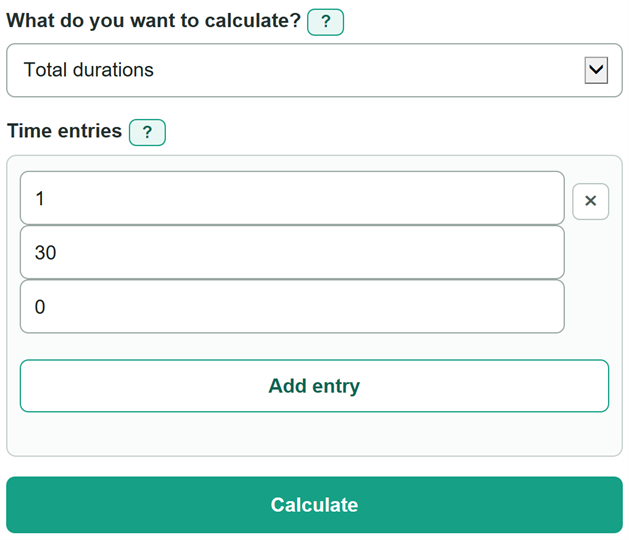
- Choose Total durations to add elapsed time blocks, or choose Find end time to apply their total to a clock time.
- Enter each block in a Time entries row. Use whole numbers for Hours, Minutes, and Seconds; leave an unused part blank.
- For Find end time, choose whether to add or subtract the combined time, then enter the starting clock time from your schedule.
- Click Calculate. Read Combined duration as elapsed time, so a total greater than 24 hours stays greater than 24 hours.
- Check Day change with the ending clock time. For example, 1:15 AM and 1 day later means the next day.
Definitions
Duration: Elapsed time, such as 2 hours 15 minutes. A duration can be longer than 24 hours.
Clock time: A time of day, such as 8:30 AM. It repeats every 24 hours.
Combined duration: The elapsed time from all completed Time entries, shown as hours, minutes, and seconds.
Day change: How many days the ending clock time is after or before the starting day. Zero means the same day.
Decimal hours: Elapsed time written as a decimal for a spreadsheet or time record. For example, 1.5 hours equals 1 hour 30 minutes.
Common mistakes and quick fixes
Mistake: Entering 1.5 in Hours to mean 1 hour 30 minutes.
Fix: Check What do you want to calculate? and then recalculate. Enter 1 in Hours and 30 in Minutes. Each duration field accepts whole units.
Mistake: Entering 60 in Minutes or Seconds.
Fix: Check What do you want to calculate? and then recalculate. Carry 60 seconds into 1 minute, or 60 minutes into 1 hour. Minutes and Seconds must each be from 0 to 59.
Mistake: Reading a combined duration over 24 hours as a clock time.
Fix: Treat Combined duration as elapsed time. For example, 25 hours remains 25 hours, not 1:00.
Mistake: Using Total durations when the question asks when an activity ends.
Fix: Check What do you want to calculate? and then recalculate. Choose Find end time, then enter the start time and choose whether to add or subtract the combined time.
Mistake: Assuming an ending time after midnight is on the same day.
Fix: Read Ending clock time with Day change. A negative day change means an earlier day; a positive one means a later day.
Limitations & Key Assumptions / Boundary Conditions
- The calculator uses elapsed durations and a time of day, not calendar dates. A Day change of 1 means one day later but does not identify a calendar date.
- Hours, Minutes, and Seconds in each Time entries row must be whole numbers. Minutes and Seconds must be from 0 to 59.
- A blank Minutes or Seconds field counts as zero only when another part of the same row has a value. A fully blank row is ignored.
- Start time is treated as a local clock time. Time zones, daylight saving changes, travel, and date-specific schedule rules are not included.
- Decimal hours are converted from elapsed time and are not the same notation as hours and minutes.
Methodology
Adding time entries
Each completed row is converted to seconds before the rows are added. This handles minute and second carry automatically.
row_seconds = hours * 3600 + minutes * 60 + seconds
combined_seconds = sum of all row_seconds values
The combined seconds are split into total hours, remaining minutes, and remaining seconds. Total hours do not wrap after 24 hours.
decimal_hours = combined_seconds / 3600
Finding an ending clock time
For Find end time, the start clock time is converted to seconds after midnight. The combined duration is added or subtracted. Only the displayed clock time wraps within a 24-hour day; Day change keeps the before-or-after-day information.
raw_ending_seconds = start_clock_seconds + applied_duration_seconds
day_change = floor(raw_ending_seconds / 86400)
ending_clock_seconds = raw_ending_seconds - day_change * 86400
Worked example
1 hour 45 minutes 30 seconds plus 30 minutes 45 seconds equals 8,175 seconds, or 2 hours 16 minutes 15 seconds. This is 2.270833 decimal hours. Adding 2 hours 30 minutes to 11:45 PM gives 2:15 AM with a Day change of 1.