
Enter a limiting-reactant charge, conversion, and selectivity to calculate desired-product yield and see where the charged material went.
Advanced options
This is the chemically desired yield before downstream recovery loss.
This includes unreacted material and side-product diversion. It is not automatically waste because unreacted material may be recovered or recycled.
This is not actual product mass unless stoichiometry and molecular weights support a 1:1 mass relationship.
This material remained unreacted and may still be recoverable or recyclable.
Calculation details
This is chemical diversion, not measured by-product mass.
Consumed material includes the desired reaction path and side reactions.
Table of contents
How to use our Reaction Conversion, Selectivity, Yield and Loss Calculator
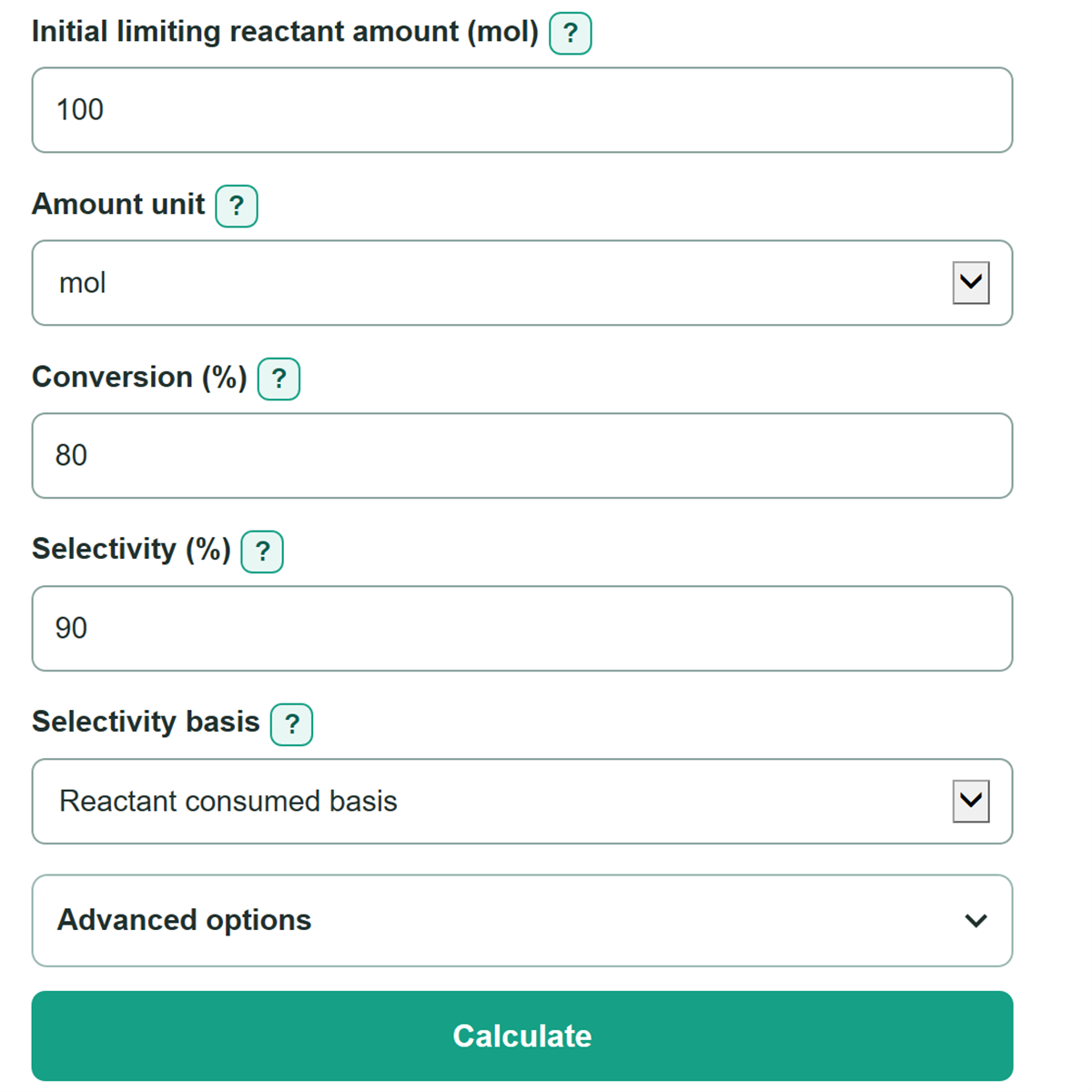
- Enter the Initial limiting reactant amount from your reaction record, then choose the matching Amount unit.
- Enter measured Conversion and Selectivity as percentages from 0 through 100.
- Choose the Selectivity basis stated by the analysis method that produced your selectivity value.
- Enter Product recovery after reaction (%) only if isolation or purification recovery was measured, then select Calculate.
- Check that Desired-product reaction yield equals Conversion times Selectivity, and confirm that the material amounts use the same unit as your initial charge.
Definitions
Limiting reactant: The reactant that sets the maximum amount of product possible for the reaction basis used.
Conversion: The percentage of the initial limiting reactant that reacted.
Selectivity: The percentage assigned to the desired reaction path, using the denominator named in Selectivity basis.
Reactant consumed basis: Selectivity compares desired-product-equivalent material with limiting reactant consumed.
Quantified products basis: Selectivity compares desired product with all significant quantified products after they are expressed on a consistent equivalent basis.
Desired-product reaction yield: Conversion times selectivity on the selected limiting-reactant-equivalent basis. Conversion, selectivity, and yield are related but distinct measures. [1]
Product recovery after reaction: The percentage of chemically desired material recovered during isolation, purification, transfer, or another downstream step.
Limiting-reactant-equivalent material: An amount reported in the same unit as the initial limiting reactant; it is not automatically the actual mass of product.
Common mistakes and quick fixes
Mistake: Entering Conversion as if it were the desired-product yield.
Fix: Enter the measured conversion; Desired-product reaction yield is calculated from both Conversion and Selectivity.
Mistake: Choosing a Selectivity basis that does not match the report or analysis method.
Fix: Use Reactant consumed basis only for a selectivity based on consumed limiting reactant; otherwise choose Quantified products basis when it matches your reported calculation.
Mistake: Treating Unreacted limiting reactant as material that was definitely discarded.
Fix: Read it as material left unreacted. Recovery, recycle, and reuse are outside the base reaction calculation.
Mistake: Reading Desired-product-equivalent material in grams as the actual mass of product.
Fix: It stays on the limiting-reactant-equivalent basis. Convert to actual product mass only with a balanced equation and the needed molecular weights.
Mistake: Putting isolation losses into Selectivity.
Fix: Enter chemical reaction selectivity separately, then use Product recovery after reaction (%) for measured isolation or purification recovery.
Limitations & Key Assumptions / Boundary Conditions
- The calculation assumes Conversion and Selectivity are percentages from 0 through 100 and are measured on a compatible limiting-reactant-equivalent basis.
- For Quantified products basis, all significant products must be quantified and converted to a consistent equivalent basis before entering Selectivity.
- Amount results keep the selected amount unit. A mass result is not actual product mass unless the balanced stoichiometry and molecular-weight relationship support that conversion.
- Unreacted limiting reactant may be recovered, recycled, or reused. The calculator does not estimate that credit.
- Product recovery after reaction covers only the downstream boundary represented by the entered measurement. It does not identify the cause of recovery loss.
- This is a material-accounting calculation, not a kinetic model or a complete process material balance.
Methodology
Calculation method
First, the calculator finds how much limiting reactant was consumed. It then assigns the selected share of that consumed material to the desired reaction path. The remaining consumed material is assigned to side-product diversion.
reacted amount = initial limiting reactant amount x conversion / 100
desired-product reaction yield = conversion x selectivity / 100
desired-product-equivalent material = initial limiting reactant amount x conversion x selectivity / 100 / 100
unreacted limiting reactant = initial limiting reactant amount - reacted amount
material diverted to side products = reacted amount - desired-product-equivalent material
potential raw-material loss before reuse = initial limiting reactant amount - desired-product-equivalent material
Optional recovery calculation
If Product recovery after reaction (%) is entered, it is applied after the chemical reaction calculation. This keeps physical recovery loss separate from side-product formation.
overall isolated-product yield = desired-product reaction yield x recovery / 100
isolated-product-equivalent material = desired-product-equivalent material x recovery / 100
desired material lost during recovery = desired-product-equivalent material - isolated-product-equivalent material
Worked example
With an initial charge of 100 mol, Conversion of 80%, and Selectivity of 90%, 80 mol reacts. Desired-product reaction yield is 72%, so desired-product-equivalent material is 72 mol. The remaining 20 mol is unreacted, and 8 mol is assigned to side products. If recovery is 80%, isolated-product-equivalent material is 57.6 mol and recovery loss is 14.4 mol.
Calculation choices
The calculator uses 100 percentage points per whole. It accepts the two named selectivity bases because the denominator must be known to interpret a selectivity value. It does not convert between reactant mass and product mass, estimate unmeasured products, or assume unreacted material is discarded.