
Enter shop measurements to estimate plating solution carried into rinses and its annual chemical replacement value.
Calculation details
Table of contents
How to use our Plating Drag-Out Loss, Rinse Load and Chemical Cost Calculator
- Choose Direct rate if you measured Drag-out per load, or choose Water balance if you have daily bath flow records.
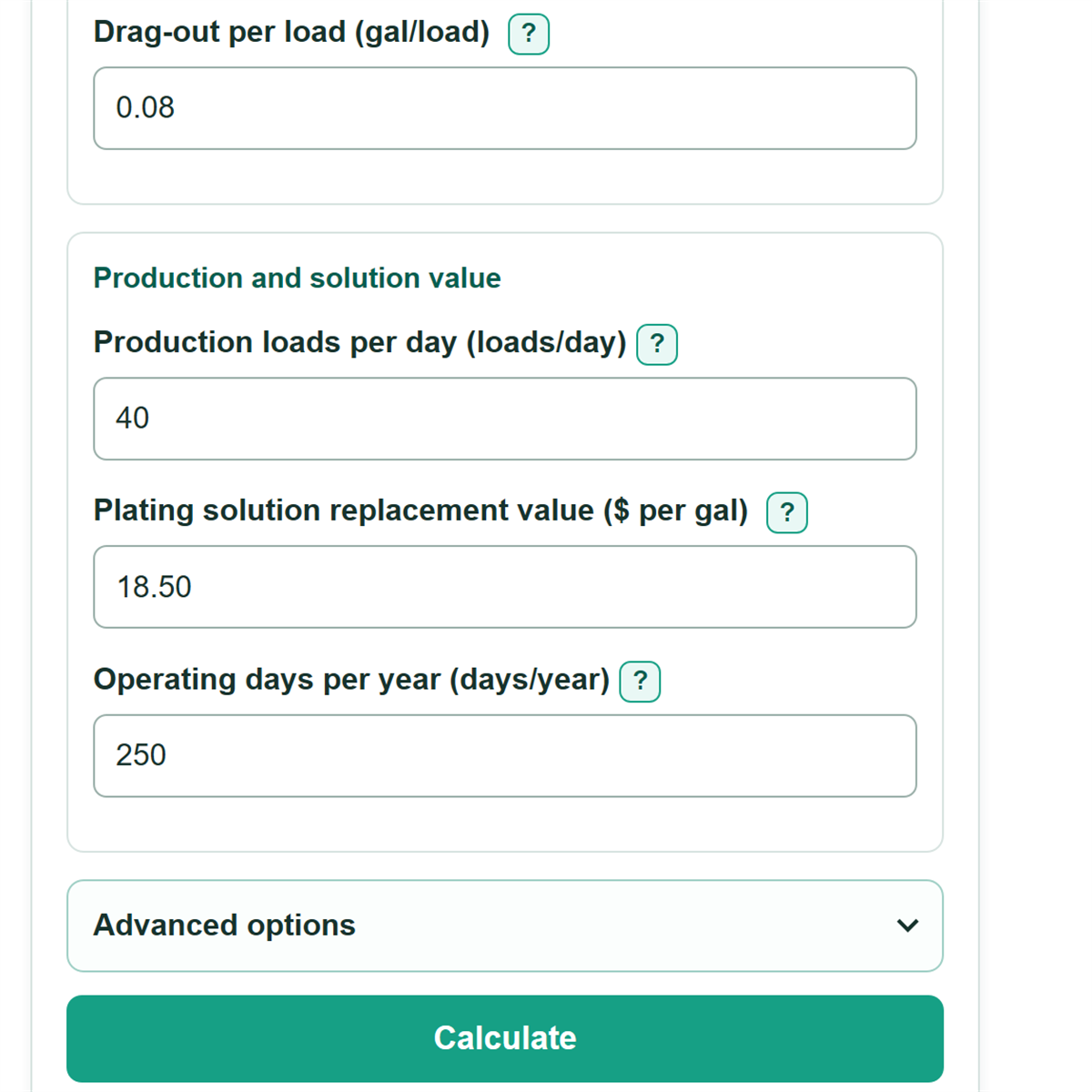
- Enter Production loads per day, Plating solution replacement value, and Operating days per year from records that use the same load and time period.
- For Water balance, enter Water added to the bath, Water lost to evaporation, Bleed, overflow, and filter discharge, and the signed Bath level change.
- Optionally enter Low drag-out measurement (gal/load) and High drag-out measurement (gal/load) from repeated tests to see a range.
- Check that the daily carryover and annual cost fit your production records; if they do not, confirm the load count, measurement period, and solution value before using the estimate.
Definitions
Drag-out: Plating solution that leaves the bath on parts, racks, barrels, baskets, or tooling.
Water balance: A way to infer daily drag-out by accounting for water added, evaporation, other liquid discharge, and the bath volume change.
Evaporation: Water that leaves as vapor. It does not directly carry dissolved bath chemicals into rinses. [1]
Bath level change: The net change in bath liquid volume during the daily period. A rise is positive; a drop is negative.
Rinse carryover: Dragged-out plating solution entering the rinse system. It is not the same as total clean rinse makeup water.
Replacement value: Your facility's estimated value of one gallon of working plating solution, in $/gal.
Common mistakes and quick fixes
Mistake: Entering a daily drag-out amount in Drag-out per load .
Fix: Divide the measured daily amount by Production loads per day , or use Water balance.
Mistake: Treating Water lost to evaporation as plating solution carried into rinses.
Fix: Enter evaporation separately; it is subtracted from the water balance and is not rinse carryover.
Mistake: Entering a falling bath volume as a positive Bath level change .
Fix: Enter a rise as positive and a drop as negative.
Mistake: Using a component chemical price for Plating solution replacement value when the value already includes the full working solution.
Fix: Enter one facility replacement value per gallon and do not add component costs again.
Mistake: Setting Low drag-out measurement (gal/load) above the nominal rate or High drag-out measurement (gal/load) below it.
Fix: Use a low value at or below the nominal rate and a high value at or above it.
Limitations & Key Assumptions / Boundary Conditions
- The estimate treats all nominal drag-out as plating solution entering rinses and gives no credit for recovery, return drainage, or reclaimed chemicals.
- Water-balance entries must cover the same daily period and must reflect a stable, correctly measured bath inventory.
- The calculator estimates chemical replacement value only. It excludes water, sewer, treatment, disposal, energy, labor, equipment, and capital costs.
- Results depend on the load definition. A rack, barrel, or basket used for Production loads per day must match the unit used for drag-out measurement.
- Low and high results are measurement-based scenarios, not statistical confidence limits.
- Bath composition, concentration control, solution value, and operating conditions can change over time, so update inputs when the process changes.
Methodology
Calculation method
Direct rate starts with the measured plating solution carried out by one load. Water balance instead infers the daily amount after subtracting water-only evaporation, recorded liquid discharge, and any bath volume increase from added water. [1]
daily drag-out = drag-out per load x production loads per day
daily drag-out = water added - evaporation - bleed, overflow, and filter discharge - bath level change
A positive bath level change means the bath ended the period with more liquid, so it reduces inferred drag-out. A negative level change means the bath fell and increases inferred drag-out.
carryover per load = daily drag-out / production loads per day
annual rinse carryover = daily drag-out x operating days per year
annual chemical loss cost = annual rinse carryover x plating solution replacement value
chemical loss cost per load = carryover per load x plating solution replacement value
Low and high measurements
If a low or high drag-out measurement is entered, the calculator multiplies that gal/load value by production loads per day and operating days per year. A blank bound uses the nominal per-load result for that side of the range.
annual range carryover = selected drag-out rate x production loads per day x operating days per year
annual range cost = annual range carryover x plating solution replacement value
Worked example
With 0.08 gal/load, 40 loads/day, 250 days/year, and $18.50/gal, daily carryover is 3.2 gal/day. Annual carryover is 800 gal/year, and estimated annual chemical loss cost is $14,800.