
Scale a jar-test coagulant dose into daily liquid product use, pump feed rate, and chemical cost using your plant and supplier values.
Plant operation
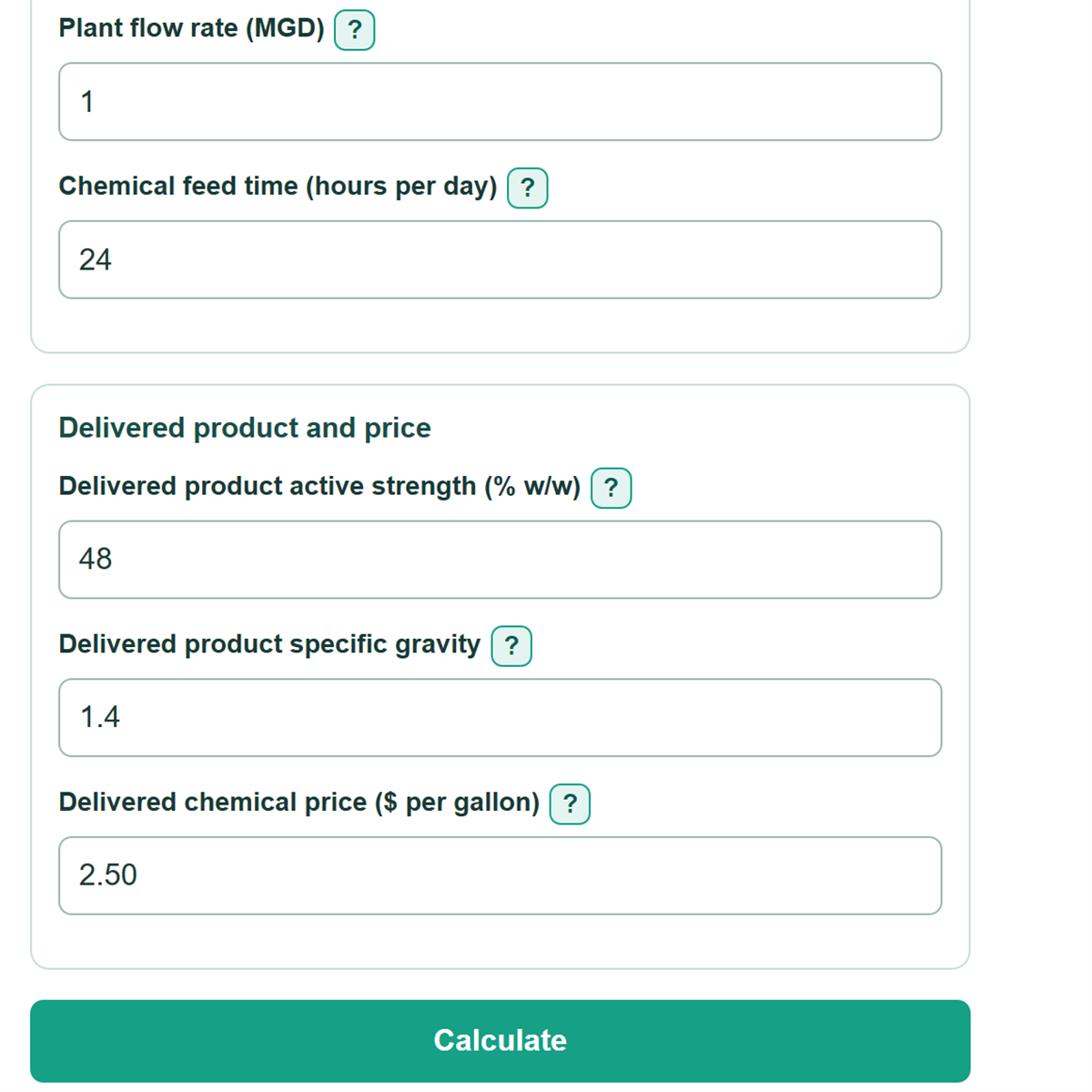
Delivered product and price
Table of contents
How to use our Jar Test Dose Scale-Up, Daily Coagulant Usage and Cost Calculator
- Choose "Use jar-test dose" if your worksheet already gives an active dose in mg/L. Choose "Build dose from lab measurements" if you recorded stock added to the jar, stock concentration, and jar sample volume.
- Enter the Plant flow rate (MGD) and Chemical feed time (hours per day) from the operating record or control schedule.
- Copy Delivered product active strength (% w/w) and Delivered product specific gravity from the current supplier document. Make sure they use the same active-ingredient basis as the jar-test dose.
- Enter the Delivered chemical price ($ per gallon) from a quote, purchase order, or invoice, then select Calculate.
- Sanity-check that Active coagulant dose used matches the chosen jar-test result and that Liquid feed rate while running is within the pump's reliable operating range before using it as a feed target.
Definitions
Active coagulant dose (mg/L): Mass of active chemical applied to each liter of treated water. It is the dose used to scale daily chemical demand.
Stock active concentration (g/L): Active chemical mass in each liter of the prepared lab stock solution. One g/L equals one mg/mL.
MGD: Million gallons per day, a daily plant-flow unit.
Active strength (% w/w): The percentage of the delivered liquid product that is the active ingredient by weight.
Specific gravity: A density comparison with water. It helps convert delivered product mass into delivered liquid gallons.
Delivered liquid product: The supplied chemical solution, including water and other non-active material, rather than active chemical alone.
Common mistakes and quick fixes
Mistake: Entering mL pipetted into a jar as Jar-test active dose (mg/L).
Fix: Choose "Build dose from lab measurements" and enter Stock added to jar (mL), Stock active concentration (g/L), and Jar sample volume (L).
Mistake: Using a dose basis that does not match Delivered product active strength (% w/w).
Fix: Confirm both values refer to the same active ingredient and chemical basis on the jar-test record and supplier document.
Mistake: Treating Delivered product specific gravity as if it were the strength percentage.
Fix: Enter both values separately. Delivered product active strength (% w/w) changes product mass, while Delivered product specific gravity converts that mass to gallons.
Mistake: Entering a per-pound or per-ton price in Delivered chemical price ($ per gallon).
Fix: Use the delivered liquid price per gallon because Daily chemical cost is calculated from Delivered liquid product needed per day in gallons.
Mistake: Using 24 for Chemical feed time (hours per day) when the feed system runs only part of the day.
Fix: Enter the actual run time. This changes Liquid feed rate while running, even though the daily product amount stays the same for the same daily flow and dose.
Mistake: Reusing an old Jar-test active dose (mg/L) after raw-water conditions change.
Fix: Perform or review a current jar test and recalculate the feed target with the new dose and Plant flow rate (MGD).
Limitations & Key Assumptions / Boundary Conditions
- The calculation scales the entered jar-test dose. It does not choose or verify the best treatment dose. Jar testing should be reviewed when raw-water conditions change.[1]
- The jar-test dose and Delivered product active strength (% w/w) must use the same active-ingredient basis. A basis mismatch can produce a wrong feed and cost result.
- Daily chemical cost includes only delivered liquid gallons multiplied by Delivered chemical price ($ per gallon). It excludes freight, minimum-order charges, tank rental, disposal, pump electricity, and other costs.
- Liquid feed rate while running is an average rate during the entered Chemical feed time (hours per day). Confirm actual pump calibration, turndown, stroke settings, and control behavior separately.
- Zero Plant flow rate (MGD) produces zero chemical use and zero daily cost. Chemical feed time must be greater than zero and no more than 24 hours per day.
- Results use a US gallon equal to 3.785411784 liters. Rounding in displayed results can cause small differences from manual calculations.
Methodology
Dose and daily active mass
In direct-dose mode, the recorded jar-test active dose is used without changing it. In lab-measurements mode, the stock addition is converted to an active dose because 1 g/L is equal to 1 mg/mL.
active dose (mg/L) = stock added to jar (mL) * stock active concentration (g/L) / jar sample volume (L)
The plant flow is changed from MGD to liters per day, then multiplied by the active dose.
daily treated volume (L/day) = plant flow (MGD) * 1,000,000 * 3.785411784
active coagulant (kg/day) = active dose (mg/L) * daily treated volume (L/day) / 1,000,000
Delivered product and cost
The active mass is divided by the active-strength fraction to find delivered product mass. Specific gravity then changes that mass into US gallons of supplied liquid.
delivered product mass (kg/day) = active coagulant (kg/day) / (active strength (% w/w) / 100)
delivered liquid product (gal/day) = delivered product mass (kg/day) / (specific gravity * 3.785411784)
liquid feed rate (gal/hr) = delivered liquid product (gal/day) / chemical feed time (hours/day)
daily chemical cost ($/day) = delivered liquid product (gal/day) * delivered chemical price ($/gallon)
Worked example
For a 20 mg/L active dose, 1 MGD flow, 48% active product, specific gravity of 1.4, 24 feed hours, and $2.50 per gallon, active demand is 75.71 kg/day. The calculator gives 29.76 gal/day of delivered product, 1.24 gal/hr while running, and $74.40/day.
Calculation choices
The calculation treats MGD as the daily treated-water flow basis and treats one liter of water as 1 kg when applying specific gravity. It calculates only usage-dependent product cost, not fixed or service charges. A jar test is used to identify a dose for the water being treated; operators should revisit that dose as water conditions change.[1]