
Estimate column size, cycle count, resin replacements, and resin-only campaign cost from your batch load, capacity, recovery, and resin plan.
Calculation details
Table of contents
How to use our Chromatography Resin Capacity and Cost Calculator
- Enter the product mass for one batch and a Dynamic binding capacity, DBC (g per L resin) that matches your target, feed, flow conditions, and test method.
- Enter DBC used for loading (percent) once; do not reduce the DBC elsewhere for the same loading allowance.
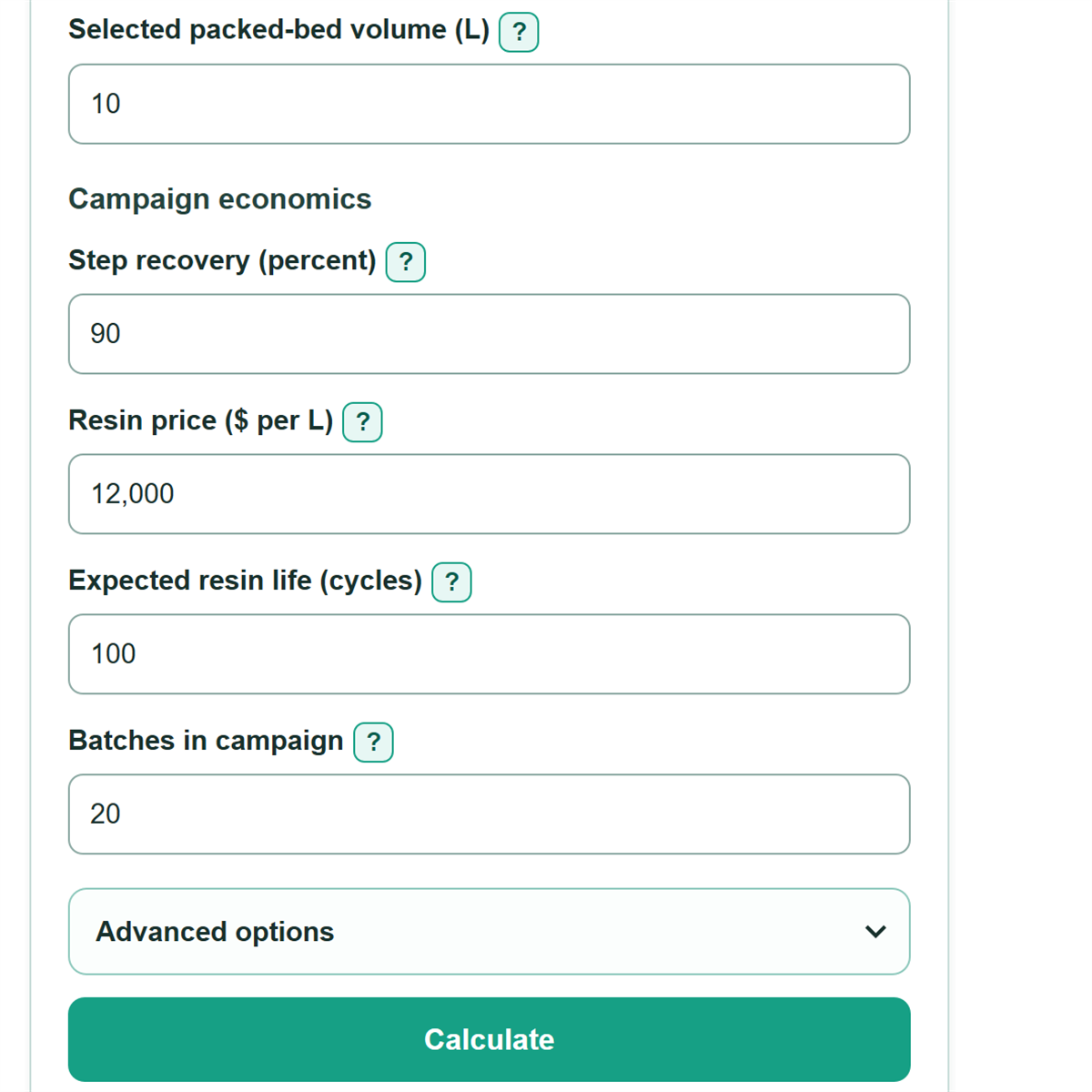
- Enter the Selected packed-bed volume (L), Step recovery (percent), and the price and expected life of the resin.
- Enter Batches in campaign, then select Calculate to see the required one-cycle bed volume, cycles, resin charges, and resin-only costs.
- Sanity-check the result by comparing Packed-bed volume needed for one cycle with Selected packed-bed volume (L): if the required volume is larger, more than one cycle per batch is expected.
Definitions
Dynamic binding capacity (DBC): The product mass a liter of resin can bind under stated operating conditions. It is entered in g per L resin.
Usable resin capacity: DBC after applying DBC used for loading (percent). This is the capacity used for sizing calculations.
Packed-bed volume: The volume occupied by settled resin after packing in the column, measured in L.
Cycle: One complete use of the packed bed to process a load. A batch may need more than one cycle when its mass exceeds selected-bed capacity.
Step recovery: The percentage of product entering this chromatography step that is recovered after the step.
Resin charge: One complete selected packed bed of resin. The calculator counts a new full charge when campaign cycles exceed the expected resin life.
Slurry concentration: The percent of a resin slurry volume that is settled resin by volume before packing.
Common mistakes and quick fixes
Mistake: Using a generic or static capacity for Dynamic binding capacity, DBC (g per L resin) when the value was measured under different feed or flow conditions.
Fix: Enter a DBC that matches the planned chromatography process, or use a conservative process-development estimate.
Mistake: Reducing Dynamic binding capacity, DBC (g per L resin) before also entering a reduced DBC used for loading (percent).
Fix: Enter the measured or stated DBC, then apply the loading allowance only through DBC used for loading (percent).
Mistake: Treating Packed-bed volume needed for one cycle as the same thing as Selected packed-bed volume (L).
Fix: The first is a calculated one-cycle requirement; enter the actual planned column resin volume as Selected packed-bed volume (L).
Mistake: Entering the product expected after purification as Product mass to load per batch (g).
Fix: Enter the mass entering this step, then use Step recovery (percent) to calculate recovered product.
Mistake: Reading Initial resin purchase cost as the full campaign expense when resin use exceeds Expected resin life (cycles).
Fix: Use Campaign resin purchase cost and Full resin charges needed for campaign for the resin cost across all planned batches.
Mistake: Typing a price such as 12,00 in Resin price ($ per L).
Fix: Use a decimal point for decimals or normal thousands commas, such as 12000 or 12,000.
Limitations & Key Assumptions / Boundary Conditions
- DBC must match the planned target molecule, feed, flow or residence time, and operating conditions. A value from another process can give misleading sizing results.
- The calculation assumes every batch has the same product mass, loading percentage, recovery, and cycles per batch.
- Resin replacements are counted as whole full resin charges. The estimate does not include partial purchases, remaining resin value, or resale value.
- Campaign resin purchase cost includes resin only. It excludes buffers, solvents, labor, equipment time, testing, cleaning, disposal, and yield losses outside the entered step recovery.
- The optional column diameter assumes a circular column and uses the entered selected packed-bed volume and planned bed height. Confirm hardware limits and packing requirements separately.
- The optional slurry-volume estimate does not include overpack, transfer loss, hold-up volume, or packing-procedure allowances.
Methodology
Capacity and cycle calculations
The calculator first applies the planned loading allowance to the entered DBC. It then uses this usable capacity to calculate both the bed volume needed for a one-cycle batch and the capacity of the selected packed bed.
usable capacity (g/L resin) = DBC (g/L resin) x DBC used for loading (%) / 100
packed-bed volume needed for one cycle (L) = product mass to load per batch (g) / usable capacity (g/L resin)
selected-bed capacity per cycle (g) = usable capacity (g/L resin) x selected packed-bed volume (L)
cycles needed per batch = round up(product mass to load per batch / selected-bed capacity per cycle)
Rounding up means a partial final load still counts as a complete operating cycle.
Campaign resin and recovered mass
Total campaign cycles equal cycles needed per batch times batches in campaign. Full resin charges are rounded up, so the first charge is included and another charge is added only after the available cycle life is exceeded.
full resin charges needed = round up(total campaign cycles / expected resin life)
initial resin purchase cost = selected packed-bed volume x resin price per L
campaign resin purchase cost = initial resin purchase cost x full resin charges needed
recovered product across campaign (g) = product mass to load per batch x step recovery (%) / 100 x batches in campaign
resin cost per recovered gram = campaign resin purchase cost / recovered product across campaign
Optional preparation estimates
If planned bed height is entered, the calculator treats the bed as a cylinder. One liter equals 1,000 cubic centimeters. If slurry concentration is entered, it divides packed-resin volume by the settled-resin fraction.
column inside diameter (cm) = square root(4 x selected bed volume (L) x 1000 / (pi x bed height (cm)))
resin slurry volume (L) = selected packed-bed volume (L) / (slurry concentration (%) / 100)
Worked example
For a 1,000 g batch, DBC of 50 g/L resin, and 80% loading, usable capacity is 40 g/L resin. A 10 L bed holds 400 g per cycle, so the batch needs 3 cycles and would need 25 L of packed bed to fit in one cycle. With 20 batches, 90% step recovery, a 100-cycle resin life, and resin priced at $12,000 per L, the campaign uses 60 cycles, needs 1 resin charge, recovers 18,000 g, and has a resin cost of about $6.67 per recovered gram.